Freshwater Length-To-Weight Estimate
Walleye Weight Calculator
Blend a walleye length curve with a girth check, then tune the estimate for profile, season, forage, and frame. Use it for logbook entries, slot-limit comparisons, and quick catch estimates before release.
Enter your walleye measurements
Best practice: use total length and measure girth at the deepest point, just ahead of the dorsal peak.
Keep the fish level on a bump board and pull the tape snug, not tight.
Support the belly with two hands and finish the tape work fast.
Weight results
Final estimate
Length curve
Girth check
Condition score
Detailed breakdown
| Species | -- | Single-topic walleye model |
|---|---|---|
| Measured length | -- | Raw field entry |
| Measured girth | -- | Deepest body wrap |
| Length mode | -- | Total, fork, or standard |
| Effective length | -- | Total-length basis |
| Body profile | -- | Frame and belly bias |
| Season factor | -- | Spring to winter shift |
| Forage factor | -- | Bait availability effect |
| Frame factor | -- | Narrow vs broad frame |
| Girth ratio | -- | Girth divided by effective length |
| Length-only model | -- | Curve using a=0.000163, b=3.12 |
| Girth-only model | -- | L x G squared body formula |
| Blend mix | -- | How much each model matters |
| Standard weight | -- | Neutral benchmark |
| Confidence range | -- | Field-estimate band |
| Final estimate | -- | Adjusted walleye weight |
Common length checkpoints
| Length | Lean | Average | Heavy |
|---|---|---|---|
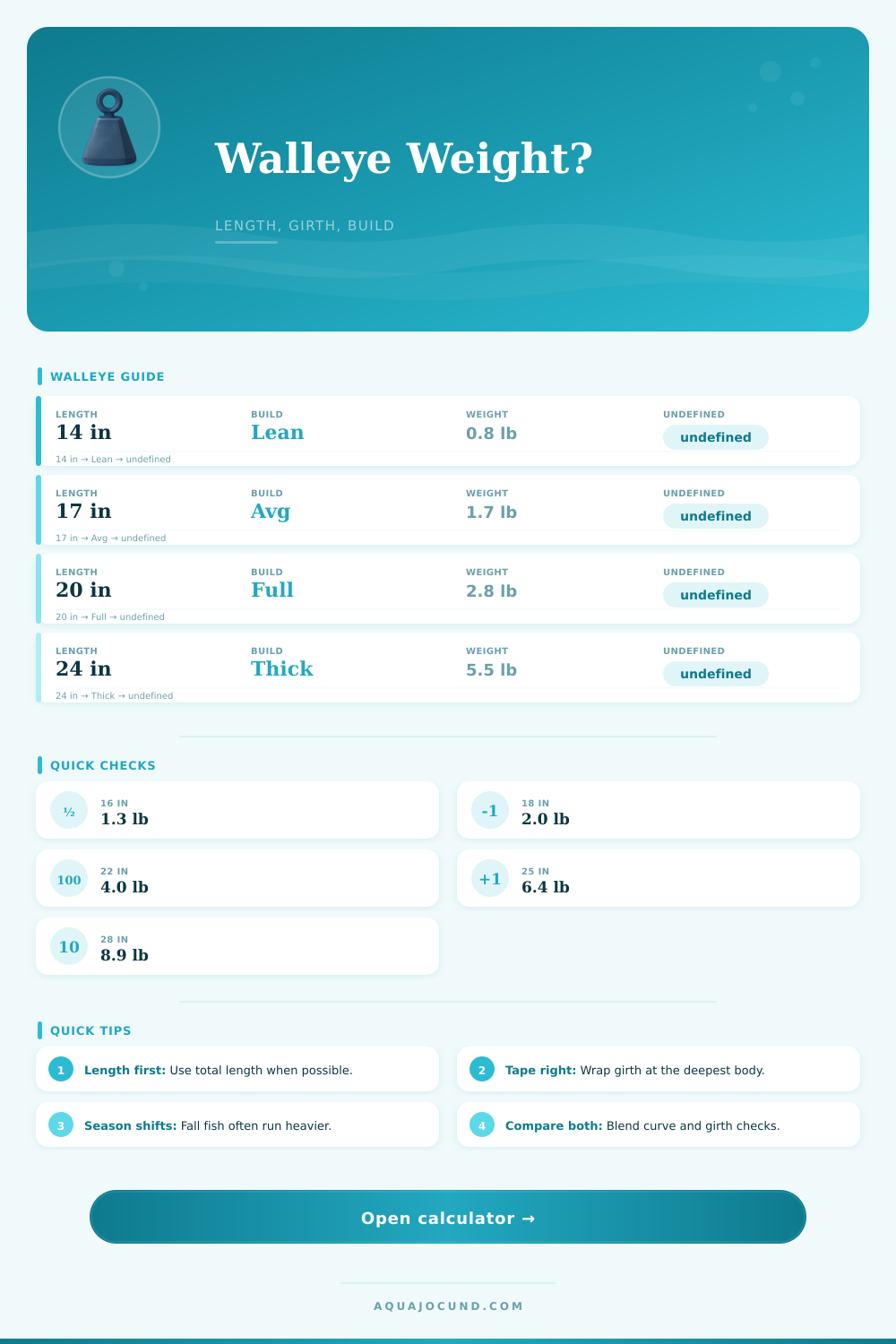
| 14 in | 0.7 lb | 0.8 lb | 0.9 lb |
| 18 in | 1.8 lb | 2.0 lb | 2.3 lb |
| 22 in | 3.6 lb | 4.0 lb | 4.6 lb |
| 26 in | 6.0 lb | 6.7 lb | 7.6 lb |
| 30 in | 9.2 lb | 10.3 lb | 11.7 lb |
Rounded benchmarks for walleyes measured in total length.
Girth ratio guide
| Ratio | Read | Meaning | Use |
|---|---|---|---|
| 0.46 | Very slim | River or post-spawn | Lean |
| 0.50 | Normal | Neutral frame | Balanced |
| 0.54 | Healthy | Good bait base | Full |
| 0.58 | Heavy | Deep shoulders | Thick |
| 0.61 | Trophy | Big female belly | Trophy |
Ratio means girth divided by effective total length.
Season and forage factors
| Setting | Factor | Effect | Use |
|---|---|---|---|
| Spring | 0.98 | Spawn swing | Mixed depth |
| Summer | 1.00 | Neutral | Base season |
| Fall | 1.06 | Feeding gain | Fat baitfish |
| Winter | 0.96 | Slow burn | Cold checks |
| Low forage | 0.94 | Light body | Tough systems |
| High forage | 1.05 | Extra mass | Smelt feed |
Use these only when the fishery clearly runs above or below average.
Length mode and unit guide
| Input | Factor | Applied as | Note |
|---|---|---|---|
| Total | 1.000 | No change | Best choice |
| Fork | 1.022 | Fork to total | Tail notch |
| Standard | 1.090 | Body to total | Tail base |
| cm input | 0.3937 | cm to in | Used for both |
| oz out | 16.00 | lb to oz | Small fish |
| kg out | 0.4536 | lb to kg | Metric |
Total length is always the target basis for the model.
Usually 13 to 15 inches with girth ratios around 0.47 to 0.50.
About 16 to 20 inches and often close to the standard curve.
Commonly 21 to 25 inches with shoulders that make girth matter more.
Usually 26 inches and up with broad female frames and big fall swings.
If the estimate looks far outside the expected class, re-measure girth first.
To more accurately estimate the weight of an walleye, it is first necessary to measure the length and girth of the walleye. The length and girth of the walleye will determines the total weight of the fish. While the walleye may be a specific length, the weight of the walleye can vary depending on the body shape of the walleye.
For instance, walleyes that lives in river systems may be thin in comparison to walleyes that live in lakes. Therefore, it is possible for two walleyes of the same length to have different weight as a result of these difference in body shape. To determine the weight of the walleye, it is first necessary to measure the length of the walleye from the snout to the tip of the tail.
How to Estimate Walleye Weight
In some instances, the length of the walleye from the snout to the tail fork may be used in place of the total length of the walleye, but the same type of measurement should of be use each time to ensure consistency in the estimation of the weight of the walleye. Following the measurement of the length of the walleye, you should measure the girth of the walleye by wrapping the measuring tape snugly around the deepest part of the belly of the walleye, but just ahead of the dorsal fin. The girth is a critical measurement of the walleye, as the girth indicate the condition of the walleye.
For example, a walleye that has just spawned may have a smaller girth than a walleye that has been eating baitfish. In addition to the girth measurement, the chest width of the walleye may also be an indication of the weight of the fish, as female walleyes often have a broader chest than male walleyes. The weight of the walleye can be determined through a few different methods.
For instance, one method may use a standard formula that correlates the length of the walleye to an estimated weight of the walleye, but that formula may not be accurate for walleyes that is thin or thick in body composition. An alternative method, referred to as the girth check, may be used to determine the weight of the walleye based off the thickness of the walleye, and this method will be more accurate for walleyes with a large belly. The final weight of the walleye can be determined by blending the results of the length determination and the girth determination.
If the girth of the fish is relatively very large compared to the length of the walleye, the final calculation will place more importance on the girth of the walleye than the length. Thus, this method will indicate if the walleye is lean, balance, or heavy. It is possible for errors to occur in the measurement of a walleye.
For instance, if the person measures the girth of the walleye when the measuring tape is too loosely placed around the deepest part of the belly of the walleye, the weight of the walleye will be underestimated. The length of the walleye should be measured while the fish is held level on a flat board, as otherwise the length of the walleye may again be incorrectly measure. In addition to these errors, you should support the body of the walleye while measuring it, as the process should be completed quick and efficiently.
Additionally, the reference tables for the average weight of walleyes of specific lengths may be utilized to help determine the weight of the caught fish. Finally, the weight of the walleye should be log after it is measured. Its important to recieve accurate data so your able to track fish size over time.
There is alot of variaton in walleyes weight.