💡 PAR Calculator for Aquariums
Estimate PAR at substrate level based on light output, tank depth, and water clarity
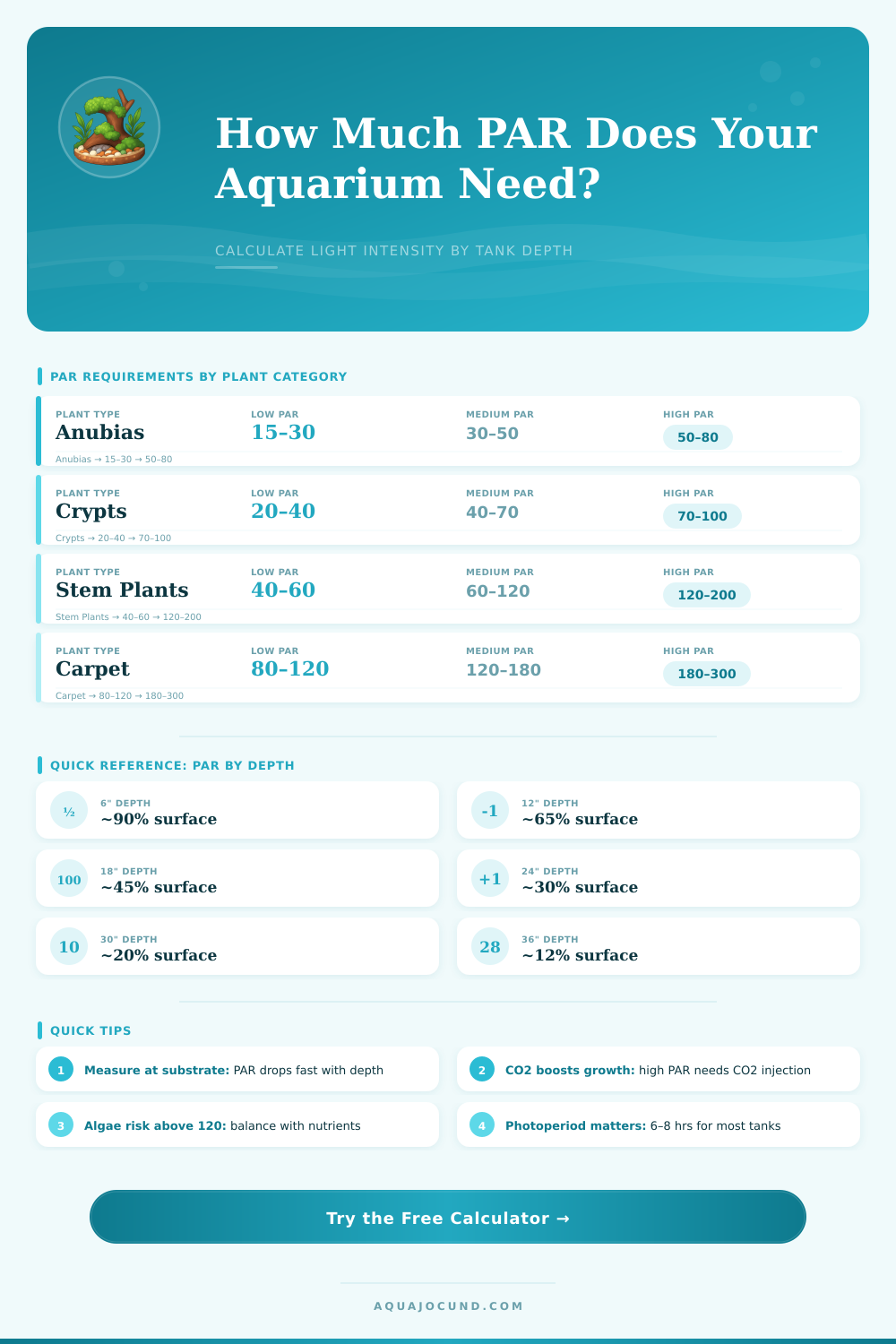
| Plant Category | Low Light PAR | Medium PAR | High PAR |
|---|---|---|---|
| Anubias / Java Fern / Moss | 15–30 | 30–50 | 50–80 |
| Crypts / Swords / Vals | 20–40 | 40–70 | 70–120 |
| Stem Plants / Rotala | 40–60 | 60–120 | 120–200 |
| Carpet (HC Cuba, Monte Carlo) | 80–120 | 120–180 | 180–300 |
| Corals (Soft) | 50–100 | 100–150 | 150–250 |
| Corals (SPS / Hard) | 150–250 | 250–400 | 400–700 |
| Depth (in) | Depth (cm) | PAR Retained | Typical Tank |
|---|
| Tank Size | Dimensions (in) | Low Light | High Light |
|---|---|---|---|
| 5 gal | 16 × 8 × 10 | 150 lm | 400 lm |
| 10 gal | 20 × 10 × 12 | 250 lm | 700 lm |
| 20 long | 30 × 12 × 12 | 400 lm | 1200 lm |
| 29 gal | 30 × 12 × 18 | 500 lm | 1500 lm |
| 40 breeder | 36 × 18 × 16 | 700 lm | 2000 lm |
| 55 gal | 48 × 13 × 20 | 900 lm | 2500 lm |
| 75 gal | 48 × 18 × 20 | 1100 lm | 3000 lm |
| 125 gal | 72 × 18 × 22 | 1500 lm | 4500 lm |
Photosynthetically active radiation (PAR) is a type of light that the plants use to grow; PAR is composed of light wavelength between 400 and 700 nanometers. People use lumens to measuring the light in an aquarium; however, lumens dont measure the amount of PAR that the plants require to perform the process of photosynthesis. The water can absorb and scatter the light that is add to the aquarium; the deeper the water, the less light that will reach the substrate.
Thus, the depth of the aquarium and the type of light that is utilized in the aquarium will affect the amount of PAR that reach the substrate. Different types of plant will require different amounts of PAR due to the growth rates of each of those species. For instance, slow-growing plants like Anubias will require between 15 and 50 units of PAR to be present at the substrate to encourage the growth of the plant, but fast-growing carpet plants like Monte Carlo will require between 120 and 300 PAR unit at the substrate.
PAR and Light for Aquarium Plants
If the PAR levels provided to carpet plants are too low, the carpet plants will melt. Additionally, if there are too highly levels of PAR in the water with not enough nutrients provided to the aquarium, the algae in the aquarium will begin to grow. Thus, the PAR levels must be matched to the different species of plants that is contained within the aquarium.
The clarity of the water in the aquarium will also affect the amount of PAR that reaches the plants. Tannins that is released into the water from driftwood in the aquarium can block PAR light. Maintaining clear water will improve the ability of the PAR to reach the plants.
Additionally, the type of light fixture in the aquarium will affect how much PAR that are released into the water; full spectrum LED light will create more PAR then fluorescent lights. In order to determine the PAR levels that should be provided to the substrate of the aquarium, there is mathematical calculations that can be performed. Such calculations take into account the dimensions of the aquarium, the amount of PAR that is released by the lights, and the depth of the water in the aquarium.
Additionally, another factor that will influence the growth rates of the plants is the photoperiod; this is the length of time that the lights are left on each day. A longer period of time with moderate light levels will allow for the growth of the aquarium plants more better than short periods of time with high levels of light. Many individuals may think that higher levels of light are better for the plants, but too much light can have adverse effect on the aquarium.
If light levels are only measured at the surface of the aquarium water, the light levels at the substrate will be much lower. Thus, it is necessary to measure the amount of PAR that reaches the substrate where the plants are growing. Furthermore, it is best to begin with conservative estimates of PAR levels to the substrate of the aquarium, and to adjust those levels according to the growth of the plant.