🌊 Aquarium Overflow Calculator
Size drain pipes, weir length, return flow, and sump reserve before the system ever hits a panic point.
Preset systems
Tank and overflow inputs
Full breakdown
| Step | Math | Result |
|---|
Conservative drain capacity
| Drain | Safe GPH | Pair GPH | Use |
|---|---|---|---|
| 3/4 in | 250 | 500 | Nano |
| 1 in | 600 | 1200 | Common |
| 1.25 in | 950 | 1900 | Strong |
| 1.5 in | 1500 | 3000 | Reef |
| 2 in | 2600 | 5200 | Big |
Weir loading by system
| System | GPH/In | Noise | Target |
|---|---|---|---|
| Fresh | 55 | Low | Simple |
| Planted | 48 | Low | Gentle |
| Mixed | 42 | Mid | Balanced |
| Reef | 36 | Low | Quiet |
| SPS | 30 | Very low | Wide |
Overflow style comparison
| Style | Redundancy | Noise | Best fit |
|---|---|---|---|
| Open | Low | Mid | Budget |
| Durso | Low | Low-mid | Simple |
| Herbie | High | Low | Quiet |
| BeanAnimal | Very high | Very low | Best |
Shutdown reserve quick guide
| Drop | 48x18 | 72x24 | Note |
|---|---|---|---|
| 0.5 in | 1.9 gal | 4.7 gal | Tight |
| 1.0 in | 3.7 gal | 9.4 gal | Common |
| 1.5 in | 5.6 gal | 14.1 gal | Safer |
| 2.0 in | 7.4 gal | 18.8 gal | Large |
An aquarium overflow system are designed to allow water from the display tank to flow into the sump. The aquarium overflow system must be designed in such a way as to prevent the water in the display tank from overflowing. If the return pump should fail during a storm or power outage, the water in the display tank will drain into the sump.
The water will continue to drain into the sump until the level of the water in the display tank reach the level of the weir. The opening in the display tank through which the water exit the tank. If the overflow system isnt designed to handle the volume of water that will drain from the display tank into the sump if the return pump should fail, the sump will begin to overflow, which could lead to flooding in the room in which the aquarium is located.
How an Aquarium Overflow System Works
In order to avoid flooding the sump tank, it is important to calculate the volume of water that will drain into the sump if the return pump should fail. This volume of water is known as the shutdown reserve. This shutdown reserve is the water that drains from the display tank into the sump before the water level in the display tank reach the weir.
If the shutdown reserve isnt properly calculated, there will not be enough space in the sump tank for the water to collect after the return pump fails. Additionally, you should determine the flow rate of the return pump and the capacity of the drains. The return pump should be sized according to the total volume of the display tank and the turnover rate of the tank’s water.
However, some additional capacity should be provided in the size of the return pump to allow for the possibility of increased bio-load in the tank, or for the possibility that the tanks filters may become clog. Another component of the overflow system that should be considered is the weir. The weir will impact the level of noise that the overflow system creates, as well as the turbulence of the water that exit the tank.
Weirs that are longer than others allow for the water to spread out over a greater area, and longer weirs allow the water to exit the tank in a more quiet manner. Additionally, some forms of livestock in the aquarium tank, such as corals, can be sensitive to areas of turbulence in the tank. Therefore, the weir should be designed to create a gentle flow of water from the display tank.
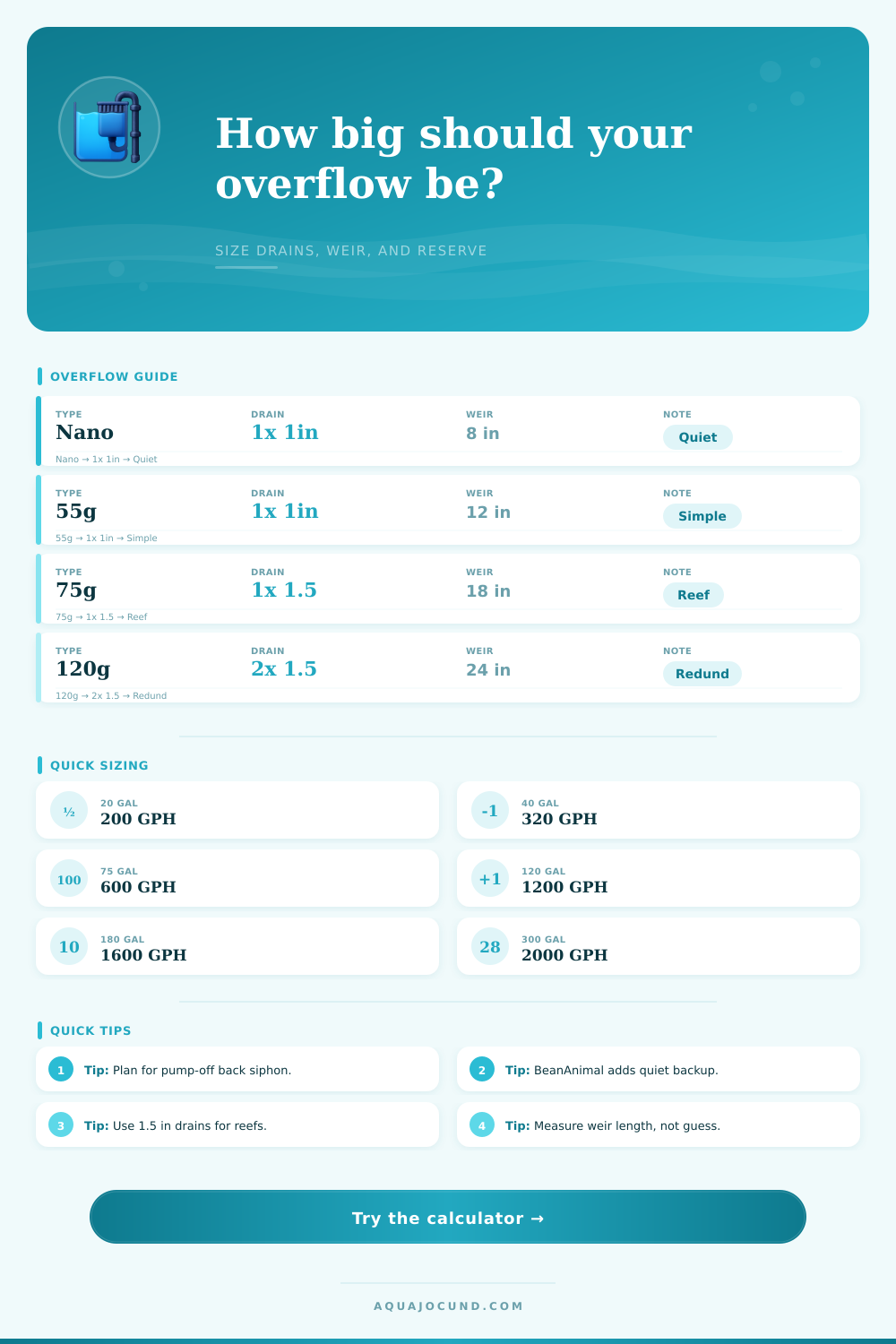
For instance, some reef systems can have a flow rate of 42 gallons per hour for every inch of weir without creating any noise in the aquarium system. Other systems, however, may have different requirements for the weir in order to maintain gentle movement of the tanks water. The drains should also be considered in the overflow system.
The drains must be able to remove the water from the sump at a rate that is faster than the return pump can add the water to the tank. For instance, a single 1-inch drain can remove 600 gallons of water per hour. Other drain styles, such as Herbie or BeanAnimal systems, use siphon action to increase the rate at which the drains can remove water from the sump tank.
Additionally, the emergency drain line is dry of the main drain line under normal operation of the aquarium system. However, in the case that the main drain line becomes clogged with debris, the emergency drain line will become active. If the main drain line should become clogged and there was no emergency drain line, the water will begin to overflow the display tank.
Additionally, the head loss that occurs as the return pump moves the water through the aquarium system must be considered. Head loss occurs when the return pump must push the water through vertical rises in the aquarium system or through the elbows in the plumbing system. Head loss can reduce the efficiency of the return pump.
For instance, if the return pump must push water up to a height of five feet in the aquarium system, the return pump may lose 20% of its efficiency in moving that water. Therefore, the return pump should be selected to be more powerful than the calculated requirements for the aquarium system. Aquarium overflow systems are available in several different styles, each with different levels of noise and reliability.
Open channel overflows are some of the most common overflow systems for aquarium tanks. However, open channel overflows tend to create more noise in the tank. Other overflow systems, such as the Durso overflow system, incorporate a vent to allow for the water levels to remain steady within the system.
Herbie overflows use a single siphon system to allow for the return of the water to the tank. The BeanAnimal overflow system use three lines to allow the system to create as little noise as possible, and to increase the reliability of the system. Therefore, the BeanAnimal overflow system is one of the most reliable overflow systems for aquarium tanks.
Each system has its pros and its cons, so selecting the wrong overflow system for the aquarium can lead to the overflow system being too noisy or becoming unsafe for the aquarium tank. Finally, reference tables can be used to ensure that the measurements and calculations for the overflow system are correct. For example, 1.5-inch drains are used for reef tanks, as tanks that contain corals can handle 1.5-inch drains that provide twice the water capacity of 1-inch drains.
Furthermore, you should measure the weir within the display tank, and some additional space should be provided within the sump tank beyond the shutdown reserve. Following these steps and using these reference tables will ensure that the overflow system will function correctly, that the sump tank will remain dry, and that the water will remain contained within the aquarium system. You should of checked the size of the drains based off the pump.
It is actualy alot of work to set up a moddern aquarium system.