Euro Bracing Aquarium Calculator
Plan brace strip lengths, opening area, and silicone needs before you cut glass.
📌Preset Layouts
🌐Units & Inputs
Calculated Results
Full Breakdown
📊Brace Material Comparison
📑Reference Tables
| Tank size | Layout | Brace span | Notes |
|---|---|---|---|
| 24 x 12 x 12 | Perimeter | 0.25 in | Light build |
| 36 x 18 x 16 | Perimeter | 0.25 in | Short reef |
| 48 x 24 x 20 | 1 center | 0.30 in | Mixed load |
| 72 x 24 x 24 | 2 centers | 0.35 in | Long span |
| Layout | Long strips | Short strips | Best fit |
|---|---|---|---|
| Perimeter | 2 | 2 | Most tanks |
| Perim + 1 | 2 | 2 | Mid spans |
| Perim + 2 | 2 | 2 | Heavy load |
| Three-sided | 1 | 2 | Peninsula |
| Glass | Thickness | Span note | Brace note |
|---|---|---|---|
| Float | 12 mm | Short | Standard |
| Float | 15 mm | Mid | Wider strip |
| Starphire | 19 mm | Long | Heavy euro |
| Laminate | 19 mm | Long | Check edge |
| Bead width | Seam type | Use | Note |
|---|---|---|---|
| 6 mm | Thin | Small tanks | Clean line |
| 8 mm | Std | Most builds | Good hold |
| 10 mm | Wide | Deep tanks | More seal |
| 12 mm | Heavy | Long spans | Extra margin |
Euro bracing is a method of reinforcing a glass aquarium with flat strips of glass that is glued to the top rim of the aquarium. Euro bracing is used to stiffen the glass walls of an aquarium so that the glass walls does not flex or bow under the weight of the water in the aquarium. If you dont use enough euro bracing, the glass panels of the aquarium may flex, which can cause the aquarium to leak.
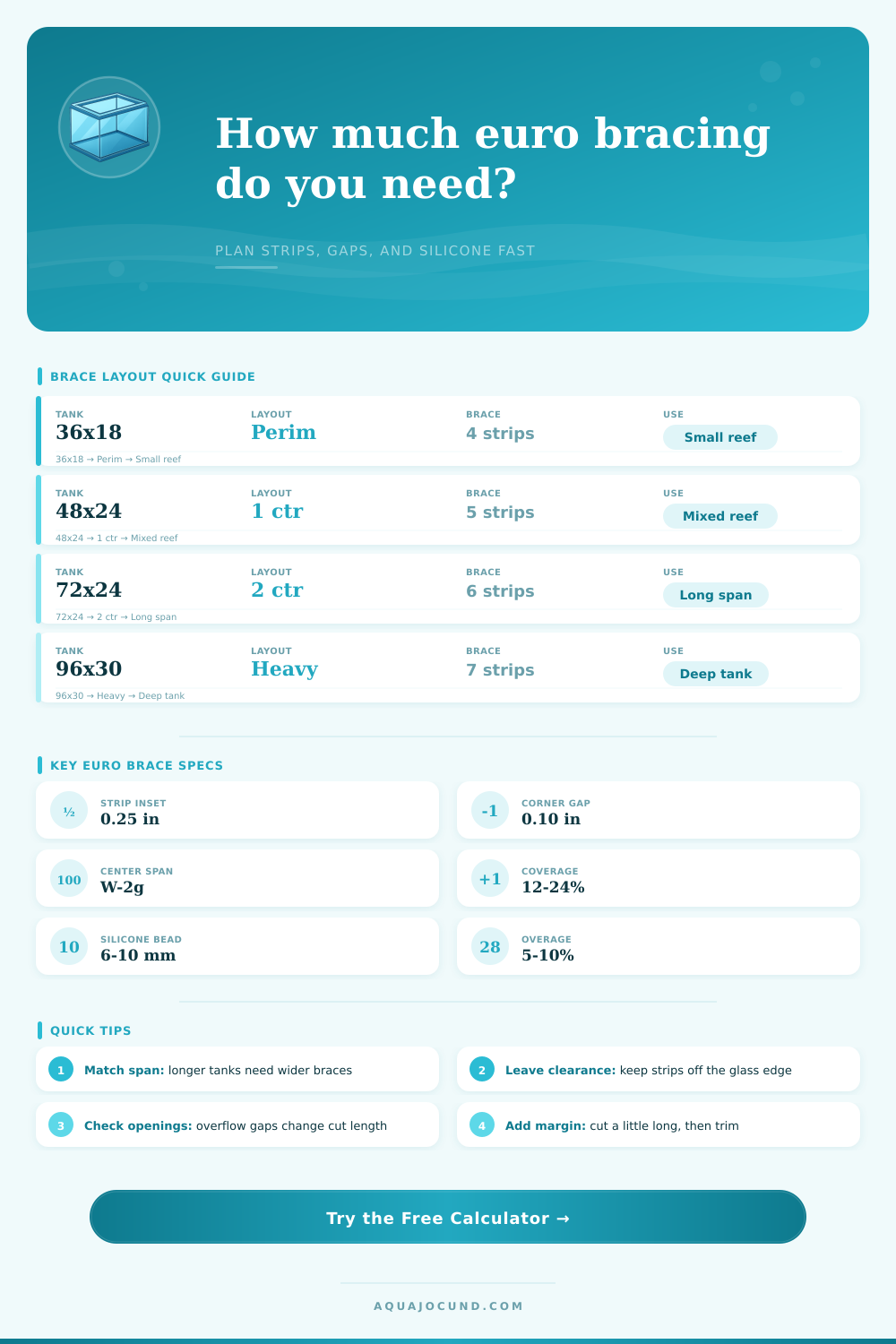
When you are placing the euro bracing on an aquarium, you must account for the silicone seam at the corners of the aquarium. The front glass brace and the back glass brace should run nearly the full length of the aquarium, but you must pull each of these braces away from the corners of the aquarium by approximately one-quarter inch. Additionally, you must also pull each of the side glass braces away from the corners by one-quarter inch.
How to Fit Euro Bracing on a Fish Tank
This type of setback for each of the glass braces allows for the silicone seams to remain even with the edges of the aquariums glass walls; euro bracing need to distribute the stresses even across the aquarium to prevent the aquarium from bowing under the weight of the sand within the tank or the vibrations from the aquariums equipment. You must ensure that the euro bracing covers the correct amount of the aquarium’s top surface area. Euro bracing should cover between 12 and 24 percent of the top area of the aquarium.
If the euro bracing covers less than 12 percent of the top area of the aquarium, the tank may sag over time. If the euro bracing covers more than 24 percent of the top area of the aquarium, the opening at the top of the tank will be too small to allow for proper maintenance of the tank. For instance, it will be difficult to feed fish or to inspect the aquarium for the presence of algae if the opening is too small.
Additionally, if the top opening of the aquarium is small, more water will evaporate from the aquarium in a dry room. The silicone that adheres the euro bracing to the aquarium must be applied according to the depth of the tank. If the aquarium is deep, the bead of silicone that bond the euro bracing to the aquarium should be wider than if the aquarium is shallow.
This is because wider beads of silicone will better seal the euro bracing from twisting relative to the aquariums other glass walls. Additionally, you must calculate the volume of the silicone based off the size of the aquarium in units of milliliters or ounce. This will ensure that you have enough silicone to adhere all of the euro bracing to the aquarium.
If you must cut the strips of glass that will form the euro bracing, add five to ten percent to the measurements of the length of each strip to account for potential mistakes. Aquarium glass shop charge fees for any new glass cuts, and a trim saw could of been used to make mistakes in the length of each strip of glass. The type of glass that you use for your aquarium can impact how the euro bracing function within the tank.
If the aquarium uses the standard type of glass, it will bond well with the silicone and be a common choice for the construction of aquariums with euro bracing. Low-iron glass is an alternative for those who wish to use a type of glass that does not have a green tint when viewed through the tank. Additionally, if you choose to use acrylic instead of glass for your aquarium, you will need to use wider strips of acrylic for the euro bracing.
This is because acrylic is more flexible than glass. Additionally, the height of the aquarium will also impact the width of the euro bracing. If the aquarium is tall, it will experience more side loads on its structure, so the euro bracing must be wider to allow for sufficient reinforcement.
Finally, if the aquarium has an overflow cutout for the return of the water to the filter, the overflow will reduce the length of the rear euro bracing strip. Thus, you must measure the aquarium carefully when placing the euro bracing to ensure that the lid to the aquarium will still be able to fit when completed.