Length, girth, and body-shape estimator
Bass Weight Calculator
Estimate largemouth, smallmouth, spotted, striped, white, and hybrid bass from the way a bass actually carries weight.
Measure the fish
Keep the tape snug, level, and on the thickest part of the bass.
Wet your hands and support the fish horizontally before letting go.
Weight results
Final estimate
Length-only model
Girth-check model
Confidence band
Full Breakdown
| Species | -- | Species-specific bass frame |
|---|---|---|
| Measured length | -- | Raw input value |
| Measured girth | -- | Wide-body measurement |
| Length type | -- | Total, fork, or standard |
| Effective length | -- | After length-mode conversion |
| Body profile | -- | Frame bias from presets |
| Condition | -- | Lean, average, or trophy |
| Season | -- | Spring, summer, fall, or winter |
| Forage level | -- | Food-rich water adds mass |
| Girth ratio | -- | Girth divided by effective length |
| Length curve | -- | Species weight curve |
| Girth curve | -- | Mass check from the body tube |
| Blend | -- | Weighted mix between both models |
| Final estimate | -- | Recommended answer |
Bass Species Comparison Grid
Largemouth Bass
Classic thick-shouldered lake fish. Best when the belly is round and the fish looks deep through the midsection.
Smallmouth Bass
Torpedo build with less belly mass. Often reads a little lighter at the same length, especially in clear rivers.
Spotted Bass
Usually slimmer than a largemouth and often a touch more athletic. Good for creek arms, ledges, and broken rock.
Striped Bass
Deep-bodied and powerful. Same length can mean a much heavier fish, especially when the girth is wide.
Hybrid Bass
A broad-shouldered mix that sits between a striper and a bass. Expect a heavier read than a pure bass of equal length.
White Bass
Lighter and more compact. Great for school-size fish, but they do not hold the same mass as deeper bass species.
Reference Tables
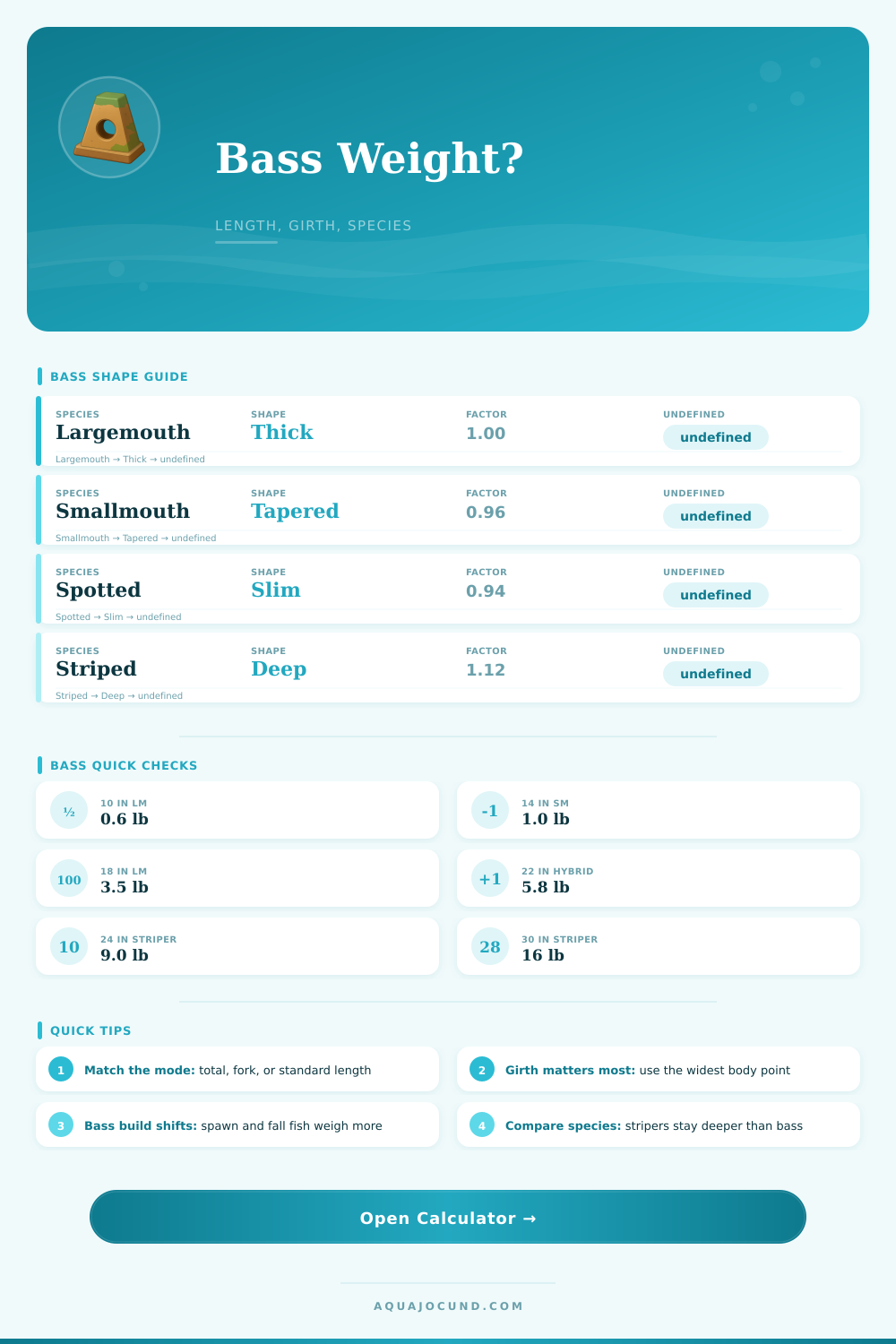
Species curve factors
| Species | a | b | Girth bias |
|---|---|---|---|
| Largemouth | 0.00055 | 3.05 | 1.00 |
| Smallmouth | 0.00049 | 3.06 | 0.96 |
| Spotted | 0.00046 | 3.07 | 0.94 |
| Striped | 0.00072 | 3.02 | 1.10 |
| Hybrid | 0.00066 | 3.03 | 1.06 |
| White | 0.00048 | 3.04 | 0.92 |
Use these when you want a curve that starts with species first.
Length checkpoints
| Length | LM | SM | Striper |
|---|---|---|---|
| 10 in | 0.6 lb | 0.5 lb | 0.8 lb |
| 14 in | 1.2 lb | 1.0 lb | 1.7 lb |
| 18 in | 3.5 lb | 2.8 lb | 4.6 lb |
| 22 in | 5.8 lb | 4.9 lb | 8.4 lb |
| 26 in | 8.8 lb | 7.2 lb | 12.5 lb |
These are quick checkpoints, not tournament-certified weights.
Girth ratio guide
| Ratio | Read | Meaning |
|---|---|---|
| 0.58-0.64 | Lean | Longer fish, less belly |
| 0.65-0.71 | Normal | Balanced bass frame |
| 0.72-0.78 | Full | Heavy feed or spawn mass |
| 0.79+ | Bulky | Very thick or short-bodied |
A higher ratio usually pushes the girth model upward.
Measurement modes
| Mode | Use when | Note |
|---|---|---|
| Total | You have the whole fish | Best default |
| Fork | Fork-tailed fish | Runs a touch shorter |
| Standard | Research logs | Needs conversion |
| Preset | Fast rechecks | Good for repeat fish |
Keep one measuring method for every fish log you compare.
In order to accurately estimate the weight of an bass fish, two different measurements must be taken of that fish: the length of the bass and the girth of the bass. The length of the bass alone wont provide an accurate measurement of the weight of the bass fish due to the difference in the body shapes of the various species of bass fish. For example, largemouth bass fish has a different body shape than smallmouth bass fish, which means that the weight of those two types of bass will necessarily differ from one another, even if the length of each fish are the same.
In order to estimate the weight of a bass fish, you must measure the length of the bass fish and the girth of that bass fish. The girth of the bass is the measurement of the fish around it’s belly, and it is located just behind the pectoral fin of the bass. The girth measurement is important in that it indicate the weight of the bass fish.
How to Estimate the Weight of a Bass
In order to calculate the weight of the bass, the length and the girth of the bass must be measured and logged. The length of the bass fish will measure the length of the skeletal framework of the bass, while the girth measure the weight of the muscles and fats contained within that framework. The ratio between the length and girth measurements of the bass will change according to the season of the year in which the bass is caught, as the available food sources for those fish will differ throughout the year.
Thus, both of these measurement are necessary in the estimation of the weight of the bass fish. In order to measure the length of the bass correctly, it is important to ensure that the length is taken from the correct location on the bass fish. For bass fish that have a V shaped tail, you should measure the length of the fish from the tip of the snout to the end of the fork of the tail.
However, for those that are measuring the length of the bass for logging into a research database, the standard length should be used instead. Should the incorrect length be measured, the weight of the bass will be incorrect logged. Preset button on many weight estimation programs allow for the measurement of common lengths of bass fish; however, custom input should be used to ensure that the length of the bass is accurately measure.
In order to accurately measure the weight of a bass fish, there are a few habit and steps that should be followed. Ensuring that your hands are wet prior to handling the bass will allow your skin to better adhere to the skin of the bass. Additionally, the bass should be kept in a horizontal position while measuring the length of the bass.
The tape measure should be placed against the body of the bass, but should not be placed so as to compress the body of the bass. Finally, the weight of the bass should be logged so as to follow the weight of the bass throughout the year. You should of used a more modern method to track the fishes weight.
There is alot of ways to do this, but the methods based off of these rules is the most reliable. Its important to recieved the correct data.