
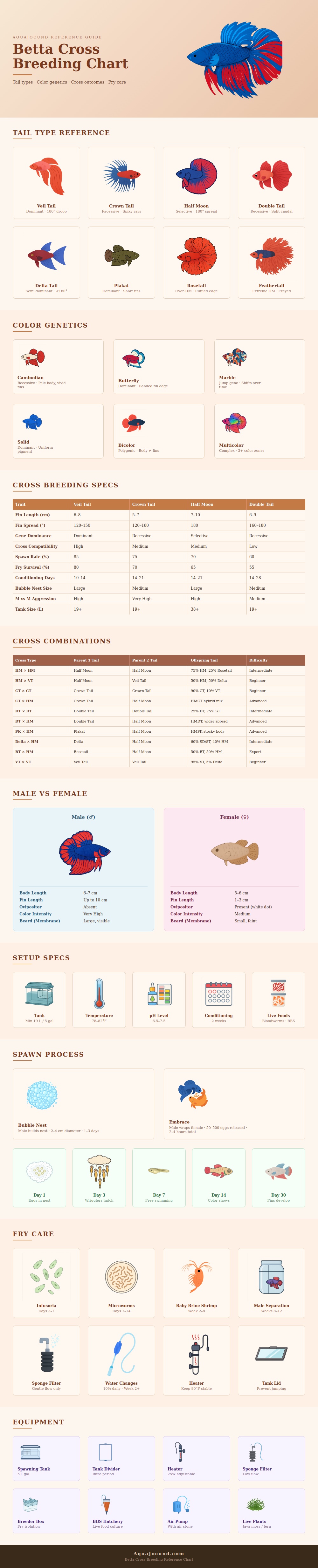
Betta fish breed requires an understanding of the genetics of the fish, the different types of tail that betta fish can have, and the color trait of those fish. In order to breed betta fish, you must use a breeding chart to understand how the physical trait of the two parent betta fish will appear in the offspring. While many people attempt to breed betta fish without an aid of a breeding chart, breeding without a breeding chart will lead to unpredictible outcome of the offspring.
Each type of tail have specific rules regarding genetics and dominance or recessiveness of those trait. Veil tail are a dominant trait, meaning that if you breed veil tails with other type of tail traits, the veil tail trait will often appear in the offspring. Crown tail are a recessive trait, meaning that to introduce crown tails into the offspring, you must select both parents to have the gene for crown tails.
Breeding Betta Fish: Tails, Colors and Baby Care
Half moon tails does not have a genetic hierarchy of dominance or recessiveness, making them more difficultly to breed. An understanding of the genetics and hierarchy of tail traits will allow you to select the appropriate betta fish to ensure that you get the desired types of tails in the offspring. Color trait are some of the most complex traits to understand in betta fish.
Color traits are polygenic, meaning that multiple genes within the betta fish control them. As a result, color traits do not follow simple rules of genetics. For instance, if a betta fish have marble genes, its coloration may change over time.
Additionally, if the betta fish have solid color, the colors will remain the same. In comparison, multicolored betta fish require several zone of color to have the appropriate coloration. Match the genetics of the parents to ensure the fry have the proper colors.
Not all types of tail traits is compatible with each other. For instance, veil tails are compatible with all other tail type. Additionally, veil tails have high spawn rate.
Half moon betta fish require larger tank and take longer to condition than other breeds because there fin may snag on tank decorations. Double tail betta fish has lower rates of spawning success, thus making them better for experienced breeder. Crown tail male betta fish can be very aggressive, so ensure that you separate the introductions of crown tail male betta fish to avoid fight.
Breeding specific types of tail to other types of tails will result in specific type of offspring. If you breed two half moon betta fish, you will get half moon offspring, although there is a chance that the offspring will have rosetail tail if the rays of the half moon fish over branch. Breeding a half moon fish to a veil tail will result in offspring with delta or half moon tail.
Breeding crown tail fish to half moon betta fish will result in spiky fan hybrid offspring. Additionally, breeding a double tail betta fish to a half moon betta fish will result in offspring with wider fin; however, avoid breeding rosetail betta fish unless you are an experienced breeder. In order to breed two betta fish, you must be able to distinguish between male and female betta fish.
Male betta fish will have longer body and fins than female betta fish; additionally, males will have a beard under their gills. Female betta fish will have more compact body and shorter fins. Additionally, female betta fish will have a white ovipositor, signaling to the breeder that the female is ready to spawn egg.
Knowing the difference between male and female betta fish ensure that you dont waste your time breeding a male to a male or a female to a female. In order to breed the betta fish, you must prepare the environment correct. Breeding tank should hold at least five gallons of water.
Additionally, the breeder should maintain the tank temperature at 80 degree. For two week before breeding begins, condition the betta fish using live food to ensure they are prepared to spawn. During breeding, the male will build a nest of bubble and care for the eggs alone.
When the fry are born, they will be wrigglers for the first three days of life; after seven days, they will be able to swim free. Begin feeding the fry infusoria, followed by microworm and baby brine shrimp. Use sponge filter to aerate the tank and avoid harming the fry.
Perform ten percent water change daily to prevent ammonia buildup in the tank, although ensure that you change the water careful around the fry. Finally, separate the male fry from the other fish in the tank by eight week of age to avoid any fight between the two fish. You should of checked the water quality alot.
