Aquarium Head Loss Calculator
Estimate static lift, friction, and fitting loss so the pump you choose actually matches the return line, not just the box rating.
Descriptive Presets
Tap a layout to load a common plumbing geometry.Inputs
Core plumbing and pump variables.Results
Calculated from your tank, pipe, and pump curve.Full Breakdown
Every line in the total dynamic head.| Component | Formula | Result | Meaning |
|---|
Reference Tables
Pipe, fitting, material, and turnover guides.Material and Species Comparison Grid
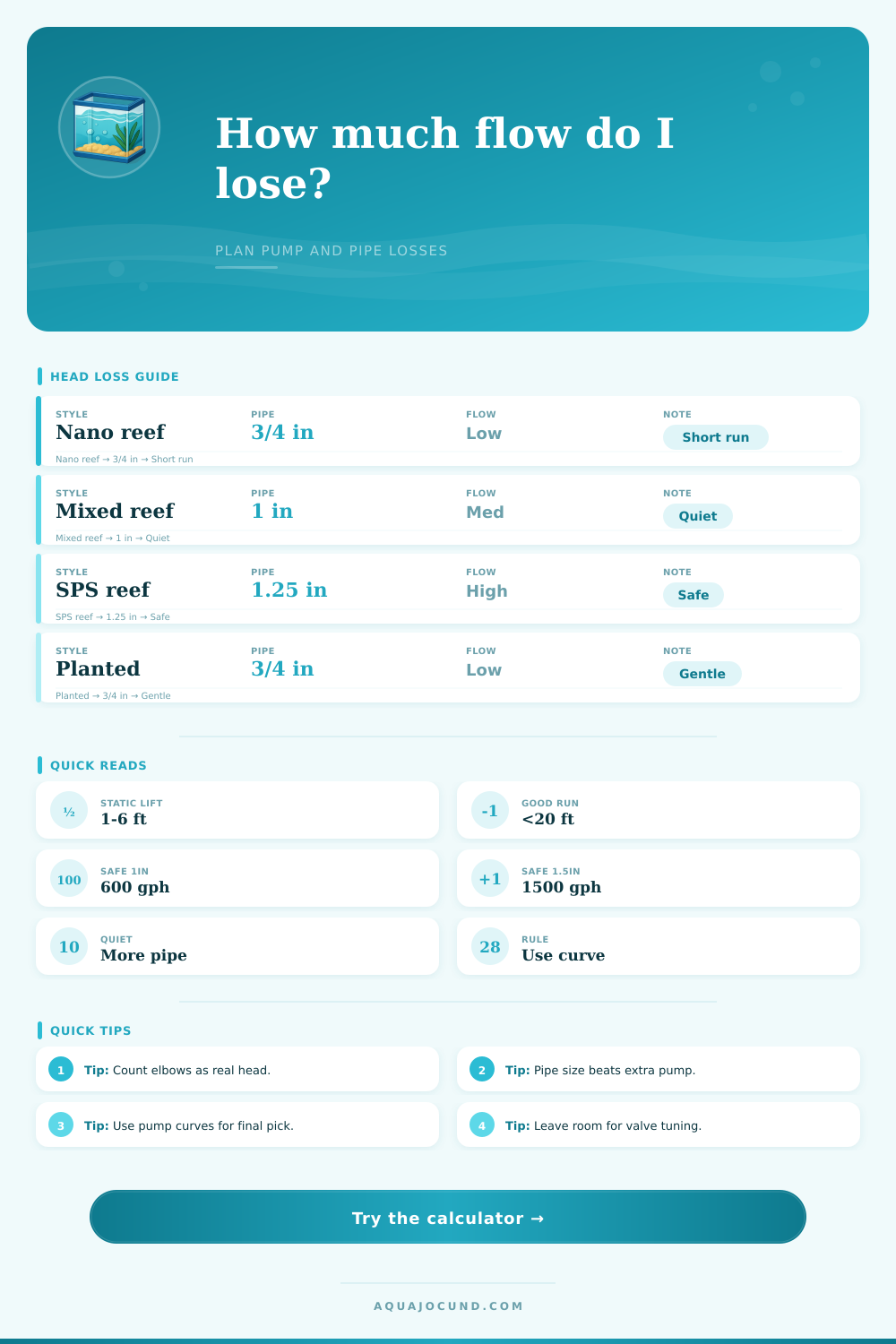
Match plumbing choices with aquarium goals.Head loss are the reduction in water pressure within a plumbing system caused by gravity and friction. Head loss can be broken down into two different component: static head and friction head. Static head is the vertical distance that the water must travel from the surface of the water in the sump to the highest point in the plumbing system; the force of gravity causes static head.
Friction head is the resistance to the movement of the water through the plumbing system. Friction head increase if narrow pipes are used in the plumbing system. Friction head also increases if long pipe are used in the plumbing system.
Head loss in aquarium plumbing
Friction head also increases if many elbow is used in the plumbing system. Friction head also increases if many valve are used in the plumbing system. Each elbow and valve create turbulence in the water.
Turbulence creates heat instead of water movement. A single 90-degree elbow creates significant friction in the plumbing system due to the turbulence that it creates. Using two 45-degree elbows instead of a single 90-degree elbow creates less turbulence in the plumbing system; therefore, it is preferred to use two 90-degree elbows.
Small diameter pipes cause high water velocity in the system, and high velocity of water creates both high friction and high noise level within the system. Different material create different amounts of friction head in plumbing systems. Pipes made from rigid PVC material are smooth, while flexible tubing isnt smooth to the same extent as rigid PVC material.
Build up of biofilm inside the plumbing system over time creates a rough surface within the plumbing system, which increases the head loss due to the friction between the water and the rough plumbing system. Because head loss due to friction increase over time due to the build up of biofilm, head loss due to friction will continue to increasing over time as the aquarium plumbing system ages. To determine the correct turnover rate (which is the number of times that the total volume of the aquarium is moved through the plumbing system in one hour) you must first calculate the total head loss in the system.
Reef tanks require a turnover rate of eight to ten times the volume of the tank per hour, while planted tanks require a turnover rate of four to six times the volume of the tank per hour. You cant use the rating of the pump that you should of use in the aquarium; the pump rating indicated on the box is only the flow rate of the pump when there is zero head loss. The actual flow rate will be less then the rating of the pump due to the head loss that is calculated in the system.
If the pump is undersized, there will not be enough turnover of the water in the aquarium. If the pump is oversized, the pump will use too much electricity, and there will be too much turbulence create by the pump. To avoid these problem, unions should be used in the plumbing system.
The unions will allow for the pump to be easily removed from the system in order to clean it or replace it. Additionally, outlets can be incorporated into the manifolds to allow for the water to be even distributed throughout the aquarium; this will allow for the correct calculation of how the water from the aquarium is to be split. Finally, using larger diameter pipes will reduce the head loss due to friction in the system; therefore, water will move more efficient in the aquarium.