Salmon-specific length and girth estimate
Salmon Weight Calculator
Mix species, run stage, body profile, and a real girth check to get a practical weight estimate for chinook, coho, sockeye, pink, chum, and Atlantic salmon.
Fast Presets
Inputs
Result Snapshot
Full Breakdown
| Factor | Value | Effect |
|---|---|---|
| Choose a preset or enter measurements to populate the breakdown. | ||
Species Reference Table
| Species | Build | Length Div. | Girth Div. |
|---|---|---|---|
| Chinook | Deep | 2050 | 770 |
| Coho | Lean | 2450 | 840 |
| Sockeye | Slim | 2850 | 900 |
| Pink | Small | 3300 | 970 |
| Chum | Tall | 2700 | 860 |
| Atlantic | Round | 2325 | 810 |
Measurement Method Table
| Method | Factor | Best Use | Note |
|---|---|---|---|
| Total | 1.00x | Most logs | Cleanest baseline |
| Fork | 1.04x | Fork tails | Shorter input |
| Standard | 1.12x | Research | Body only |
| Girth | 1.00x | Heavy fish | Use with length |
Body Profile Table
| Profile | Factor | Look | Weight Bias |
|---|---|---|---|
| Streamlined | 0.94x | Knife-like | Lean bias |
| Balanced | 1.00x | Even line | Neutral |
| Deep-bodied | 1.08x | Thicker side | Heavier |
| Thick-set | 1.14x | Round chest | Heaviest |
Stage and Origin Table
| Setting | Factor | Meaning | Weight Bias |
|---|---|---|---|
| Bright | 1.00x | Fresh fish | Stable |
| Running | 1.04x | Feeding run | Fuller |
| Pre-spawn | 1.06x | Bulking up | Heavier |
| Spawned | 0.86x | Spent fish | Lighter |
| Wild | 0.98x | Natural | Lean |
| Hatchery | 1.03x | Feed raised | Fuller |
| Farmed | 1.12x | Dense stock | Heaviest |
Material and Species Comparison Grid
Quick Usage Notes
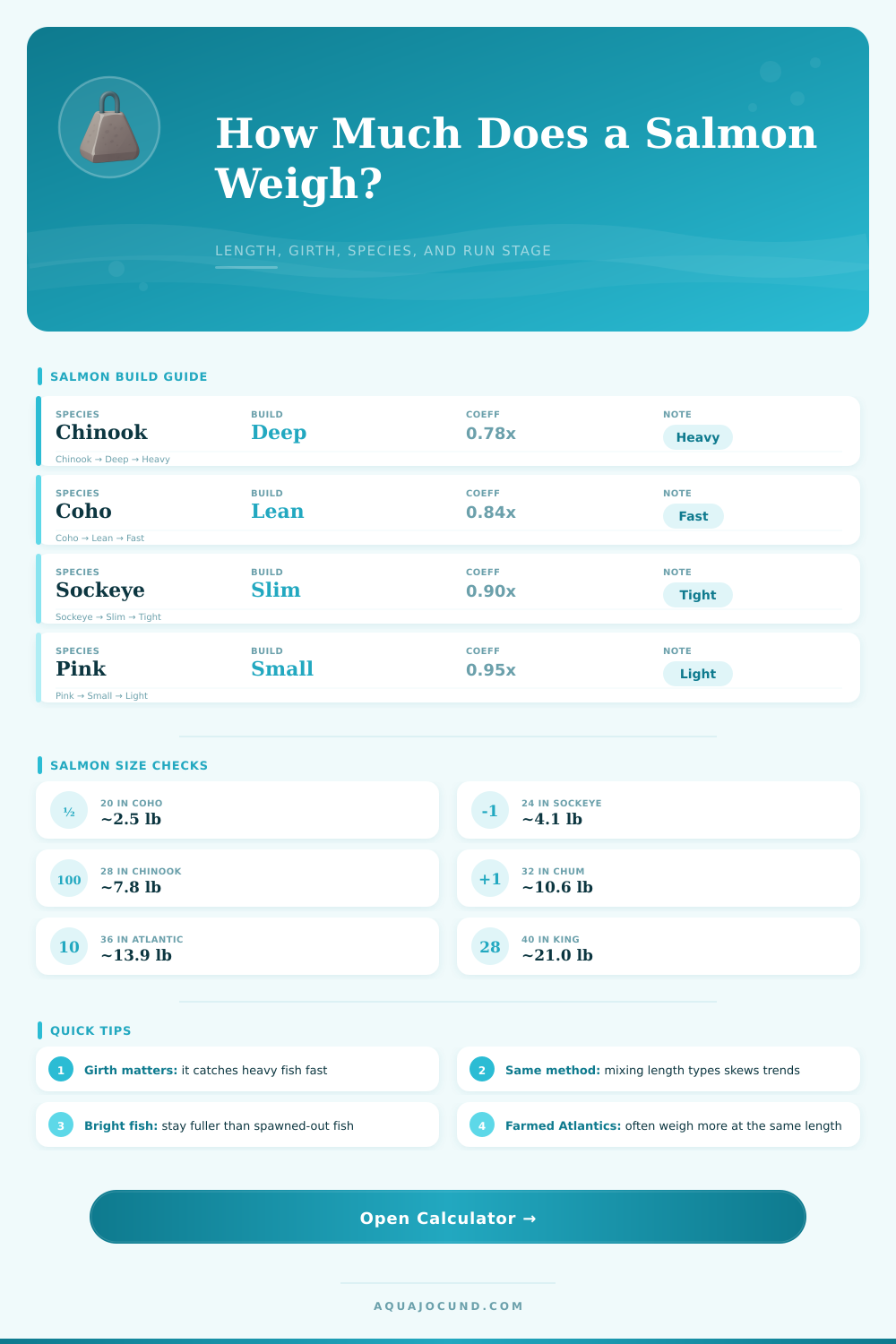
This salmon weight calculator is built around a simple idea: length tells you the size class, girth tells you how full the body really is, and the species setting nudges the estimate toward the right frame. Chinook salmon are usually the deepest and heaviest, while pink salmon tend to be the lightest for the same length. Coho and sockeye usually sit between those extremes, and Atlantic salmon often land a little rounder when they are farmed.
The calculator blends a length curve with a girth check so you do not get trapped by a single number. A 34 inch fish with a slim body can weigh much less than a 34 inch fish with a broad chest and a wide belly. The blend also changes with run stage because fresh, bright fish often carry more body mass than spawned-out fish.
If you are logging fish over time, keep the method steady. Total length, fork length, and standard length are not interchangeable without an adjustment, and that matters once you start comparing runs from different days. The same rule applies to girth: if you measure too far forward or too far back, the result will drift lower or higher than reality.
The comparison grid and reference tables are there so you can sanity-check the output. If your fish looks like a deep chinook, a lean coho, or a round farmed Atlantic salmon, the species table helps you confirm the build before you trust the final number. The tables are also useful when you are comparing catches across trips and want the method to stay consistent.
For best results, measure the fish flat, keep the tape snug but not tight, and use the same technique every time. If you are recording a log for yourself, a hatchery, or a processing note, consistency beats perfect theory. That is what makes a field calculator useful: it gives you a repeatable estimate that is close enough to support real decisions.
In practice, this tool is most helpful when you need a fast answer on the bank, on the dock, or in the kitchen. It will not replace a scale for a final record, but it does give you a reliable way to compare salmon by species, size, and body condition without slowing the moment down.
These estimates are practical field approximations, not a replacement for an actual scale.
To estimate the weight of a salmon, a person will need to measure both length and the girth of the salmon. These measurement can be used to provide an estimation of the weight of the salmon because length provide information about the salmon’s skeleton and the girth provides information about the weight of the salmon’s meat. Thus, to find the weight of a salmon, it is necessary to measure the girth of the salmon behind the pectoral fins (where the salmon is the thickest), making sure that the measurement are taken with a snugly measuring tape.
There are different type of salmon that have different body shapes and weights. For instance, chinook salmon are deep and heavy, indicating that they is heavy in weight. Sockeye salmon have a slim and tight body indicating that they weigh less then other types of salmon.
How to Measure a Salmon’s Weight
Pink salmon have a compact and light body while chum salmon have tall and lean bodies. Coho salmon have fast lines down there bodies while Atlantic salmon (often farmed) are much more fuller. Thus, because there are different types of salmon with different body shapes, there is no one rule for determine the weight of a salmon of any given species.
Consistency are necessary when measuring the weight of salmon. For example, you should use the same method for measuring the weight of each salmon. For instance, total length (from the nose to the tip of the tail) can be use or the length of the salmon’s tail when it is notched.
Mixing method for measuring the salmon will result in inaccurate measurement of the weight of the salmon. Additionally, the life stage of the salmon will impact the weight. For instance, salmon that have just come from the salt weigh more than fresh salmon.
Salmon that are in the pre-spawn period weigh more than salmon that have spawned, as the salmon that have spawned have lost some of there weight. The origin of the salmon will also impact its weight. For instance, hatchery salmon is fed regularly, so salmon from hatcheries are often fuller of oil than wild salmon.
Salmon that are wild must fight for their food. Additionally, salmon that have deep bodies weigh more than those that are streamlined in there bodies. Thus, in determining the weight of a salmon, it is best to use both length and girth measurements.
Follow these steps to ensure that the weight of the salmon is correctly measure: measure a dry salmon (salmon that has not been exposed to much water) to best provide the weight of the fish; dont pinch the tail of the salmon, as this will make the salmon appear shorter then it is; ensure that the measuring tape is not too loose around the salmon; and note the sex of the salmon if you can easily observe the salmon’s sex. For instance, male salmon may be slimmer than females after battling other salmon for spawning rights. There are many reason for being able to estimate the weight of a salmon.
For example, one can track the weight of salmon over time. It is also possible to compare the weight of salmon from different origins, such as hatchery versus wild salmon. Additionally, you can use the weight of the salmon to portion the salmon when smoking the salmon, thus avoiding waste of salmon.
While not perfect, estimating the weight of the salmon will result in a number that is very closely to the actual weight of that salmon.