
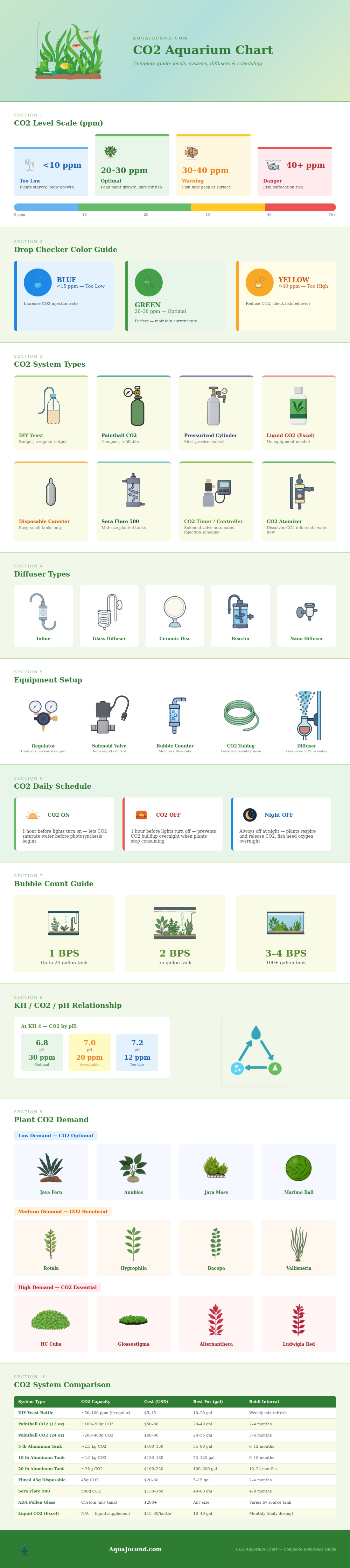
Aquarium plant require carbon dioxide to perform a process of photosynthesis, and carbon dioxide is a necessary component to perform the process of plant growth. Most aquarium dont provide enough carbon dioxide to the plants from the carbon dioxide in air and natural environment. Therefore, it is necessary to supplement the carbon dioxide in an aquarium to supply the plants with the gas necessary to perform their photosynthesis.
If the levels of carbon dioxide are too low, the plants will not be able to perform enough photosynthesis to promote there growth, and their leaf will turn yellow. If the levels of carbon dioxide are too high, though, the carbon dioxide will harm and even kill the fish in the aquarium. In order to provide the necessary carbon dioxide to the aquarium, it is important to maintain a specific level of that gas in the tank to provide for the growth of the plants, as well as to provide for the survival of the fish in that aquarium.
How to Give CO2 to Your Aquarium Plants Safely
If the carbon dioxide concentration is below 10 parts per million (ppm), the concentration is too low to allow the plants to perform enough photosynthesis for adequate growth. If the concentration is below 10 ppm, the plants will stop to grow. Between 20 and 30 ppm carbon dioxide, however, is ideal for both the plants and the fish in the aquarium; the levels allow for maximum plant growth while remaining safety for the fish.
If the concentration of carbon dioxide is between 30 and 40 ppm, though, the fish will begin to gasp for oxygen at the surface of the water. If the carbon dioxide concentration exceed 40 ppm, the fish may become oxygen deprived and begin to suffocate. The most common tool to monitor the carbon dioxide levels in an aquarium is a drop checker.
A drop checker contains a liquid solution that change colors based off the level of carbon dioxide in the water. If the drop checker solution is blue, the carbon dioxide levels in the aquarium are too low and you should increase them. If the solution is green, the carbon dioxide levels are in the ideal range.
If the solution is yellow, the carbon dioxide levels are too high and should be decreased. Drop checkers are typically hung in the middle of the aquarium and placed away from water currents to ensure accurate readings of the dissolved carbon dioxide in the water. Another means of measuring the carbon dioxide levels is through the use of a bubble counter.
A bubble counter allows the aquarium owner to count the number of bubbles that the carbon dioxide system releases per second. Small aquariums that contain 20 gallon or less of water may require only one bubble to be released per second. For larger aquariums, though, three or four bubbles per second may be required.
Bubbles counters should be adjusted to provide the necessary carbon dioxide levels according to the drop checker measurement in the aquarium. Finally, there are different methods of adding carbon dioxide to the aquarium. One of the most common method of adding carbon dioxide to the aquarium is through the use of a DIY (do it yourself) system that uses yeast and sugar to produce carbon dioxide.
The disadvantage of this method is that the bursts of carbon dioxide are not as even or precise as other methods. An alternative to use yeast and sugar is to use liquid carbon supplements, which must be added to the aquarium daily. Finally, the most precise method of adding carbon dioxide is through the use of pressurized gas cylinder, which provide a continuous supply of carbon dioxide.
Additionally, the method of dissolving the carbon dioxide into the water can impact the growth of the aquarium’s plants. Methods such as glass diffusers will create small bubbles of carbon dioxide in the water, but the glass can shatter if the aquarium experiences a significant amount of water movement. Ceramic diffusers will release the carbon dioxide into the substrate of the aquarium, distributing the gas even throughout the water column.
Inline atomizers can be placed into the filter return of the aquarium filter, but are best used in aquariums with high water movement. Finally, whatever method is used to provide carbon dioxide to the aquarium, it should be placed low in the aquarium; if placed at the top of the aquarium, the carbon dioxide will leave the water before the plants can absorb it. The carbon dioxide can be turned on one hour before the lights are turned on in the aquarium, as the plants require the carbon dioxide to complete the process of photosynthesis while the lights are on.
Additionally, you should turn off the carbon dioxide one hour before the lights are turned off; the plants will no longer perform photosynthesis when there is no light. If the carbon dioxide is not turned off during the night, the carbon dioxide levels will become too high in the aquarium, and the fish may not have enough oxygen to survive. The chemistry of the water in the aquarium will impact the change in the pH of the water after the addition of carbon dioxide.
The carbonate hardness (KH) of the water will help to balance the pH level of the water. The KH level of the aquarium should be tested prior to introducing carbon dioxide; the KH level will determine the change in the pH of the water. Additionally, different types of aquarium plants have different requirement for the amount of carbon dioxide that they require for survival and growth.
For example, plants like Java fern require less carbon dioxide than plants like HC Cuba; if the HC Cuba plants are not provided with enough carbon dioxide, they will not be able to perform enough photosynthesis to allow them to grow normal, and they may even become stunted.
