
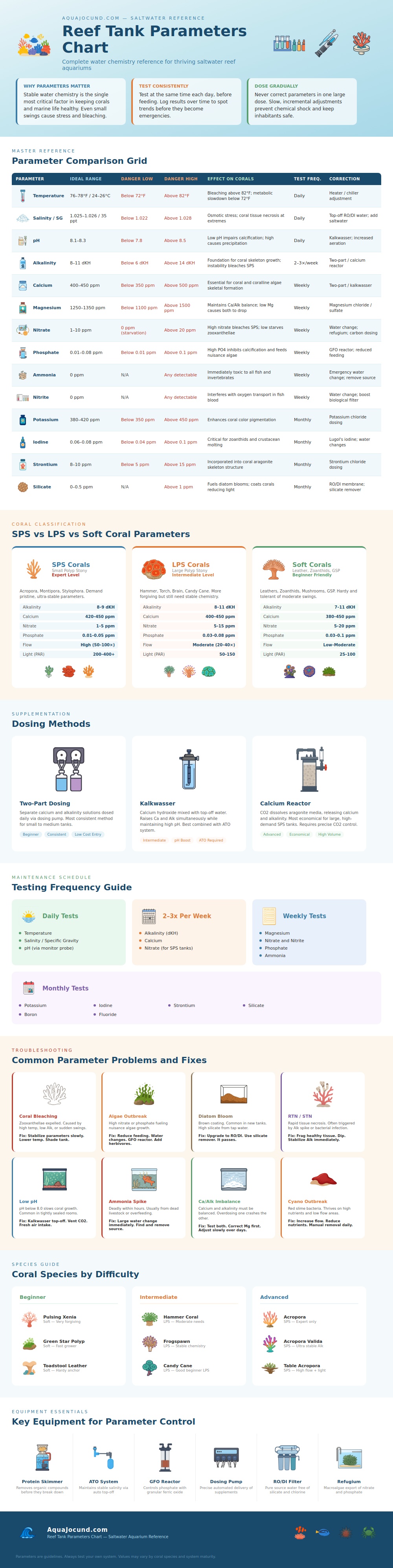
Maintaining a reef tank require you to manage the water chemistry. Managing the water chemistry require that you maintain certain parameters in the tank. The corals that lives in reef tanks require these parameters to be stable in order to build their skeletons and to feed the algae that live within them.
Should the temperature and salinity of the tank change, the corals will experience stress, which can lead to bleaching of the corals. The corals expel the algae if the water chemistry change or if the temperature increase. To avoid this, the keeper must continuously monitor the water chemistry of the reef tank to ensure that it remain consistent.
How to Keep Reef Tank Water Chemistry Stable
Consistency in chemistry is more important than perfect chemistry. To ensure consistency, test the chemistry of the tank at the same time every day, preferably before feeding the fish to the tank. Fish waste can impact the chemistry of the tank, therefore testing after feeding the fish may provide a different result than testing before feeding the fish.
Additionally, it is important to keep a log of the chemistry tests that are performed. By maintaining such a log, the keeper can monitor the chemistry of the tank over time and recognize any trend in the chemistry. These trends can help to correct potential problems in the reef tank before the corals begin to show sign of distress.
New reef tank keepers often strive to bring the levels of nitrates and phosphates to zero. However, the corals require these nutrient to grow. If the levels of nitrates and phosphates are zero, the corals will experience starvation, which will halt the growth of the corals.
Therefore, aim for a balance in the level of nitrates and phosphates that allow the corals to grow, but does not encourage algae growth in the tank. Additionally, ensure that the magnesium levels is maintained in the tank. Magnesium is responsible for regulating the levels of calcium and alkalinity in the water.
If the magnesium levels drop, the levels of calcium and alkalinity will also become unstable, which can impact the health of the corals in the reef tank. You can use dosing methods to even further adjust the levels of calcium and alkalinity that is present in the water. However, you must dose the chemicals gradually into the water tank.
If you add a large amount of chemical all at once, this can lead to chemical shock for the corals, which can lead to the death of those corals. Two part solutions can be used to add both calcium and alkalinity to the water tank. These chemicals can be pumped into the water tank each day to compensate for the amount of calcium and alkalinity that the corals consume.
An auto top off system can also be used to add water to the tank; this system automatically replaces the water that evaporates from the tank. By adding water in this manner, you prevent the salinity of the water from increasing. These chemicals should always be tested prior to and after being added to the tank, and the parameters should be adjusted in small increments rather than large increment.
There are different types of corals that have different requirement for the tank in which they reside. Soft corals are the most hardy of the corals, and can tolerate changes to the parameters of the tank. Large Polyp Stony (LPS) corals require more stability in the tank than soft corals, but do not require the same level of stability of Small Polyp Stony (SPS) corals.
SPS corals, such as acropora corals, require the water parameters to be very stable in regards to alkalinity, and require high levels of water flow through the tank. If the parameters of alkalinity fluctuate from the required level, the acropora corals will cease to grow, and will lose their growth tips. In addition to the requirements for the corals of the tank, there are steps that can be taken to troubleshoot common problem in the reef tank.
If the corals are exhibiting bleaching, then it is recommended that you check both the temperature and the alkalinity of the tank; heat and changes in alkalinity cause corals to bleach. If there are algae bloom in the tank, it may be necessary to reduce the amount of food that is provided to the fish; excess nutrient in the water lead to the growth of algae blooms. If the pH of the tank begins to drop, the tank aeration system should be increased; increased aeration raises the pH of the water.
Finally, if the acropora corals is experiencing Rapid Tissue Necrosis (RTN), the keeper should stabilize the alkalinity of the tank; unstable alkalinity causes RTN in the acropora corals. The frequency with which you test the water should be based off the parameters that you are testing for. Parameters such as temperature, salinity, and pH should be checked daily to ensure that the water chemistry remains stable within the parameter that are required for the marine species in the tank.
Parameters such as magnesium, nitrates, and phosphate levels should be checked every week to provide an overview of the nutrient content of the water in the tank. Additionally, there are several piece of equipment that can aid in the management of the aquarium, such as protein skimmers and refugiums to remove nitrates from the water. Additionally, RO/DI systems ensure that the water that is used to fill the aquarium does not contain silicate.
