
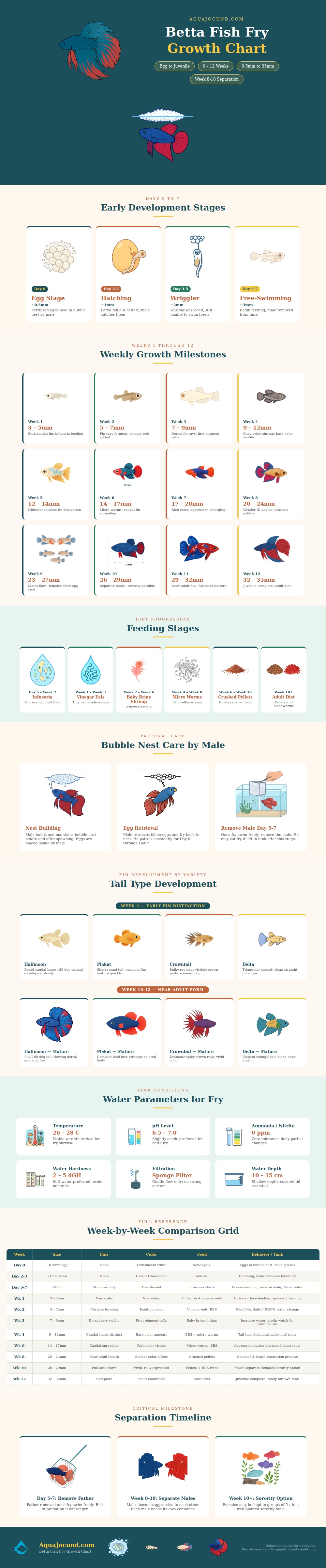
Betta fry developments begins when a male betta fish constructs a bubble nest and protects the eggs that he fertilize. The male betta fish will retrieve any eggs that fall out of the bubble nest in order to ensure that the eggs remains within the bubble nest. After two or three days, the eggs will hatch and the larvae will emerge.
These larvae has a yolk sac that provides nutrition to the developing larvae. The larvae tend to hang vertical from the bubble nest until they are able to swim horizontally; this occurs between five and seven day after the fry first hatch from there eggs. At this time, the male betta fish should be removed from the tank to prevent the male from eating the fry.
How to Care for Betta Fry and Track Their Growth
The fry must be provided with food that correspond to the size of the fry’s mouth. When the fry are very young, their mouths are small enough to require microscopic foods like infusoria. If you provide too large food to the fry at this early stage, the fry will starve due to their small mouth size and inability to eating the food.
After the fry begin to grow, you can provide foods like vinegar eels and baby brine shrimp to the fry. The size of the food should increase as the size of the fry increase in order to provide proper nutrition to the fry. Proper nutrition of the fry help to prevent malnutrition and stunted growth of the fry.
Around the fourth week after the fry were first born, you can examine the fins of the fry to determine the type of tail that each fry will possess. For example, fry that have halfmoon tails will have broad caudal fins; fry with plakat tails will have compact fins. Crowntail fry will have fins that have gaps between the rays of the fins, while those with delta tails will have triangular fin.
The fry with the less developed fins can be removed from the tank to allow the remaining fry to receive all of the resources that is necessary to survive. Ensure that the tank is not overcrowded with the fry, as overcrowding can lead to stunted growth or fighting among the fry. Water quality are crucial to the survival of the fry.
The water in which the fry live should contain zero level of ammonia and nitrite. The water temperature should be maintained at between 26 and 28 degrees Celsius. A sponge filter should be used to clean the water, as it will not “eat” the fry.
Partial water change should be performed daily to prevent the toxins from becoming too strong within the water in the tank. If the water parameters is not stable, the fry may develop fungus or bacterial infections. The growth of the betta fry follow a pattern.
During the early weeks, people have to feed the fry small foods multiple times per day. During the middle stages, the fry will develop their color and longer fins. During weeks eight to ten, you can add crushed pellets to their diets, but the male fry have to be separated into individual container.
The reason for this separation is that the male fry will attack each other if they are kept together. At twelve weeks, the fry have developed into juveniles that are approximately 30 millimeter in size. Betta fry can be improperly cared for if the owners rush the growth process.
For instance, some owners may add too much fry to the tank, they may fail to perform water changes in the tank, and they may feed dry food to the fry too soon. Using a growth chart for the fry will allow owners to track the growth of the fry. Using a growth chart will help owners to recognize any change in the fry, such as their body opacity, fin length, and behavior.
Noticing these changes will allow owners to take action to ensure that the fry are developing proper.
