
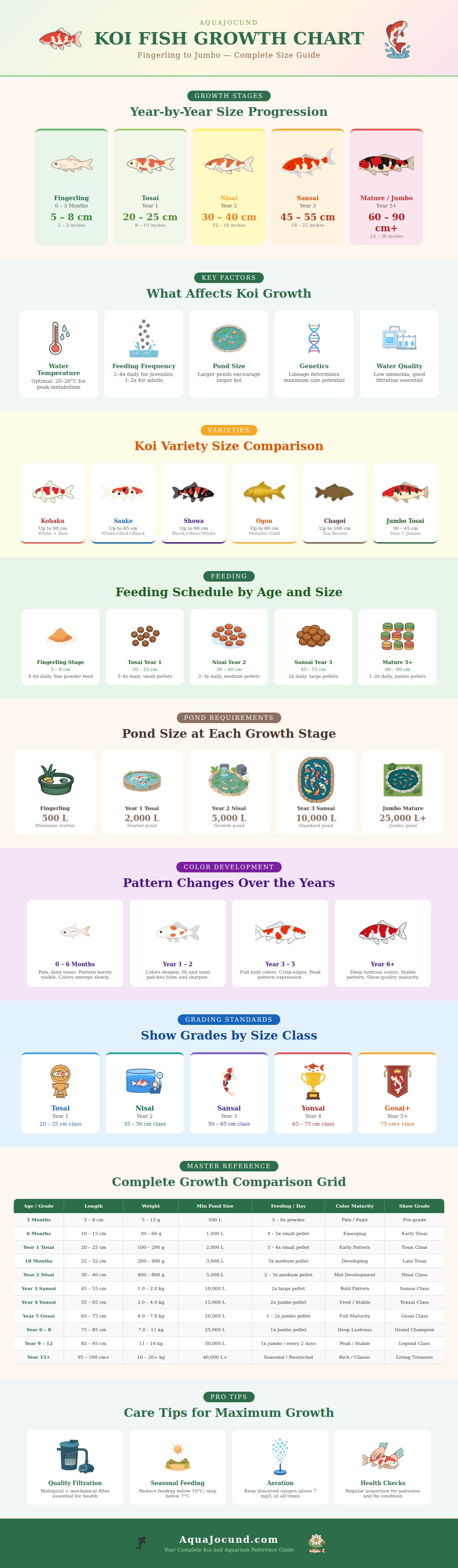
To understand the growth cycle of your koi fish, you need to know that koi growth take place over several years. While the growth cycle of koi fish does not follow a schedule, there are certain stage that most koi will pass through over time. A first-year koi is known as a Tosai, while a koi that is approaching its second year are referred to as a Nisai.
At this first year, the koi will be small and may even be of a pale colors. However, by its second year, as it matures into a Nisai, the colors of the koi will be more defined and visibly. By its third year, the koi will have developed into the body shape and color patterns that will last for the life of the koi.
How Koi Grow and How to Care for Them
The genetics of the koi are the primary factor that will determine the size of the koi fish. In some instance, breeders may genetically breed the koi to become giant or jumbo koi fish. These fish will grow to be larger than those with other geneticmakeups.
The genetics of the koi are not, however, the only factor that affects the growth of the koi. Some of the environmental factors that impact the growth of the koi include the temperature of the water in which the koi is kept. The warmer the water, the faster the koi’s metabolism.
If the water is too hot or too cold for the koi, however, its metabolism will change and it will slow in its rate of growth. Another environmental factor that can affect the growth of koi is the volume of the pond in which they lives. A larger volume of water allows for the koi to swim in more space and avoid stunting in its growth.
Because the feeding requirement of koi change with their age and size, you must manage the type of food accordingly. Small koi require feeding more frequent than large koi. Furthermore, the size of the food pellets should be sized according to the mouth size of the koi.
If the pellets are too large for the koi to eat, food will be wasted, and the waste will foul the water. Overfeeding the koi will cause the water to become ammonia. High level of ammonia in the water are harmful to the koi; ammonia can make the koi stressed and halt the growth of the fish.
Different varieties of koi will have different growth patterns and body shapes. For example, Kohaku koi can reach impressive lengths, as can Sanke and Showa koi varieties. Furthermore, Chagoi koi can grow to be larger than other varieties of koi, and can grow to reach one meter in length under an appropriate conditions.
An Ogon variety of koi will tend to have a more compact body than the Chagoi variety of koi. Therefore, the type of koi that is purchased should be appropriate for the size of the pond in which they will reside, as koi that grow to very large sizes may not be suitable for small ponds. Planning of the pond is necessary to ensure the long-term growth of the koi fish.
The pond must be of a size that can accommodate the mature size of the koi. While small tubs and small ponds may be appropriate for young koi fingerlings, the pond requirements increase to reach thousands of liter of water when the koi reaches its second year of life. Furthermore, the depth of the pond should be at least over one meter deep to provide adequate layers of oxygen for the koi fish, as well as to provide safety for the koi should winter arrive in the region in which the pond is established.
If the pond is too small or too shallow for the koi, the koi will not be able to develop its body to have deep and powerful muscles to swim vigorous. The colors of the koi will change as the fish ages. When young, the colors may appear somewhat washed out.
However, by the second year of the koi’s life, the colors will become more defined. Furthermore, the koi will display peak colors between its third and fifth year of life. These colors are dependent upon the health of the koi and its diet; utilizing feeds that enhances the color of the koi can aid in the development of the bodys colors.
In order to ensure the health of the koi, regular maintenance is required. You should inspect the fins of the koi each week for tear. The water in the pond should be regularly tested for quality.
Aeration is necessary to provide the water with enough oxygen for the koi fish. Finally, filtration is required to remove the waste from the kois bodily function, converting it to nitrates that are less harmful to the fish. During the winter months, when the pond may reach water temperatures of less than ten degrees Celsius, you should reduce the amount of food given to the koi to provide a period of fasting for the fish.
