🌊 Coral Calculator
Calculate stocking capacity, lighting PAR & flow for your reef tank
| Coral Type | PAR (µmol) | Flow (x Turnover) | Space Needed | Difficulty |
|---|---|---|---|---|
| SPS (Acropora) | 300-450 | 40-80x | High | Advanced |
| SPS (Montipora) | 200-350 | 30-60x | Medium-High | Intermediate |
| LPS (Hammer/Torch) | 100-250 | 20-40x | Medium | Intermediate |
| LPS (Brain) | 80-200 | 15-30x | Medium | Beginner-Int |
| Soft (Mushrooms) | 50-150 | 15-25x | Low-Medium | Beginner |
| Soft (Leathers) | 80-200 | 15-30x | Medium | Beginner |
| Soft (Zoanthids) | 50-150 | 15-25x | Low | Beginner |
| NPS Corals | 0 | 30-60x | Medium | Expert |
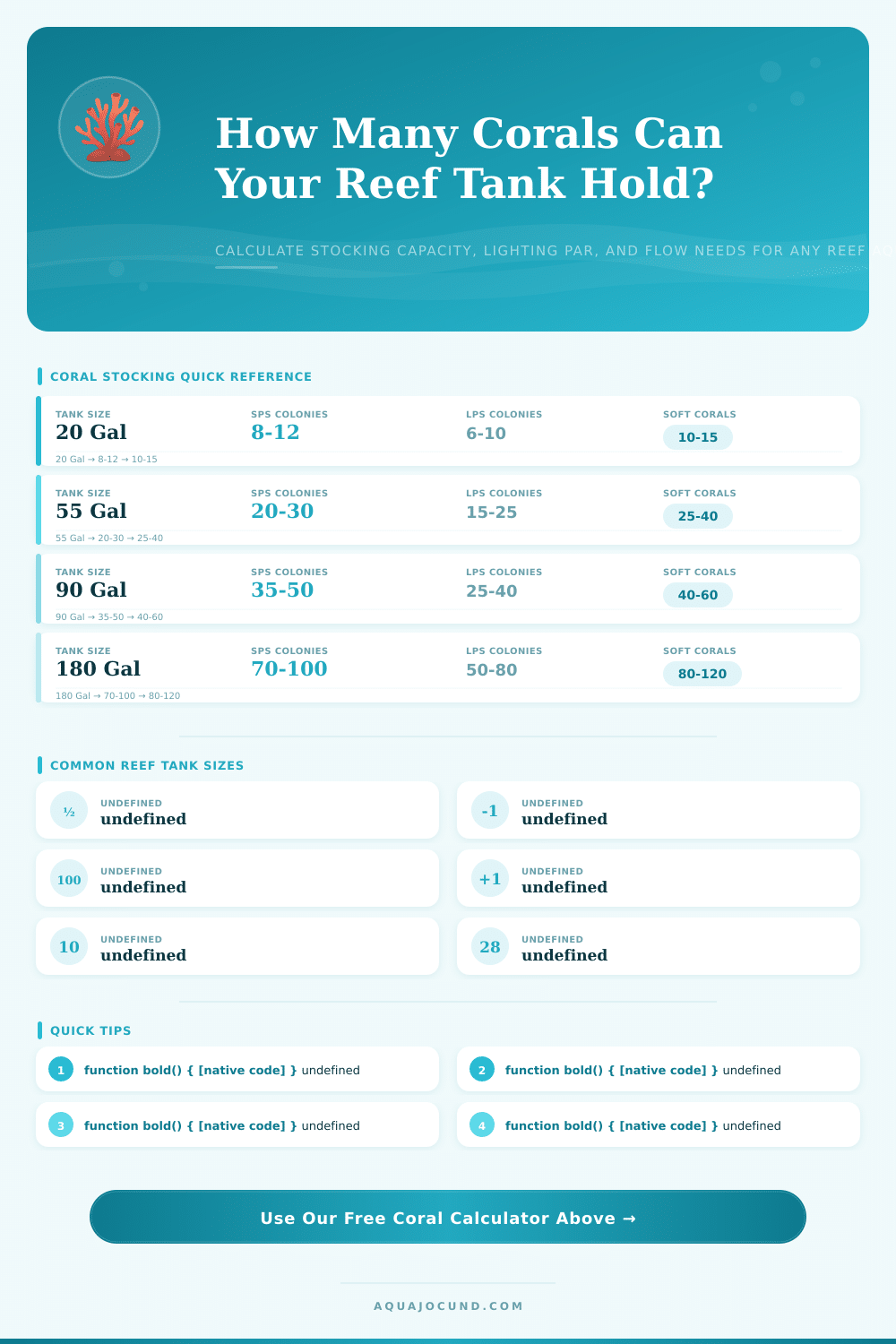
| Tank Size | SPS Colonies | LPS Colonies | Soft Corals | Mixed Reef |
|---|---|---|---|---|
| 10 Gallon | 4-8 | 3-6 | 6-10 | 5-8 |
| 20 Gallon | 8-15 | 6-12 | 12-20 | 10-16 |
| 40 Gallon | 15-25 | 12-20 | 20-35 | 18-28 |
| 55 Gallon | 20-35 | 15-28 | 28-45 | 22-36 |
| 75 Gallon | 28-45 | 20-35 | 35-55 | 30-45 |
| 90 Gallon | 35-55 | 25-42 | 42-65 | 36-54 |
| 120 Gallon | 45-70 | 35-55 | 55-85 | 48-70 |
| 180 Gallon | 65-100 | 50-80 | 80-120 | 70-100 |
| Lighting Type | Watts/Gal (SPS) | Watts/Gal (LPS) | Watts/Gal (Soft) | PAR Efficiency |
|---|---|---|---|---|
| LED | 2.5-4 | 1.5-2.5 | 1-1.5 | Excellent |
| T5 Fluorescent | 4-6 | 3-4 | 2-3 | Good |
| Metal Halide | 5-8 | 3-5 | 2.5-3.5 | Good |
| Hybrid (LED+T5) | 3-5 | 2-3 | 1.5-2 | Very Good |
| Coral Type | Min Turnover | Ideal Turnover | Max Turnover | Flow Pattern |
|---|---|---|---|---|
| SPS | 40x | 60x | 80x | Random/Chaotic |
| LPS | 20x | 30x | 40x | Gentle/Alternating |
| Soft Coral | 15x | 22x | 30x | Low/Gentle |
| Mixed Reef | 25x | 40x | 55x | Variable Zones |
| NPS | 30x | 45x | 60x | Strong/Constant |
💡 Coral Placement Tips
- Place SPS corals at the top of the tank for maximum PAR exposure and strong flow
- LPS corals do best in the middle zone with moderate, indirect flow to prevent tissue damage
- Soft corals tolerate lower light and can fill bottom or shaded areas of the reef
- Leave at least 3 inches between aggressive coral species to prevent chemical warfare
⚡ Flow & Lighting Best Practices
- Use multiple powerheads to create random turbulent flow rather than a single strong stream
- Acclimate new corals to lighting gradually over 2-3 weeks to prevent bleaching
- Monitor PAR at different depths with a meter to ensure proper light distribution
- Clean pumps and powerheads monthly to maintain rated flow output levels
Keeping alive coral in a tank can be the most fun part of saltwater aquarium-hobby. For many fans it represents the most wanted target, ideal setup, that ties everything nicely. Even so, it requires expense so do good research before invest in the first gear.
Alive corals form the core of any saltwater reef, whether natural in the sea or at home in your room. Interesting fact is, that the look of coral can change strongly according to the area. They are alive creatures, that requires care, food, enough space, everything matters.
Coral Care for Beginners
Big part depends on right surroundings for species. You need to control exactly the water quality, light and flow, otherwise problems show up soon.
For foundations choose sturdy species, that does not suffer because of tiny changes in water. Soft corals, mushroom, leather, zoanthids, large-polyp sack corals and gorgonians all answer well. In many reef tanks soft corals lead, and truly, one easily understands the reason.
Except ease in care, they give some of the brightest colours and hypnotic moves, that the hobby offers. Zoanthids, leather, kenya trees, colt corals, green star polyps, xenias and the most of mushroom species stay fairly easy. Some of them spread like this quickly, that they become actual challenge, filling the tank more quickly, then one imagines.
Duncan corals form other good choice for newcomers. When they open and rise, they add joyous energy to your tank. But if they shrink, you immediately will notice, that something is wrong.
They work like a natural measure for the health of the whole reef.
Bubble coral (sometimes called bubble), grape or pearl, answers, if you care about sack corals. Set it in the bottom, because it weighs up, when the bubbles rise. Pulsing pompom xenia belong to the most dynamic corals, that one can have.
Those colonial creatures have many arms and polyps, that spread to almost every surface, that they touch.
One warning for keepers: mushroom anemones. They spread like fire and shade other corals, taking from them light and food. Well research fit between species and space their needs, that truly helps.
Dwarf- and nano-reef tanks grow in charm. Corals do not create heavy load, if one does not feed them, they simply require light. That means little setups, focused only on corals.
Usually more easily choose one main style than care about clashing parts in reef. There is a lot to learn about corals, fish and creatures in that hobby, andseeing your tank bloom does make every effort precious.