
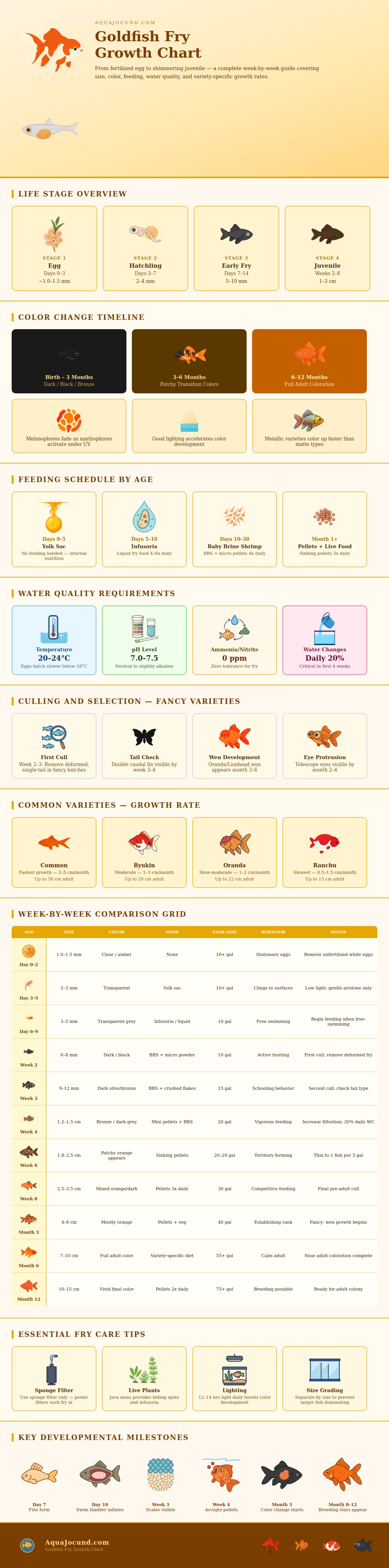
Goldfish egg are small, amber colored beads that adhere to plant leaves in an aquarium. Individuals can observe a tank containing goldfish for several days until the goldfish eggs hatch. Upon hatching, the young goldfish have yolk sac attached to their bodies, providing them with the nutrients necessary to survive in the early stages of their lifes as they havent yet developed the ability to eat food from the aquarium.
During the first stage of a goldfish’s life, the young goldfish utilize the nutrients from their yolk sacs for energy. At this life stage, you should provide young goldfish with low light and calm water within the tank. However, after six days, the young goldfish begin to become free swimming, at which point they require infusoria (single-celled microorganisms) to survive; without providing them with this food source, the young goldfish will starve.
How to Care for Goldfish Eggs and Young Fish
At this young age, you should provide the young goldfish with liquid fry food or cultured infusoria four to six times per day. After two weeks, the young goldfish can be introduced to baby brine shrimp, which contain the protein that the young goldfish can easily digest. After one month, sinking pellets may be introduced to the diet of the goldfish, but only if provided careful and in moderation.
Providing too much food to the goldfish will lead to the ammonia levels in the tank to increase, which will lead to the death of the goldfish. Consequently, a water change of approximately twenty percent of the water in the tank each day must be performed by the keeper to remove the ammonia from the tank and to ensure the health of the goldfish. As the goldfish age, there color change.
When first acquired, goldfish are typically dark colors, such as black or bronze, which aids in their ability to camouflage within their natural environment. Around the age of three months, patches of orange begin to develop on the body of the goldfish. This change in color is the result of the pigment cells shifting from melanophores to xanthophores.
To encourage the goldfish to develop its full adult coloration, you should expose it to light for twelve to fourteen hour every day. Water quality is necessary to ensure the health of the goldfish. The water temperature should be maintained between twenty and twenty-four degrees Celsius to aid in the development of the goldfish.
The pH levels should be maintained at a neutral level between seven and seven point five to avoid stressing the goldfish. Use sponge filter instead of powerheads to ensure that the filter isnt vacuuming up the small goldfish. Include live plants like java moss, which will provide the goldfish with hiding place and aid in the growth of infusoria for the young fish to eat.
Size grading of the goldfish is necessary to ensure they grow properly. The larger goldfish may bully the smaller goldfish, so grading the size will ensure that all goldfish have an even feeding ground. One goldfish should be included in each five-gallon tank by the sixth week of the goldfish’ life.
Culling of some goldfish is necessary to ensure the remaining goldfish are healthy and free from any hereditary deformity. Removing the deformities will ensure the breeding of only healthy goldfish. The behavior of goldfish change according to their age.
When they are three weeks old, they will school together. However, by six weeks they will be territorial in their environment. By six months they will be calm goldfish that are considered adults.
Monitoring the progress of the goldfish is essential and will allow the fishkeeper to ensure the goldfish are developing properly. Their fin will form by day seven, their swim bladder will inflate by day ten to aid them in maintaining neutral buoyancy. Their scales will begin to appear by week three, and they will begin
