
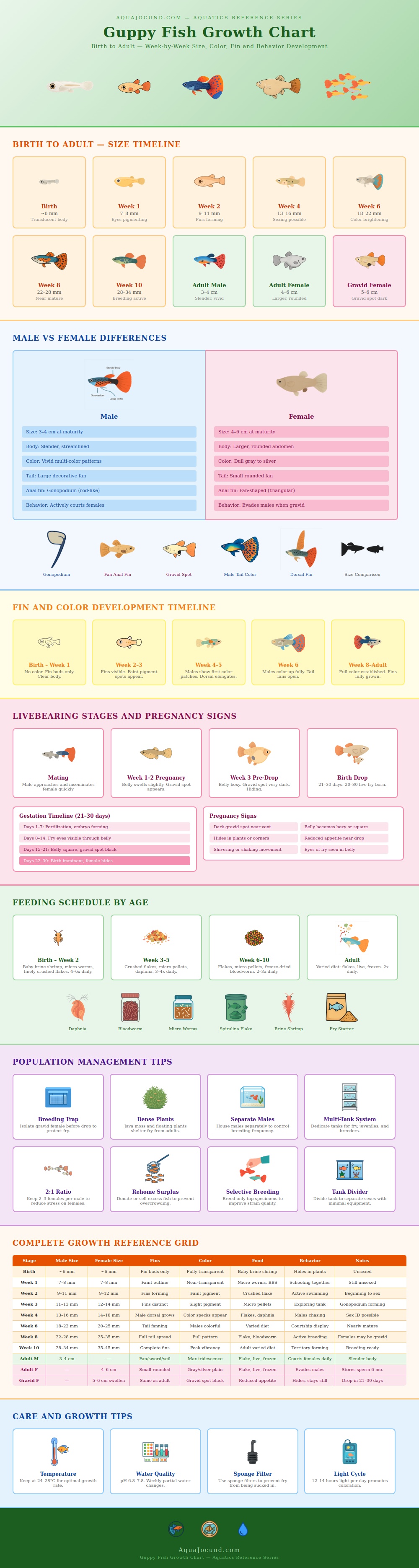
A gravid female guppy is a female guppy that is pregnant. A gravid female guppy can be identified by the dark spot near her vent and the boxy shape to her belly. When a person spots a gravid female guppy, they should prepare to care for the birth of the guppy fry.
Guppy fry are the offspring of guppy and require special care due to its small size. A growth chart can be used to track the growth of the guppy fry, and is helpful to determine the needs of the fry at any given time. Newborn guppy fry are small and translucently in color.
Care for Pregnant Guppies and Baby Guppies
Newborn guppy fry will hide within the plants within the tank in order to avoid being eaten by the adult guppies in the tank, so it is necesary to provide plant for newborn fry. During the first week, newborn fry will require frequent meal of small size in order to support its growth. The breeder should feed live baby brine shrimp or micro worms four to six times each day to the fry, as feeding this food to the fry each day will allow the fry to double in size each day.
If the fry are not feed, their growth will stall. Around the second week, the fry will begin to develop their fins and begin to school together. At this stage, crushed flakes can be added to the tank to provide the fry with juvenile fish food.
Sex differentiation occur in guppies around the four-week mark. Knowing that each fish is differentiated by sex allows for understanding of the differences in growth of each sex of guppy. Male guppies tend to develop as slim figure with tall dorsal fins and color patterns along their sides.
Female guppies are larger and have rounder bodies with triangular anal fins. Male guppies have a rod like anal fin called a gonopodium, which is one of the primary methods of recognizing male guppies. Around the six week mark, male guppies will attempt to court the female guppies with there tails.
Color development is one of the most notable feature of guppies and is most prominent in male guppies. The males will transform from a pale color to an iridescent color by the sixth week of their life, indicating their health. Female guppies will remain a silver or gray color, which helps them to blend into their environment when they are performing natural activities.
To encourage the best color development in guppies, feed them a varied diet rich in spirulina flakes or daphnia. If the diet lacks the necesary nutrients, the colors of the guppies will become dull, and in extreme cases, the guppies may experience a permanent loss of their colors. Male guppies will grow to three to four centimeters, while female guppies will grow to four to six centimeters when they mature.
The gestation period for a female guppy will last between 21 and 30 days. When nearing the moment when a female guppy is about to give birth, she may hide from view or lose interest in her food. If you isolate the pregnant female into a breeding trap containing dense java moss, you increase the chances of saving the fry.
A single female guppy can give birth to between 20 and 80 fry. Additionally, a female guppy can store the sperm from a male guppy to give birth to multiple batch of fry. The feeding requirement for guppies change as they age.
Baby fry require more meals throughout the day than adult guppies. When guppies reach the age of adulthood, they only require meals twice per day. You may offer foods such as flakes, bloodworms, or brine shrimp to adult guppies.
However, you must take care to ensure that the food is not more overwhelming for the tank’s ecosystem. Use a sponge filter to ensure that the water is circulated gentle enough for the fry. Maintain the water temperature at between 24 and 28 degrees Celsius for the best growth rate for guppies.
Managing the guppy population in the aquarium is necessary due to their reproductive tendencies. Maintain the ratio of two female guppies for every one male to avoid harassment of the young by the males. Use dividers within the tank to separate the sex of guppies.
Perform a water change once a week to maintain the stability of the pH between 6.8 and 7.8, the ideal range for guppies. Additionally, monitor the light cycles and the water temperature in the tank. Both of these factor affect both the color and the growth rate of guppies.
