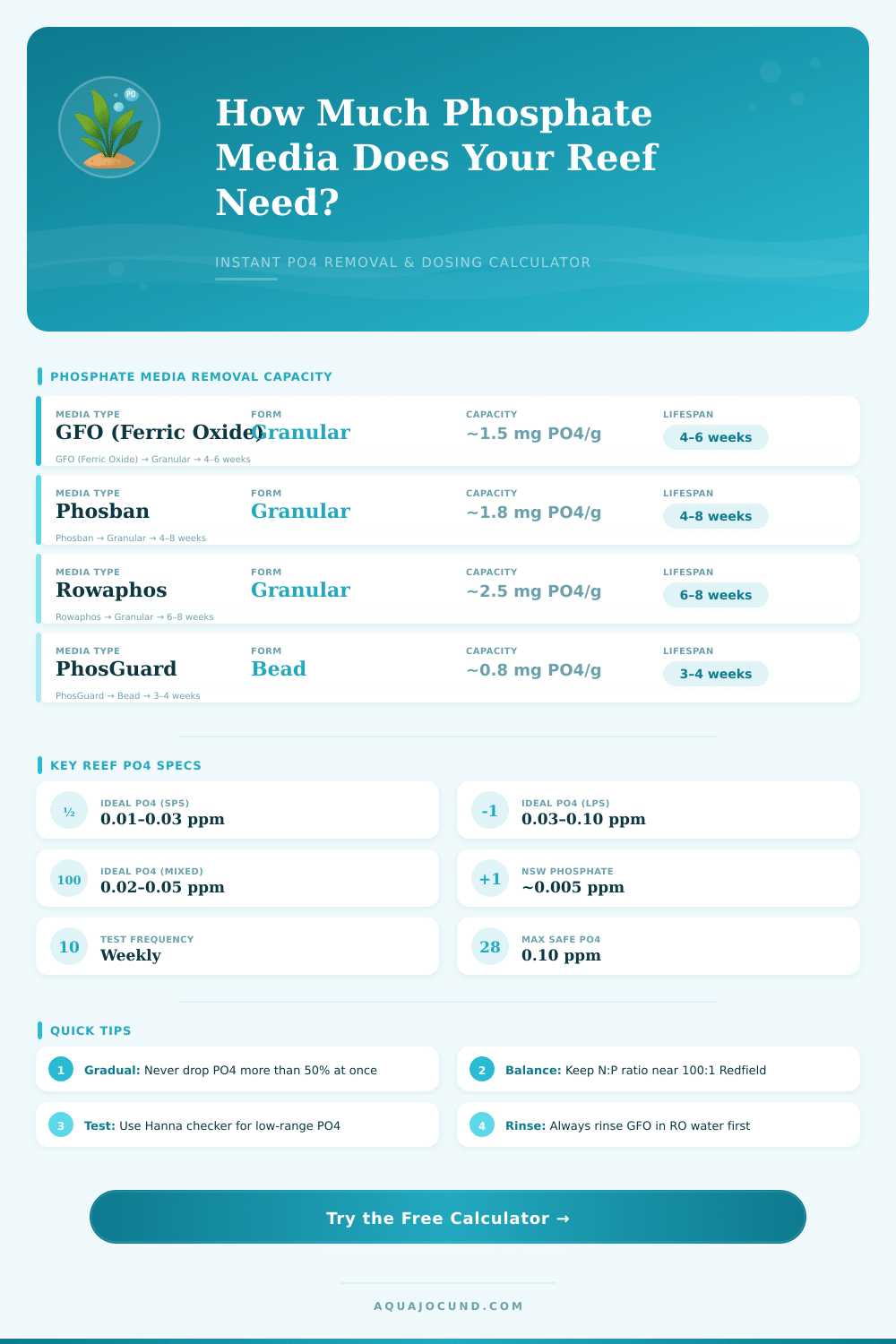
🧪 Phosphate Calculator for Reef Tanks
Calculate PO4 media removal or phosphate dosing amounts for optimal reef aquarium water chemistry
| Tank Type | Ideal PO4 Range | Max Safe PO4 | Test Frequency |
|---|---|---|---|
| SPS Dominant | 0.01 – 0.03 ppm | 0.05 ppm | 2–3x per week |
| Mixed Reef (SPS + LPS) | 0.02 – 0.05 ppm | 0.08 ppm | Weekly |
| LPS Dominant | 0.03 – 0.10 ppm | 0.15 ppm | Weekly |
| Soft Coral / Zoa | 0.03 – 0.15 ppm | 0.20 ppm | Bi-weekly |
| Fish Only with Live Rock | 0.10 – 0.50 ppm | 1.00 ppm | Monthly |
| Ultra-Low Nutrient SPS | 0.005 – 0.02 ppm | 0.03 ppm | 3x per week |
| Media | Capacity (mg PO4/g) | Typical Lifespan | Notes |
|---|---|---|---|
| GFO (Generic) | 1.0 – 1.5 | 4–6 weeks | Most widely available; rinse well before use |
| Phosban | 1.5 – 1.8 | 4–8 weeks | Higher density GFO; use in reactor for best results |
| Rowaphos | 2.0 – 2.5 | 6–8 weeks | Premium GFO; does not leach phosphate back |
| PhosGuard | 0.6 – 0.8 | 3–4 weeks | Aluminum oxide beads; can be recharged with bleach |
| Lanthanum Chloride | 3.2 mg/mL | Per dose | Liquid flocculant; dose slowly to avoid clouding |
| Carbon Dosing | ~0.05 ppm/day | Ongoing | Biological method; promotes bacteria that consume PO4 |
| Tank Size | PO4 0.25 → 0.03 ppm | GFO Needed | Rowaphos Needed |
|---|---|---|---|
| 10 Gallon (38 L) | 8.3 mg PO4 to remove | ~6 g | ~3 g |
| 20 Gallon (76 L) | 16.7 mg PO4 to remove | ~11 g | ~7 g |
| 40 Gallon (151 L) | 33.2 mg PO4 to remove | ~22 g | ~13 g |
| 55 Gallon (208 L) | 45.8 mg PO4 to remove | ~31 g | ~18 g |
| 75 Gallon (284 L) | 62.5 mg PO4 to remove | ~42 g | ~25 g |
| 90 Gallon (341 L) | 75.0 mg PO4 to remove | ~50 g | ~30 g |
| 120 Gallon (454 L) | 99.9 mg PO4 to remove | ~67 g | ~40 g |
| 180 Gallon (681 L) | 149.8 mg PO4 to remove | ~100 g | ~60 g |
phosphate matters a lot in a reef tank. It affects the growth of corals, the behavior of algae and the general health of the whole system. Phosphorus is the main nutrient for reef tanks and one measures it as orthophosphate by means of usual test devices.
That is the settled and reactive form of phosphorus in the water.
Phosphate in a Reef Tank: Why It Matters and How to Control It
Food is the main source of phosphorus in reef tanks. When one puts food in the tank, phosphate enters with it. If one overfeeds, the levels of phosphate can rise, which can cause blooms of algae.
Reducing the nutrients helps to lower the levels. Fish genuinely do not need as much food, as many folks believe. Uneaten food and waste break down by bacteria and fungus, which releases ammonia, nitrate, phosphate and other dissolved minerals in the water.
Also rocks can be sneaky sources. Some kinds of rock can release phosphates in the water. It depends on the place, where one took the rock.
That can genuinely upset, when the nutrients already are low, but phosphate stays hgih.
So, where should the level of phosphate be? In a reef tank, it should sit between 0.03 and 0.2 ppm. Some like to keep it at 0.03 to 0.07 ppm for a slightly dirty tank.
Others aim for under 0.1 ppm. In natural sea, levels of phosphate are under 0.03 ppm. 0.25 ppm is fine for fish, but too high for reef.
Fish tolerate high phosphate, so they usually do not suffer, even if the levels are raised.
Corals need a little phosphate for energy change in there cells and other biological processes. Even so, in tanks with almost no phosphate, one can observe pale corals, slow growth and weak polyp spread. Rather, too high levels of phosphate cause unwanted algae, that covers corals, blocks light and competes for nutrients.
High levels also slow the growth of corals, reduce their color and push them more toward sickness.
One can control phosphate by means of several ways. Changes of water help to remove it, when the levels rise too much. A refugium with growing chaetomorpha algae consumes phosphates and nitrates.
Algae scrubbers work well, because algae can absorb toxins and heavy metals from the water, which eases the removal. GFO is another option, only some scoops in a filter bag can lower the levels. Dosing of carbon by means of stuff like vinegar or vodka is another way.
Products like Phosphate-E can be useful, but one must start slowly. For tanks that need more phosphate, there are products likeNeoPhos to raise the levels until corals feel good.