
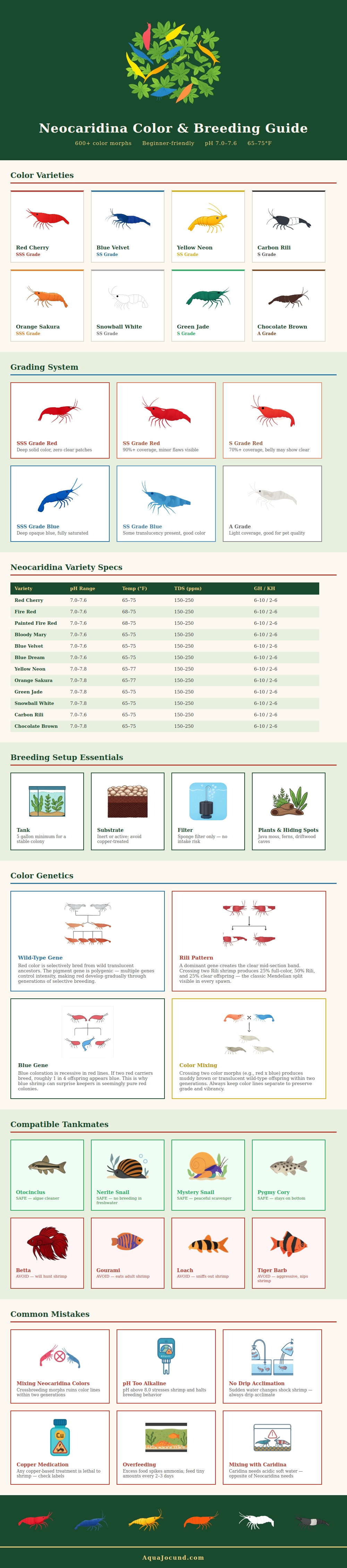
Neocaridina shrimp is small freshwater shrimp that people keep in tanks due to there various colors. Shrimp of the Neocaridina genus may experience a change in their color over several generations of shrimp due to the genetics of the Neocaridina shrimp. In order to maintain the color of shrimp colonies, the individual must understand the genetics of the shrimp, the water parameters for which the shrimp requires, and how to breed the shrimp selective.
The first step in maintaining the color of the shrimp is to ensure that the shrimp that are selected for breeding are of high quality. Shrimp breeder use a grading system for the shrimp to determine how colorful the shrimp are. For instance, shrimp that are graded as SSS have deep color throughout their entire body, and are of the highest quality due to the fact that these shrimp will breed true.
How to Breed and Keep Colorful Neocaridina Shrimp
SS and S grade shrimp have areas on their belly that are more translucent, or their edges fade in color, indicating that they will dilute the color of the breeding colony more faster than SSS shrimp. Therefore, to maintain color in a breeding colony, individual should begin with high-grade shrimp. Water chemistry is also important to the breeding of Neocaridina shrimp.
The ideal pH levels for these shrimp are between 7.0 and 7.6, and the ideal temperature range is between 65 and 75 degree Fahrenheit. Additionally, the water should be moderate mineralized. If the water become too alkaline, the breeding of the shrimp may stall.
If the water is too cold, the growth of the shrimp will slow. Additionally, a tank of at least five gallon is required for these shrimp, as a five-gallon tank will provide enough water for buffering water chemistry. Finally, the tank should use a sponge filter to ensure that a filter does not suck up baby shrimp, or shrimplets.
The breeding process for Neocaridina shrimp occur naturally in the water if the conditions are right. A female Neocaridina shrimp will have between 20 and 30 egg under her swimmerets for around four weeks until she release her fully formed baby shrimp. The color of the shrimp is determined by the gene of the shrimp.
For instance, the red color of Neocaridina shrimp contains a genetic trait that is polygenic meaning that the genes responsible for the red color must be selected for over many generations to establish such a color in the shrimp. The rili trait is determined by a different gene, it is a dominant gene. If two rili shrimp are crossed, there is a one-quarter chance the offspring will have full color, a one-half chance they will be rili, and a one-quarter chance that the offspring will be clear of color.
Additionally, genes for blue color can live within red lines of shrimp as a recessive gene, meaning that there is an one-out-of-four chance that blue colored shrimp will be born from crosses of otherwise red shrimp. Because of these different gene, Neocaridina shrimp of different colors must be kept in separate tanks. If two shrimp of different color are crossed, the offspring will ruin the color purity.
For instance, if a red shrimp is crossed with a blue shrimp the offspring may eventually become muddy brown or clear colored shrimp (wild-type). To preserve the color purity of bred shrimp, it is best to keep only one color of shrimp in each tank, and to remove those of incorrect color from the tank. It can take three to five generation of breeding for the Neocaridina shrimp to reach peak vibrancy of their colors.
Certain tankmates may ruin the survival of a Neocaridina shrimp tank. Fish that are peaceful with shrimp, such as otocinclus or pygmy corydoras, is safe to keep with Neocaridina shrimp. Nerite and mystery snail is also peaceful with Neocaridina shrimp.
However, avoid adding species like betta fish, loaches, gouramis, or tiger barbs to the tank, as they will eat the shrimp. A few of the common problem with Neocaridina shrimp are simple mistake. Overfeeding will increase the ammonia in the tank, and that will kill the baby shrimp.
Some medication have copper in them, which is poisonous to Neocaridina shrimp. People make the mistake of not using drip acclimation; when you add new shrimp to a tank, they need to be drip acclimated to that water. If they’re not, it will cause osmotic shock, and they will die.
Finally, people pair Neocaridina shrimp with Caridina species. The problem here is that these two type of shrimp have different water requirement. Unfortunatly, these water requirement clash.
