
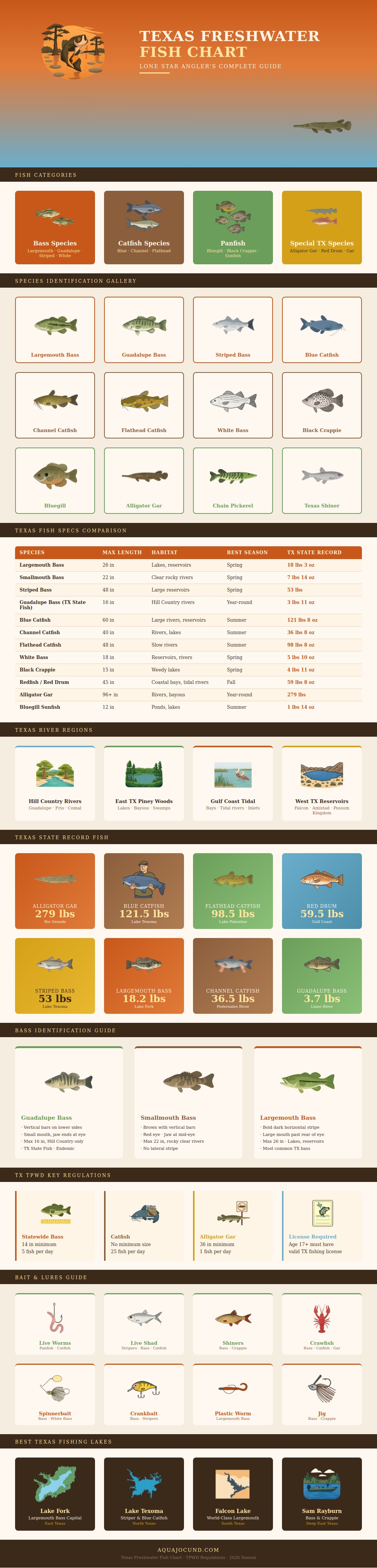
Texas freshwater fishing require the identification of many different types of fish species. Knowing how to correctly identify each of these species is important because each species of fish live in a different habitat with different regulations regarding fishing. In order to correctly catch each type of fish, it is important for anglers to be able to distinguish between the different fish species in order to use the correct type of bait to catch each type of fish and to follow the laws regarding fishing for those species.
The bass family include several different types of bass fish species. The largemouth bass is one of the most common bass fish species that can be found in the lakes and reservoirs throughout Texas. A largemouth bass can be identified by its jaw that extends past the eye of the bass fish species and a dark stripe on the side of the largemouth bass.
How to Identify Texas Freshwater Fish
The Guadalupe bass is the state fish of Texas and is often found in the clear streams that flow through the Hill Country. The Guadalupe bass can be identified by its vertical bar on its body and its mouth that does not extend past its eyes. Smallmouth bass fish are also found in Texas.
Smallmouth bass tend to live in rocky rivers throughout the state and have red eyes. These different species of bass fish lives in different habitats throughout the state. Thus, anglers must be able to correctly identify the species of bass to know where to cast their fishing lines.
In addition to the bass fish species are several different types of catfish species that live in the freshwater environment of Texas. The blue catfish, the channel catfish and the flathead catfish are three of the most common types of catfish species that are found in the state. The blue catfish live in the large rivers and large reservoirs of the state and can grow to very large size.
The channel catfish live in many of the lakes of Texas and have dark spot on their sides. The flathead catfish live in slow-moving water in the state and have mottled yellow-brown skin on their bodies and wide head. Each type of catfish requires a different type of bait to catch them.
For instance, live shad can attract blue catfish while crawfish can be used to catch flathead catfish. Panfish species are much smaller than the other fish species that live in Texas’ freshwater environments. Panfish species include bluegill and black crappie fish species.
Bluegill fish are most often found in ponds throughout the state and during the summer months and have orange bellies and blue flap on their gills. Black crappie live in lakes that have many weeds throughout the spring months and have speckled pattern on their bodies. These small fish species are easy to catch with light fishing tackle but the black crappie can provide a strong fight for the angler who catch one of these fish.
In addition to the fish species described above, Texas also has a few unique fish species. These include the alligator gar and the red drum. Alligator gar have an armored body with a snout that mimics the snout of an alligator and live in the bayous of the state.
Regulations require anglers to limit their catch of alligator gar to one fish per day if the fish species is larger than thirty-six inch in length. Red drum fish species are located in the tidal rivers of the state. These fish move into these rivers with the tide water.
The geography of Texas influences where the different types of fish live in the state. For instance, the Hill Country features clear waters that are suitable for Guadalupe bass fish species. The East Texas piney woods features swampy reservoirs that are suitable for bass and crappie fish.
The Gulf Coast features tidal areas that are suitable for red drum fish species. Lastly, large numbers of fish inhabit the West Texas reservoirs due to the arid environment of the region. The type of bait that anglers use can be determined by the location of the fish species.
For instance, shad fish can be used to attract striped bass fish species to large areas of water while worms can be used to catch panfish species in shallow area of freshwater environments in Texas. Texas freshwater fish species has specific regulations that all anglers must follow. For instance, there are different rules regarding the size of the fish that can be caught and the number of each type of fish that can be caught.
For instance, there is a minimum size limit of fourteen inches for bass species throughout the state of Texas. Additionally, anglers are limited to catching twenty-five catfish per day. All anglers who are of the age of seventeen years or older must obtain a fishing license to fish in Texas.
The behavior of fish species change with the seasons. For instance, during the spring, bass fish species exhibit aggressive behavior during their spawning season while the catfish fish species move into shallow waters during the summer season. In order to catch the fish species of Texas with success, the anglers must understand the type of bait that will attract the fish.
For instance, live worms can be used to attract panfish while live shad can be used to attract striped bass fish. In addition to using live bait species, anglers can also use artificial bait species to catch the fish. For instance, spinnerbaits can be used to catch bass fish species that live in grassy areas while plastic worms can be used to catch bass fish species in deeper water.
Additionally, using jigs will allow anglers to catch crappie fish species that live in areas with dense brush growth. Anglers can bait their lines with different movements to catch the various fish species. For instance, erratic movements in the bait will attract aggressive fish while subtle movements will allow anglers to catch fish that are easy pressured by other fish species.
