
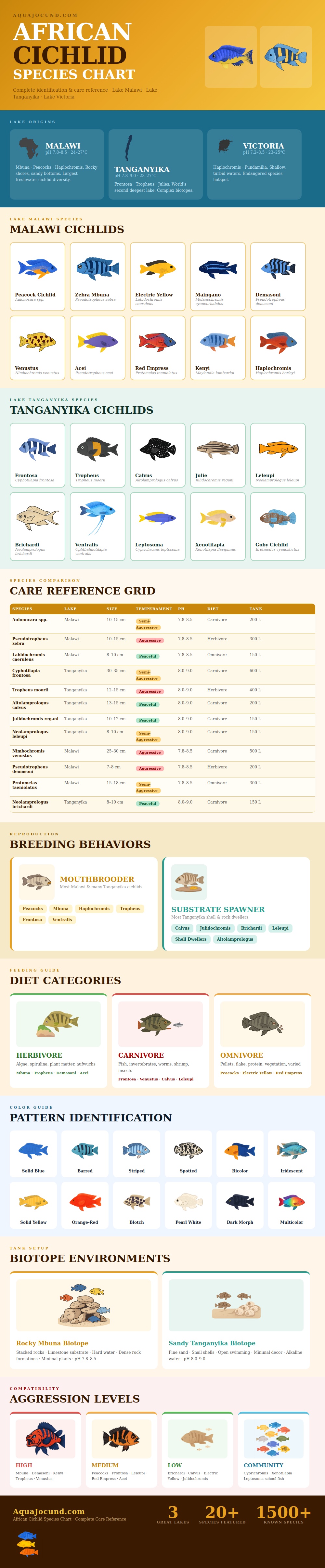
African cichlid are fish that originate from three differents rift lakes in East Africa: Lake Malawi, Lake Tanganyika, and Lake Victoria. Because these fish species originate from different lakes, there biological needs and behaviors is all different. If you dont account for these differences when caring for these fish, problems can ensue for the fish.
The largest and most well-known of these three lake is Lake Malawi, which contains many different species of African cichlids who live near rocky shores or sandy flats within the lake. The second largest of these three lakes is Lake Tanganyika, which is an deeper lake and contains many different species of African cichlid who live within shells or caves within the lake. The third and shallowest of these three lakes is Lake Victoria, which contains many different species of African cichlids that are highly adaptably to the conditions within the lake.
Caring for African Cichlids from Malawi, Tanganyika and Victoria
Thus, due to the different environments of each of these lakes, the African cichlid species found in Lake Malawi are not interchangeable with those found in Lake Tanganyika. Regardless of the species of African cichlid to be kept, the owner should maintain the water in the tank at conditions similar than those found in the lakes in Africa; high pH and hard water levels, as well as temperatures between 75 and 82 degrees Fahrenheit. Failure to maintain these conditions will lead to stress for the fish, as well as the loss of their natural color.
The different types of African cichlids can be identified by the patterns of their body. For instance, Mbuna are African cichlids from Lake Malawi that have a body color of barred blues, and live among the rocks in the lake and eat the algae that grows upon those rocks. Some African cichlid species has solid yellow or iridescent colors, and are “sand-sifters” that eat the sand and sand-dwellers within Lake Malawi, and who are calmer than Mbuna fish.
Other species have stripes or spots on their bodies, and are shell-dwellers that are native to Lake Tanganyika. These color patterns are likely used to provide camouflage for the fish, as well as to recognize other members of their own species when mating. Different species of African cichlids require different setups and spaces for their tanks.
For example, some species like Mbuna are very aggressive and will require rocks in the tank to give them place to hide. If the Mbuna do not have these hiding places, they will become aggressive with other fish in the tank and nip at their fins. Other species, like Frontosa, can grow to be very large, so the owner would of have to provide a very large tank for the Frontosa.
If the tank is too small for these large species, the African cichlids will become stress. Furthermore, the owner must avoid the wrong food for each species of African cichlid, as some species are herbivores and eat algae, while others are carnivore and eat small animals. Feeding the wrong type of diet to the cichlids can make them become sick.
Many species of African cichlids are mouthbrooders. This means that the female cichlids will carry their eggs and young fish in their mouths to protect them. Because the female cichlids carry the eggs in their mouths, they may experience stress.
Providing caves or pots in the tank for spawning can reduce this stress. Additionally, African cichlids will become more territorial when they breed so the tank should not be overcrowded with other fish. If the tank is overcrowded with other fish, they will fight with each other, potentially leading to damage to their fin.
A strong filter must be used to keep the water clean for the African cichlids. The African cichlids produce a high amount of waste in their tank. Crushed coral can be added to the tank to maintain high pH levels in the water.
Furthermore, the substrate of the tank should be matched with the type of African cichlid being kept. For example, sand and shells are required for Tanganyika shell-dwellers while rocks is required for Malawi Mbuna. By creating a species chart for the types of cichlids that will be kept in the tank and the requirement of each species of cichlid, the owner can correctly match each type of cichlid to the tank setup.
Thus, following the species chart will ensure that the owner avoids making any mistakes when setting up the tanks for the African cichlids.
