Reef Lighting Calculator
Target coral PAR, size fixture count, and compare spread, depth loss, and daily light load across common reef tank shapes.
Small cluster fixture for nano reefs and soft coral cubes with tighter spread.
High punch over round hotspots, ideal when SPS is stacked toward the upper rockwork.
Broad LED panel output with strong efficiency and even blanket coverage over mixed reefs.
Best used in rows for fill light and edge control on shallow displays and frag systems.
Uniform diffuse output, softer shimmer, and reliable blanket PAR across full tank width.
Wide hybrid platform blends punch and fill, reducing shading on branched SPS colonies.
Strong daylight-weighted intensity with high canopy heat and a generous spread footprint.
Bluer halide lamp with slightly lower PPF but useful color balance for deep reef displays.
| Type | PPF/W | Coverage | Mount |
|---|---|---|---|
| Compact LED | 1.9 | 0.20 m² | 18 cm |
| LED Puck | 2.1 | 0.28 m² | 20 cm |
| LED Panel | 2.4 | 0.37 m² | 24 cm |
| LED Bar | 1.7 | 0.24 m² | 14 cm |
| T5 HO | 1.35 | 0.30 m² | 12 cm |
| Hybrid | 1.85 | 0.45 m² | 18 cm |
| Halide 10K | 1.55 | 0.42 m² | 25 cm |
| Halide 14K | 1.48 | 0.40 m² | 25 cm |
| Tank | Dims | Volume | Typical Light |
|---|---|---|---|
| 20 long | 30 x 12 x 12 in | 20 gal | 1 compact LED |
| 40 breeder | 36 x 18 x 16 in | 40 gal | 2 panels or hybrid |
| 75 reef | 48 x 18 x 21 in | 75 gal | 3 pucks |
| 120 standard | 48 x 24 x 24 in | 120 gal | 2 hybrids |
| Profile | PAR | Hours | Notes |
|---|---|---|---|
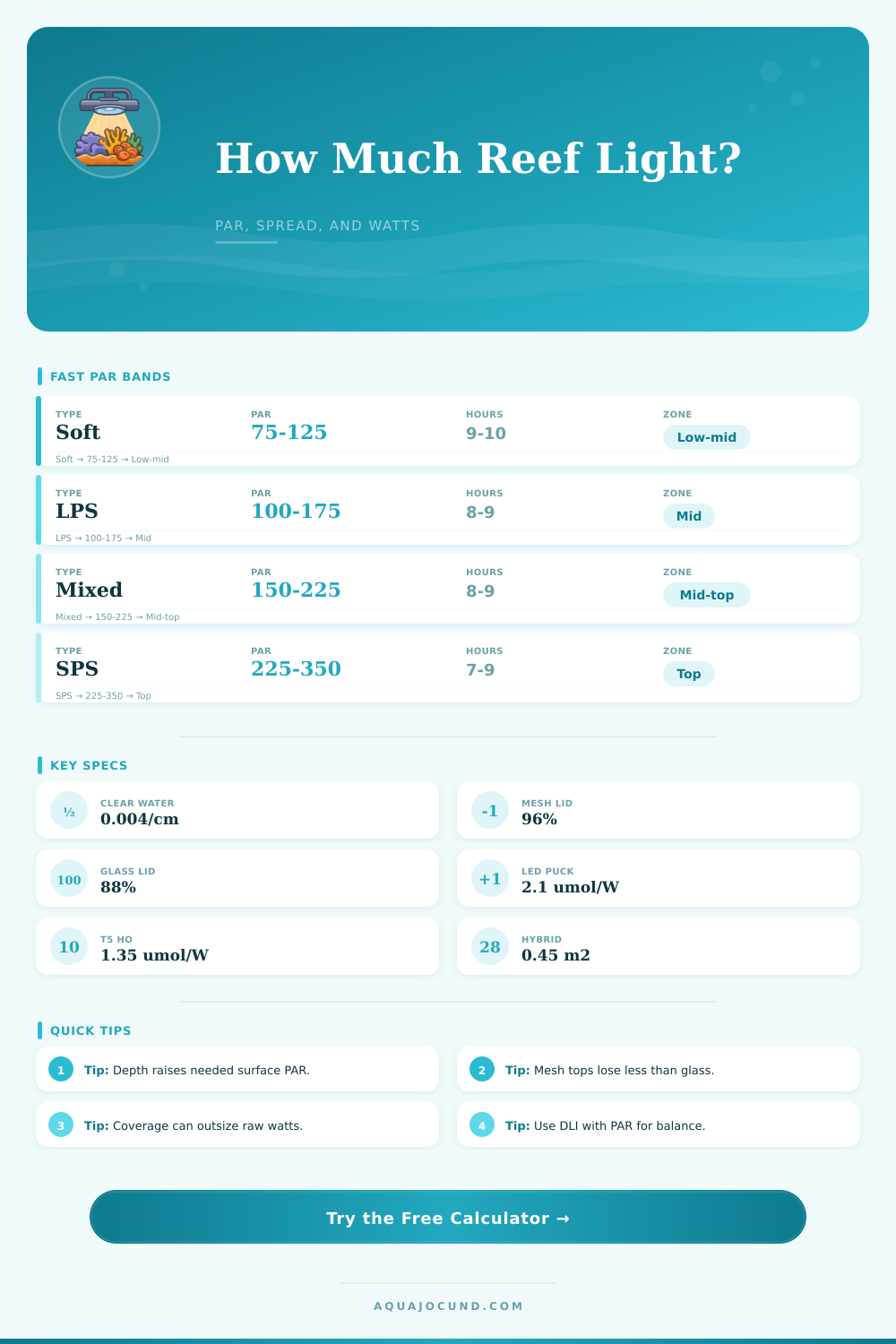
| Soft coral | 75-125 | 9-10 | Wide comfort band |
| LPS | 100-175 | 8-9 | Moderate light |
| Mixed reef | 150-225 | 8-9 | Balanced demand |
| SPS / Acro | 225-350 | 7-9 | High upper-zone need |
| Factor | Value | Effect | Use |
|---|---|---|---|
| Clear water | 0.004 / cm | Lower depth loss | Fresh carbon, low tint |
| Standard water | 0.006 / cm | Baseline attenuation | Typical mixed reef |
| Yellowed water | 0.0085 / cm | Higher blue loss | Older water, tint |
| Mesh top | 96% transmit | Small PAR drop | Common jump guard |
| Glass canopy | 88% transmit | Higher surface loss | Covered systems |
| Raise fixture | +1% spread / cm | Less punch | Blend hotspots |
Lighting for a reef tank is a critical component of establishing and maintaining a reef tanks. The intensity of lighting that is provided to the reef tank must be carefully manage because the intensity of the lighting affects the growth of corals within the reef tank. If the reef tank is exposed to lighting that is to weak, the corals will stall in there growth.
However, if the lighting is too strongly for the corals in the reef tank, the lighting may damage or “fry” the coral polyps. The person who establish the reef tank must consider both the type of corals that are to be included in the reef tank and the way in which the light reaches the various depth within the reef tank. The type of light that corals require is specific and is referred to as Photosynthetically Active Radiation, or PAR.
How to Light a Reef Tank
Corals use this type of light for the process of photosynthesis. Soft corals thrive in PAR levels between 75 and 125, indicating that they dont require high level of light to grow. Small Polyp Stony corals, or SPS corals, require between 225 and 350 PAR levels to ensure there growth.
The type of corals that are to be included in a reef tank will determine the required PAR levels for that tank. Thus, the coral tank must be establish prior to finalizing the lighting equipment for that reef tank. Another major factor to consider in the establishment of a reef tank is the depth at which the corals are to be grown.
The deeper the tank, the less light that will reach the corals growing at the bottom of the tank. As light travels through the water, the water absorbs and scatter the light. This process is referred to as attenuation.
The less clearly the water within the reef tank is, the more the light will be attenuated. Water that is yellow or contains algae will attenuate more light than clear water. If a tank canopy or lid is utilized for the reef tank, the light that enters the tank will be attenuated.
Thus, the person must increase the intensity of the lighting for the reef tank if they intends to use a canopy for the tank. Additionally, the height at which the lighting is mounted will also impact the light that reaches the corals within the tank. If the lighting is mounted low in the tank, there will be hot spot within the tank.
However, if the lighting is mounted high in the tank, the evenness of the lighting will be maintained, but the intensity of the light will be decreased. There are different type of lighting available for reef tanks. Each type of lighting have different characteristics to reef tanks.
Because LED lights are so common due to their energy efficiency and control over the intensity of the light, puck lights are best used for areas that require a great deal of light, and panel lights are used for larger areas. T5 lights provide even lighting with a shimmering effect to the tank, and hybrid lights contain features of both LED and T5 lights. You must chose the lighting for the reef tank according to the shape of the tank and the type of corals you would like to keep; the coverage of the lights is more important then the wattage of the lights.
The light output that is required for your reef tank can be calculated after you have selected the lighting for your tank. Each area of your reef tank will have a target PAR (Photosynthetic Active Radiation) level that should be targeted, but these target should be increased according to the depth of the tank and any lids that may cover the tank. The Daily Light Integral, or DLI, is a measurement of the total amount of light that each individual coral receive during the day.
You can adjust the DLI by altering either the intensity of the lights that is provided to the reef tank or the length of time in which the lights are allowed to cycle on. For example, areas with high target PAR values might only require seven hours of lighting to achieve the required DLI, but areas with low PAR values might require ten hours of lighting to achieve the same level of DLI. Reef tank lighting issues are common for reef tank beginners, so it is important to avoid these issues before the reef tank is started.
One of the most important lighting issues to avoid is cloudy water; the water should be changed regularly to ensure that it is clear and that the corals recieve the light that is required to thrive. Headroom margin is another issue to avoid; the lighting should of have enough power to account for any cloudiness in the water. Finally, another of the most important issue is to ensure that the corals are receiving the correct amount of light; you can ensure this by using a PAR meter to measure the light in the tank, as the physical appearance of the corals is the best way to ensure that the lighting for the reef tank is appropriate.