🐟 Corner Fish Tank Calculator
Estimate triangle footprint, water volume, glass weight, and total wet load for corner aquariums with bowed or pentagon fronts
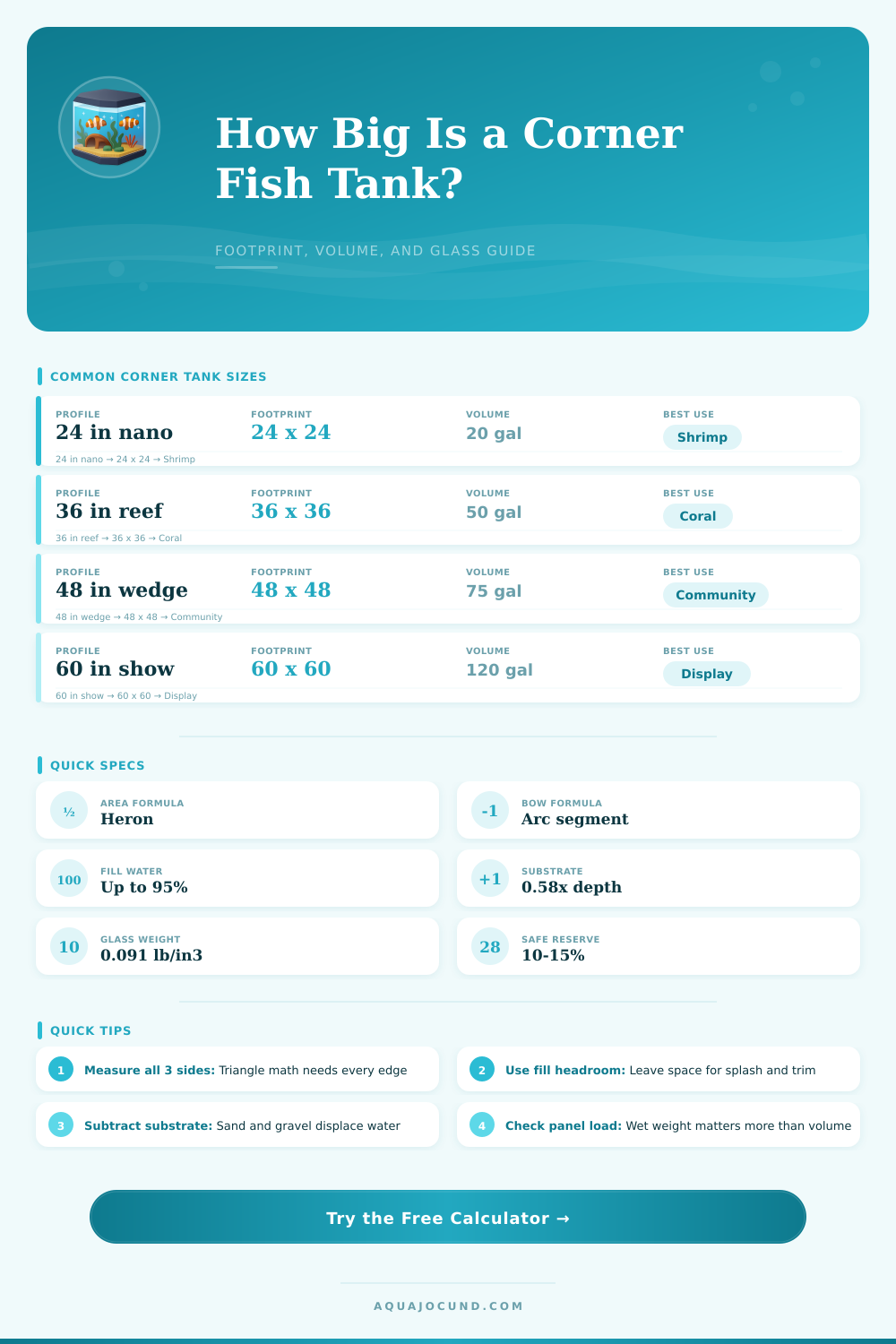
| Corner Profile | Side Lengths | Approx Volume | Best For |
|---|---|---|---|
| 24 in nano | 24 x 24 x 24 | 20 gal | Shrimp |
| 36 in reef | 36 x 36 x 28 | 50 gal | Corals |
| 48 in wedge | 48 x 48 x 30 | 75 gal | Mixed fish |
| 60 in show | 60 x 60 x 36 | 120 gal | Display tanks |
| Glass Thickness | Use Case | Safe Height | Notes |
|---|---|---|---|
| 1/4 in | Nano builds | Up to 16 in | Light duty |
| 3/8 in | Mid-size tanks | Up to 24 in | Common choice |
| 1/2 in | Large displays | Up to 30 in | Strong margin |
| 5/8 in | Oversize builds | 30 in plus | Shop check |
| Fill Level | Reserve | Look | Use |
|---|---|---|---|
| 85% | 15% | Extra safe | Heavy splash |
| 90% | 10% | Balanced | Most setups |
| 92% | 8% | Clean view | Display tanks |
| 95% | 5% | Max fill | Controlled rim |
| Substrate | Depth | Load Factor | Best Use |
|---|---|---|---|
| Bare bottom | 0 in | 0.00 | Grow-out |
| Fine sand | 1-2 in | 0.042 | Softwater fish |
| Gravel | 1.5-3 in | 0.050 | Community tanks |
| Soil cap | 2-4 in | 0.035 | Planted tanks |
- Measure the wall recess before you choose a shape.
- Check the front span and side depths twice.
- Allow space for hoses, lights, and maintenance access.
- Use a cardboard template before cutting glass.
- Add water, glass, and substrate together for the final load.
- Keep the fill line below the top trim for splash control.
- Use thicker glass when the height or side lengths climb.
- Corner tanks look compact, but the load can still be heavy.
An corner aquarium is a type of fish tank that is design to fit within the corner of a room. Such aquarium are design to utilize a space within the room that would otherwise remain unused. Many individual prefer a corner aquarium because it can save floor spaces within the room.
However, to determine whether a corner aquarium will fit into a specific corner of a room, calculation must be made regarding the shape of the tank and the weight of the aquarium when filled with water. Corner aquarium can have either a triangular shape or a curved shape; each of these shapes will hold a different amount of water, and each will place a different amount of weight upon the floor upon which it is placed. To determine the dimension of the space within the corner that the aquarium will occupy, the depth of each of the wall of the room must be measured, as well as the length of the front span of the room and the height of the aquarium.
How to Measure and Set Up a Corner Aquarium
If the corner aquarium feature straight sides, the area can be calculated using the formula for the area of a triangle. If the corner aquarium feature a bowed or curved front span, the area of the bow must be calculated and add to the area of the triangular portion of the tank. While triangular tank are often best for small space, bowed tank allow for better viewing angle of the tank’s inhabitants, although they require more glass to cover the curved portion of the tank, and thus, they are heavier than tank with triangular shape.
Aquariums feature a substrate on the floor of the tank, which can be material like sand or gravel. These substrate can alter the amount of water that can be contained within the tank. The substrate displace some of the water within the tank.
For instance, if the substrate is add to the tank, the amount of water that can be contained within the tank will decrease. Furthermore, the substrate add to the weight of the corner aquarium. In addition to the weight of the water and the substrate, others may also need to consider the fill level of the corner aquarium.
The corner aquarium should only be filled to 90 or 95% of its total height. Otherwise, the water may splash out of the tank, and there will not be enough space for the tanks equipment. Additionally, the thickness of the glass must also be considered in relation to the height of the corner aquarium.
Water create pressure on the glass of the tank. There are many common size for a corner aquarium. A 24-inch corner aquarium can hold around 20 gallon of water and is suitable for housing small fish or shrimp.
A 36-inch corner aquarium can hold approximately 50 gallon of water and is often used for reef tanks as the curved front of the tank allow for even lighting to reflect off the aquarium glass. A corner aquarium that is 48 to 60 inch wide can hold between 75 and 120 gallon of water, and the tank will require thicker glass and a stronger floor to support such a heavy tank. Calculating the total wet weight of the corner aquarium is another essential task before set up the corner aquarium.
The total wet weight of the corner aquarium include the weight of the water, the weight of the glass, and the weight of the substrate in the tank. Since water weigh 8.3 pounds per gallon, the total wet weight will help determine whether the floor or the cabinet can support the corner aquarium. In most case, the corner aquarium is so heavy that it might require reinforcing the cabinet with plywood to support the tank.
Some mistake people make when setting up a corner aquarium include measuring only one wall of the corner to determine the length of the other wall of the corner aquarium. Most corner are not even close to being symmetrical, so if people make this mistake, there corner aquarium might not fit into the corner of the room correct. Additionally, people often forget to leave some space at the top of the corner aquarium for overflow in the case that the filtration system should fail.
A space of 10 to 15 percent of the total height of the aquarium should be left for aesthetic and lighting purpose. A corner aquarium can pose challenge for the movement of water and light in the tank. Due to the angled corner of a corner aquarium, the movement of water in the corners of the tank will be slower than the rest of the tank.
Placing powerheads in the tank will help move the water to ensure that no spot in the corner aquarium are left without water movement. The lighting for the corner aquarium should also be placed in a manner that ensures that the entire tank is lit equal. Finally, the stand for the corner aquarium must have strong bracing at the corners of the tank to evenly distribute the weight of the tank.