Freshwater Fish Stocking Calculator
Estimate a comfortable freshwater community load by combining tank volume, swimming footprint, adult fish size, filtration strength, plant cover, and your weekly care routine before you add livestock.
Recommended freshwater stocking
Use the inputs above to estimate a practical fish count for a freshwater community aquarium.
Full Breakdown
Your recommendation appears here after calculation. Use the comparison cards below to see how a lighter or fuller stocking plan would change maintenance expectations.
| Profile | Typical Fish | Load Effect |
|---|---|---|
| Nano | Chili rasboras, ember tetras | More fish per gallon |
| Community | Tetras, rasboras, corydoras | Balanced baseline |
| Livebearer | Platies, guppies, mollies | Moderate waste rise |
| Bottom | Corys, loaches, otos | Footprint matters more |
| Semi-aggressive | Barbs, gouramis, shark fish | Reduce crowding |
| Showcase | Angels with companions | Leave centerpiece room |
| Adult Size | Base Fish per 10 gal | Notes |
|---|---|---|
| 1.0 in | 10 to 12 | Tiny schooling species |
| 1.5 in | 7 to 9 | Nano community |
| 2.0 in | 5 to 6 | Common tetra range |
| 2.5 in | 4 to 5 | Most peaceful community fish |
| 3.0 in | 3 to 4 | Larger schooling species |
| 4.0 in | 2 to 3 | Centerpiece fish range |
| Factor | Setting | Effect |
|---|---|---|
| Filter | Basic | Lower oxygen reserve |
| Filter | Good | Baseline turnover |
| Filter | Oversized | Extra media volume |
| Plants | Sparse | Less cover and uptake |
| Plants | Moderate | Balanced shelter |
| Plants | Dense | Better stress control |
| Load | Weekly Change | Who It Fits |
|---|---|---|
| Light | 20% to 30% | Beginners, planted tanks |
| Balanced | 30% to 40% | Most community tanks |
| Fuller | 45% to 50% | Experienced keepers |
| Heavy | 50% plus test checks | Temporary grow-out only |
Use groups before variety
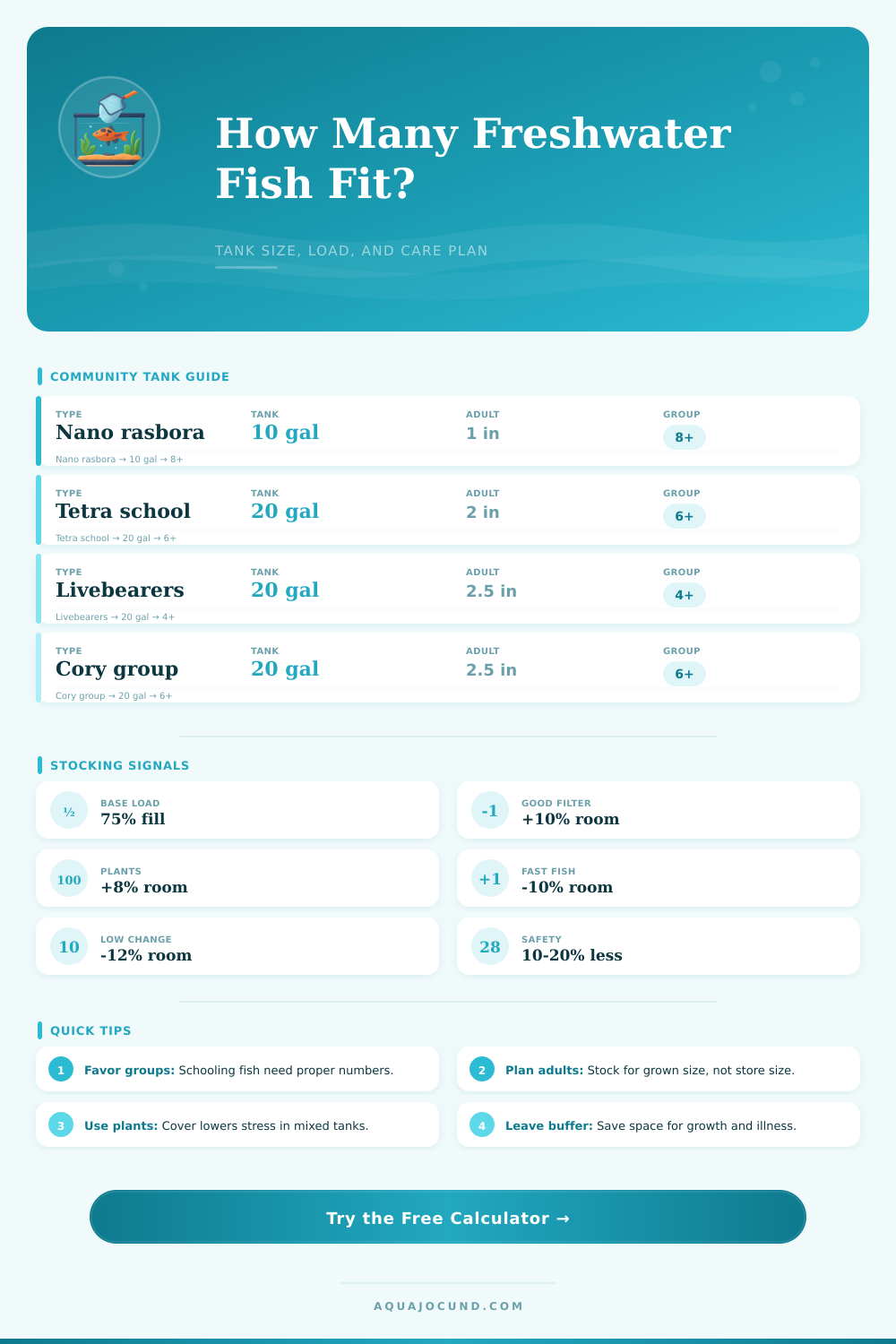
Most freshwater community fish display better color and lower stress when they are kept in complete groups. If a calculator gives you room for twelve fish, one school of eight plus a bottom group of four is usually healthier than six different pairs.
That is why the schooling buffer can hold your final number above a bare mathematical minimum when the chosen profile depends on social species.
Adult size and maintenance decide the ceiling
Good filters and plant cover help, but they do not erase waste production or swimming needs. A slightly lower stocking level often gives better long-term health, fewer algae swings, and more stable nitrate control than pushing every gallon to its maximum.
Use the fuller plan only if your water-change routine already matches the stronger maintenance target shown in the comparison grid.
While the rule of one inch of fish per gallon of water are a starting point for many new fish keepers, the rule is an oversimplification of the way that fish live in there tank. Both a twenty gallon tall tank and a twenty gallon long tank contain the same amount of water, but the tank with a larger footprint will provide more physical room for the fish to swim. Thus, the rule based solely upon the water volume may results in fish that is physical cramped within there tank.
Therefore, besides considering the volume of water that the tank will contain, it is also necessary to consider the physical space within the tank in which the fish must swimming. In order to find the proper balance for a community tank, it is important to consider two different factor: the biological load of the fish (such as ammonia and nitrate waste) and the physical space in which the fish will feel secure within the tank. Both of these factors will influence the stocking rules for the tank, and the calculator provided will help to balancing these two elements.
How to Stock Your Fish Tank the Right Way
The footprint of the tank will determine the volume of water and the space in which the fish will feel secure both in the tank and in there environment. The type of fish that will go into the tank will have an impact upon the stocking requirements for the tank. For instance, nano fish species will have a smaller footprint than other fish species, allowing the tank to contain a larger school of these smaller fish.
Additionally, livebearing fish create more waste than other type of fish, as they are required to produce fry that join the population of fish in the tank very quick. Thus, stocking rules will differ for species like guppies as compared to other types of cichlid fish. These different types of fish will have different level of biological load, forcing individuals to make stocking decision that account for that load.
Beyond stocking the tank with the appropriate number and types of fish, other elements of the tank (such as filtration systems and live plants) will impact the stocking rules. For instance, a more powerful filtration system will help to clean the water in the tank more efficient, allowing for a higher stocking of fish. Live plants will naturaly absorb the nitrates from the water, and provide hiding spot for the fish.
However, the stocking of fish in the tank will have no impact upon the amount of physical room in which the fish can swim. The water may be the cleanest in the world due to the powerful filter, but if the fish is forced to become aggressive towards one another, the stocking of the tank may need to be reduced. One of the mistake that many individuals make with their tanks is to base the stocking upon the size of the fish species at the pet store.
However, stocking for the juvenile size of the fish is a mistake because the adult size will require more room in the tank. Failure to account for the adult size of the fish will require individuals to purchase a new tank every few month. Thus, planning for the adult size of the fish is a necessity within stocking the aquarium.
The maintenance schedule for the tank will have a connection to the number of fish that are stocked into the tank. For instance, a lightly stocked tank will allow individuals to make error with water changes, but a heavily stocked tank will require a more disciplined routine for maintenance. In a heavily stocked tank, if the nitrate levels spike, there will be no buffer tank to protect the fish from those high levels of nitrate.
Beyond the biological aspects of the tank, the social dynamics of the fish within the tank will impact the stocking rules. Most community fish are schooling fish that require a minimum number of individuals to feel secure within the environment. Thus, if the math show that there is space for five fish, but the species of fish require a school of six fish, it is better to purchase the group of six fish than the group of five fish with one isolated fish.
Overall, the goal in stocking a tank is to create a stable ecosystem within the tank. By providing a buffer for the stocking of the tank, the ecosystem will be more stable. The owner of the aquarium can achieve stability in the tank by balancing the footprint of the tank, the biological load of the fish within the tank, and the maintenance schedule.
By finding this balance, individuals can move away from the one inch per gallon rule towards a system for stocking fish that ensure the tank and fish thrive.