Saltwater Stocking Calculator
Estimate marine fish capacity from tank shape, footprint, filtration turnover, reef layout, and species load so your stocking plan fits both swim room and bio room.
3.5 in adults, pair social load, moderate waste, likes covered reef structure.
3 in adult, one cave per fish, moderate territory demand, best in mixed reef plans.
3 in adult, jump prone, low waste, needs quiet tankmates and open retreat lanes.
3 in adult, hovers in midwater, pair or small group, steady but not heavy waste.
3.5 in adults, group fish, active swimmers, extra open water matters more than height.
5 in adult, faster metabolism, stronger cover and flow needs, moderate territory spread.
4 in adult, higher grazing load, one fish per territory, benefits from mature rockwork.
7 in adult, long swim lane, algae grazer, needs broad footprint before raw gallons help.
| Profile | Adult Size | Min Tank | Min Group | Gal per Fish |
|---|---|---|---|---|
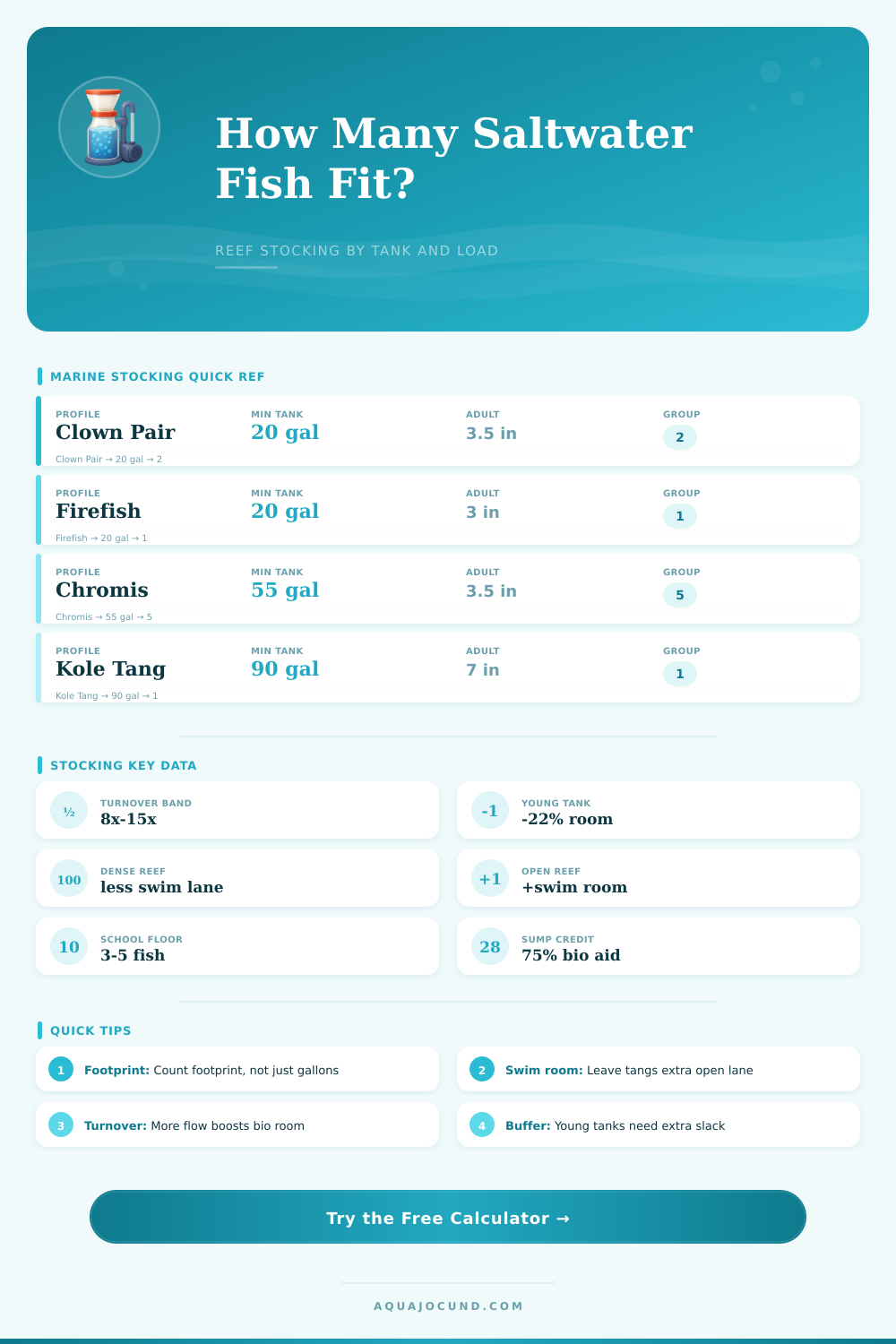
| Ocellaris clownfish | 3.5 in | 20 gal | 2 | 12 |
| Royal gramma | 3 in | 30 gal | 1 | 14 |
| Firefish goby | 3 in | 20 gal | 1 | 12 |
| Banggai cardinal | 3 in | 40 gal | 2 | 15 |
| Blue green chromis | 3.5 in | 55 gal | 5 | 16 |
| Fairy wrasse | 5 in | 55 gal | 1 | 20 |
| Coral beauty angel | 4 in | 70 gal | 1 | 22 |
| Kole tang | 7 in | 90 gal | 1 | 35 |
| Tank | Dimensions | Metric | Display Volume | Typical Fit |
|---|---|---|---|---|
| 20 High | 24 x 12 x 16 in | 61 x 30 x 41 cm | 20 gal | Clown pair or one firefish |
| 32 Cube | 20 x 20 x 18 in | 51 x 51 x 46 cm | 32 gal | One gramma with reef buffer |
| 40 Breeder | 36 x 18 x 16 in | 91 x 46 x 41 cm | 40 gal | Cardinal pair or mixed nano reef |
| 65 Tall | 36 x 18 x 24 in | 91 x 46 x 61 cm | 65 gal | Chromis group with open lane |
| 75 Standard | 48 x 18 x 21 in | 122 x 46 x 53 cm | 75 gal | Wrasse or dwarf angel reef |
| 90 Standard | 48 x 18 x 24 in | 122 x 46 x 61 cm | 90 gal | Kole tang floor with strong export |
| 120 Long | 48 x 24 x 24 in | 122 x 61 x 61 cm | 120 gal | Tang plus broader community room |
| System Lever | Lean | Balanced | Push Range | Effect on Capacity |
|---|---|---|---|---|
| Turnover | 6x | 10x | 14x | Higher turnover lifts bio room more than footprint room. |
| Water change | 10% | 15% | 25% | Export improves adjusted bio capacity for heavier feeders. |
| System age | 3 mo | 10 mo | 18 mo | Mature rock and stable bacteria widen the safety margin. |
| Aquascape | Reef wall | Balanced | Open lane | Active swimmers gain room when front to back space stays clear. |
| Margin | Conservative | Standard | Assertive | Margin changes the final recommendation after all other limits. |
When planning a saltwater aquarium, consider the relationship between the species of fish you will use and the dimensions of the saltwater aquarium. Many person focus only on the total number of gallons of water their saltwater aquarium will contain. However, the shape of the aquarium and the footprint of the saltwater aquarium are more important to the well-being of the fish species.
A long and shallow saltwater aquarium provides more swimming space for the fish and allows the fish to swim in loops within the tank. A tall and narrow aquarium may contain the same number of gallons of water as a long and shallow aquarium, but it will provide less swimming space for the saltwater aquarium’s fish. The footprint of the saltwater aquarium determine the territory available to the fish species in that aquarium.
How to Choose the Right Saltwater Tank Size, Shape, and Fish
A saltwater aquarium must be filtered to remove waste and maintain stability in the tank. Aim for a filtration rate that turns over the aquarium 8 to 15 times per hour. Using a high filtration turnover rate will lead to increased export of waste from the aquarium and increased oxygenation of the water.
Both of these factor allow the bacteria colonies in the saltwater aquarium to clean the tank effectively and prevent spikes in ammonia levels in the tank water. Additionally, perform water changes in the saltwater aquarium each week to change 15 percent of the total volume of water in the aquarium. This provides a margin of error in case waste isnt properly exported from the saltwater aquarium.
When establishing a young saltwater aquarium, it is important to perform water changes and to be cautious about adding fish to the aquarium until the saltwater has developed adequate bacterial colonies in the rockwork. The species of fish you choose will determine the requirements for the saltwater aquarium. Clownfish is suitable for smaller 20-gallon saltwater aquariums.
However, if you choose a species like a tang, the saltwater aquarium must be at least 90 gallons in size because tangs grow to large sizes. If you choose to use schooling fish like chromis, you will need to buy at least five fish so that they dont experience stress and develop fin damage when they is kept alone. Additionally, dwarf angel fish are territory-driven species.
These fish will claim specific areas of the saltwater aquarium, and their grazing activities will increase the nitrate levels in the saltwater aquarium. The aquascape for the saltwater aquarium will play a role in the amount of space that the fish have in the aquarium. If you choose to create cave in the aquarium using rocks, there will be less space for the fish to swim in open areas.
An open aquascape will provide more swimming room for the fish and increase the effective capacity of the saltwater aquarium. Additionally, using sumps to manage the waste in the aquarium will increase the stability of the saltwater aquarium. However, sumps will not increase the swimming space available for the fish since sumps are locate beneath the saltwater aquarium.
You must also consider the future growth of the fish you plan to keep in the aquarium. For example, firefish gobies start at 2 inches but grow to 3 inches in size. Therefore, the aquarium must have a lid to prevent these fish from jumping out of the tank.
Additionally, dont overstock the saltwater aquarium with fish at the beginning. Overstocking the aquarium will make it difficult for the fish to coexist in the aquarium with the established water parameters. Finally, do not choose the size of the saltwater aquarium based off only on the gallons of water it will contain because a small footprint will not provide the fish with enough swimming space.
The last factor to consider when stocking a saltwater aquarium are the compatibility of the fish species with the stability of the aquarium. When adding fish to the tank, add the fish one at a time to monitor the nitrate levels every week. Monitoring the nitrate levels will allow you to monitor the effect that the fish have on the aquarium water quality.
A mature aquarium will have a higher stability of water parameters than a new saltwater aquarium. Additionally, a mature aquarium will have more room for fish to live in than a new aquarium. However, the number of fish that must be balanced with the space the fish require for their territory will ensure the saltwater aquarium remain stable.