Aquarium Build Calculator
Plan a custom aquarium with shape-aware glass thickness, brace coverage, silicone volume, water capacity, and design load estimates before you order panels.
| Material | Density | Stiffness Factor | Best Fit |
|---|---|---|---|
| Standard Glass | 2.50 g/cc | 1.00 | General builds |
| Low-Iron Glass | 2.49 g/cc | 0.96 | Display fronts |
| Tempered Base Glass | 2.50 g/cc | 1.08 | Bottom panel upgrade |
| Starphire Glass | 2.49 g/cc | 0.95 | Premium clarity |
| Laminated Glass | 2.55 g/cc | 0.92 | Safety-first builds |
| Cell-Cast Acrylic | 1.18 g/cc | 0.58 | Lightweight shells |
| Polycarbonate | 1.20 g/cc | 0.72 | Impact-resistant builds |
| Build | Outer Size | Water | Starter Glass |
|---|---|---|---|
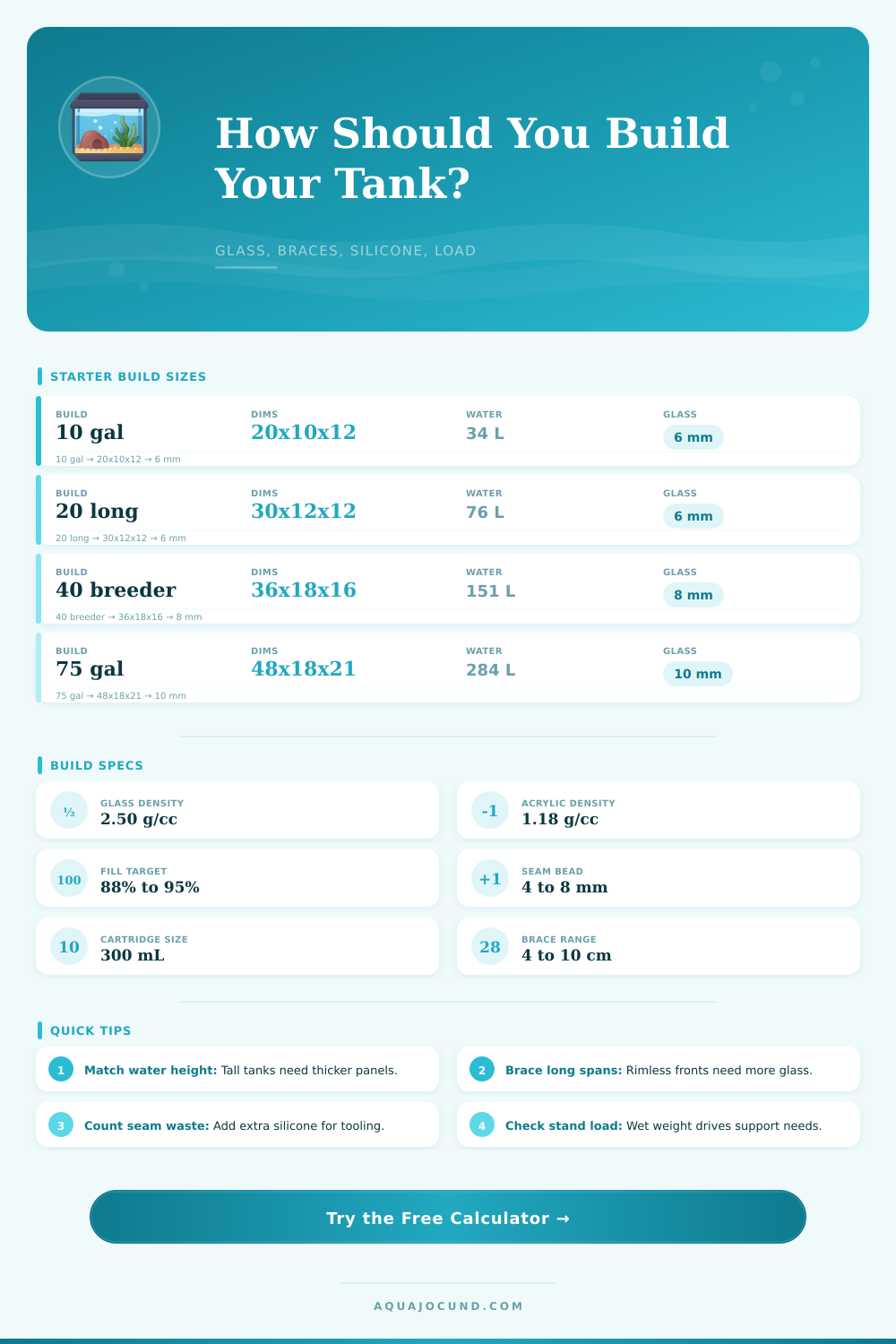
| 10 gal | 20 × 10 × 12 in | 34 L | 6 mm |
| 20 long | 30 × 12 × 12 in | 76 L | 6 mm |
| 40 breeder | 36 × 18 × 16 in | 151 L | 8 mm |
| 75 gal | 48 × 18 × 21 in | 284 L | 10 mm |
| Style | Span Factor | Brace Glass | Best Use |
|---|---|---|---|
| Rimless | 1.00 | None | Small, clean displays |
| Eurobrace | 1.00 | Perimeter strips | Long glass tanks |
| Center Brace | 0.55 | One bridge | Mid-size spans |
| Double Center | 0.38 | Two bridges | Wide or tall builds |
| Framed Top | 0.45 | Frame only | Mass-market tanks |
| Peninsula | 0.85 | View-side support | One-sided displays |
| Bead Width | Approx mL per m | Typical Use | Note |
|---|---|---|---|
| 4 mm | 8 mL | Nano tanks | Fine control |
| 5 mm | 12.5 mL | 20 to 40 gal | Common shop bead |
| 6 mm | 18 mL | 75 gal class | Good safety reserve |
| 8 mm | 32 mL | Large custom builds | Heavy tooling needed |
To create a custom aquarium, it is essential to understand the physics of the material and the aquarium. The physics of water pressure state that the higher the water, the more higher the pressure that the water will exert against the glass panels of the aquarium. The thicker the glass panels are, the more even the water pressure will be distributed.
If the glass panels are too thin for the size of the aquarium, the water will cause the glass panels to bow. If the aquarium bend too much due to the water pressure, the aquarium will fail and lead to a leak of the water from the aquarium. Therefore, it is essential to calculate the thickness of the glass panels before constructing the aquarium.
Glass Thickness and Water Pressure
Glass are a common material for aquariums as it is very dense and resists deflection. The density of float glass is 2.5 gram per cubic centimeter. Acrylic is another material used for aquariums but is less dense than glass.
Acrylic will flex more under the influence of water pressure. Therefore, if you use acrylic for aquarium tank, the thickness of the aquarium must be increased to prevent the aquarium from bowing due to the water. Another influence on the materials used for aquariums is the shape of the aquarium.
For rectangular tanks, the flat panels of the aquarium will have to withstand the force of water. For cylindrical aquariums, the hoop strength will help to even out the water pressure on the aquarium. The height of the water is the most critical factor in determining the water pressure on the aquarium.
Aquariums should not be filled to the very top to provide room for maintenance. Even with room for maintenance, the water pressure on the aquarium at the bottom will be high. For example, 20 inch of water will place enough pressure on a 6mm glass panel for it to bow under the water pressure.
To add to this, an safety margin should be provided for the aquarium. Adding 10% to the total aquarium calculation will account for the weight of the gravel and decorations in the aquarium. Another essential aspect to the construction of aquariums is bracing the aquarium to even out the water and add further support to the tank.
There is different types of braces, such as eurobraces. Eurobraces are strips of glass that go around the perimeter of the aquarium tank. These will help to even out the even of the aquarium and prevent it from bowing due to the water.
Center strips can be used to help halve the width of the aquarium and even out the flexing in the middle of the aquarium. For rimless aquariums, there is no place for the center strip to even out the flexing in the middle of the aquarium. In this case, the thickness of the aquarium glass will have to be increased to even out the water.
The last aspect to discuss in terms of aquarium construction is the type of silicone that is used in the aquarium. Silicone beads will go into the aquarium seams and act as the adhesive for the aquarium. The silicone beads should be triangular fillets in the corners of the aquarium.
For larger aquariums, the thickness of the silicone will have to be increased. Another essential aspect of the aquarium is the total weight of the aquarium. The total weight of the aquarium is the weight of the aquarium glass, the weight of the water, and the weight of the decorations.
The stand upon which the aquarium will rest must be able to support the total weight of the aquarium. For example, a 75-gallon aquarium will weigh as much as the glass and the water in it. The stand must be able to support this weight; otherwise, it will begin to compress.
Aquarium stands that compress will lead to unevenly aquariums; uneven aquariums will cause the seams of the aquarium to fail. There are different types of glass that can be used for aquariums. For instance, low-iron glass offers more clarity than standard glass.
Low-iron glass allows more light through the tank, which is beneficial for reef aquariums. However, the clarity of the low-iron glass does not change the physics of the aquarium. When purchasing aquarium glass, it is essential to check the thickness of the glass.
The standard thickness for aquarium glass is 6mm, 8mm, 10mm, and 12mm. Finally, to ensure that the aquarium can handle the water placed into it, calculate the dimension of the aquarium and the thickness of the glass panels before beginning the construction of the aquarium.