Pond Liner Calculator in Feet
Estimate liner cut size, underlayment coverage, and pond water volume from your real pond dimensions. The calculator uses shape factor, slope run, and practical edge slack so the fit stays realistic in feet.
Choose a real pond layout to seed the calculator. Each preset sets shape, length, width, depth, slope, rim wrap, underlayment overlap, and waste buffer so you can jump right to the fit check.
Pond Liner Output
Calculated from the current pond shape, depth, and allowance settings.
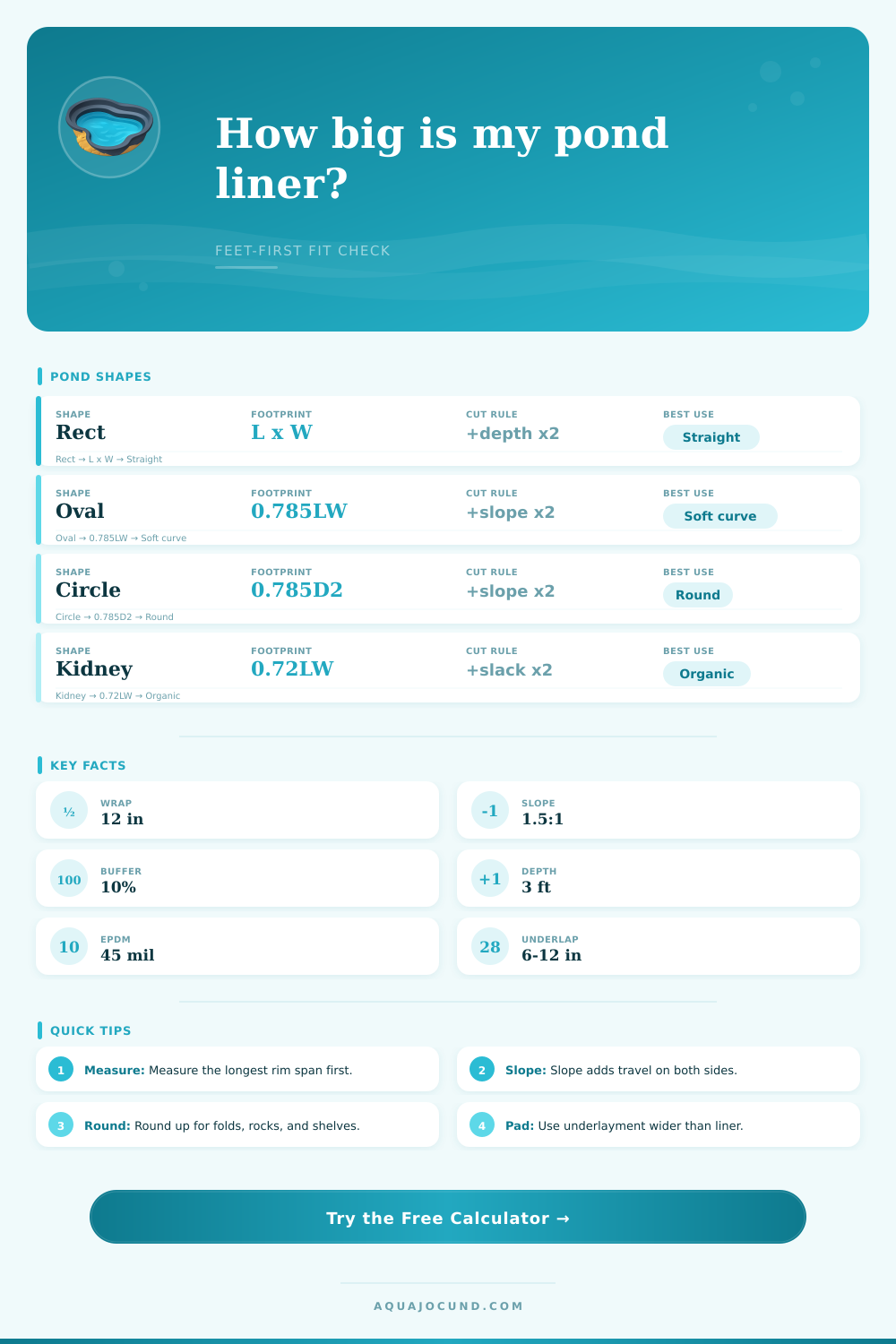
| Shape | Footprint factor | Liner rule | Best use |
|---|---|---|---|
| Rectangle | 1.00 | Depth x2 | Straight walls |
| Oval | 0.79 | Slope x2 | Soft curves |
| Circle | 0.79 | Dia only | Round basin |
| Kidney | 0.72 | Add slack | Organic outline |
| Freeform | 0.68 | Add buffer | Odd geometry |
| Material | Thickness | Flex | Best use |
|---|---|---|---|
| EPDM | 45 mil | High | Curves |
| PVC | 30 mil | Mid | Small ponds |
| RPE | 40 mil | Mid | Long runs |
| HDPE | 60 mil | Low | Straight basins |
| Allowance | Typical | Effect | Why it helps |
|---|---|---|---|
| Rim wrap | 12 in | Anchors edge | Keeps liner seated |
| Shelf slack | 6-12 in | Extra travel | Covers ledges |
| Underlap | 6-12 in | Pad cover | Protects membrane |
| Waste buffer | 5-12% | Extra trim | Safer cuts |
| Pond size | Depth | Liner cut | Approx volume |
|---|---|---|---|
| 6x8 ft | 2 ft | 11x13 ft | 1,400 gal |
| 8x10 ft | 2.5 ft | 14x16 ft | 2,900 gal |
| 10x12 ft | 3 ft | 17x19 ft | 5,000 gal |
| 12x16 ft | 3.5 ft | 21x25 ft | 8,100 gal |
To determine the size of a pond liner that are required for a pond, it is first necessary to calculate the dimensions of that pond. The dimension of the pond include the length of the pond, the width of the pond, and the depth of the pond. The pond liner must be large enough to cover the bottom of the pond, the slope of the pond walls, and the rim of the pond.
If the liner is too small, it wont be able to cover the edge of the pond. If the liner is too large, there will be excess liner that you must trim. The length and the width of the pond at the top rim must be measure.
How to Measure and Size a Pond Liner
These dimensions are not the only dimension that must be considered for liner size, however. The depth of the pond will also contribute to the total size of the liner that is required. To find the length of the liner that is required, the depth of the pond wall must be add to the length of the pond floor.
Additionally, the depth of the opposite wall of the pond must be add to this length. The extra dimension for the depth of the pond include the depth of the liner required for the rim of the pond to be anchored to the ground. The same process can be used to calculate the required width of the pond liner, as the depth of both of the side walls of the pond must be add to the width of the floor of the pond, as well as the depth of the liner that is required for the rim of the pond to be anchored.
The slope of the walls of the pond will also impact the size of the pond liner that must be purchase. If the slope of the pond walls is relatively steep, less pond liner will be required than if the slope of the pond walls is relatively gentle. A gentle slope will require more liner to cover the area than a vertical slope.
The shape of the pond will also impact the size of the pond liner. If the pond is rectangular in shape, determining the size of the pond liner is the simplest. Oval and circular ponds will require less liner than rectangular ponds of the same area.
Kidney shaped ponds will require even less liner than oval ponds. If the pond is a freeform shape, the longest and widest span of the pond will be measured, and you will purchase extra liner to account for the irregularity in the shape of the pond. The depth of the pond will impact the volume of water that will be contain within the pond.
The volume of the water will impact the size of the pump that is required for the pond and the type of filter that is required. The shelf within the pond that are used for plants will increase the area of the pond that the liner must cover. Additionally, an underlayment will be use beneath the pond liner.
The underlayment will protect the liner from any sharp rock or pond root that may puncture the pond liner. The underlayment should of been at least six to twelve inches wider than the pond liner itself. A ten percent buffer should always be include in the calculation for pond liner size.
This extra ten percent provide extra liner in case error are made when cutting the liner for the pond, or if there are unexpected rock to be found within the pond. Additionally, liner material will have flexibility. For example, EPDM rubber pond liners are flexible and can include curve or shelf within the pond.
The rubber for pond liners is flexible and will easy bend. PVC liners are less flexible than EPDM rubber liners. Additionally, PVC liners are often use for smaller ponds.
The flexibility and strength of the liner for ponds with shelf is another factor in determining the type of liner that should be use for ponds of different shape and complexity. Finally, a dry fit of the liner should be perform prior to filling the pond with water. During a dry fit, you can adjust the pond liner to ensure that it will properly drape over the shelf and slope when filled with water.
If the measurement for the pond liner are performed incorrectly, the liner will end up being too small for the pond. For instance, if only the waterline is measure rather than the rim and slope of the pond, the liner will be too small for the pond. Thus, the dimension of the pond liner should include the depth of the pond, the slope of the pond walls, and the measurement of the pond itself to ensure that the liner is of the correct size.
It is important to recieve the right size of liner so you dont have to buy more. You’ll need to be carefull with teh calculations. There is alot of math involved with the ponds dimensions.
You should check the depth of the walls more then once. It is much more comfortabley to do it right the first time. If you use the wrong size, it will be more difficult than you thought.
The modern pond design needs a largue liner.