DIY Aquarium Stand Calculator
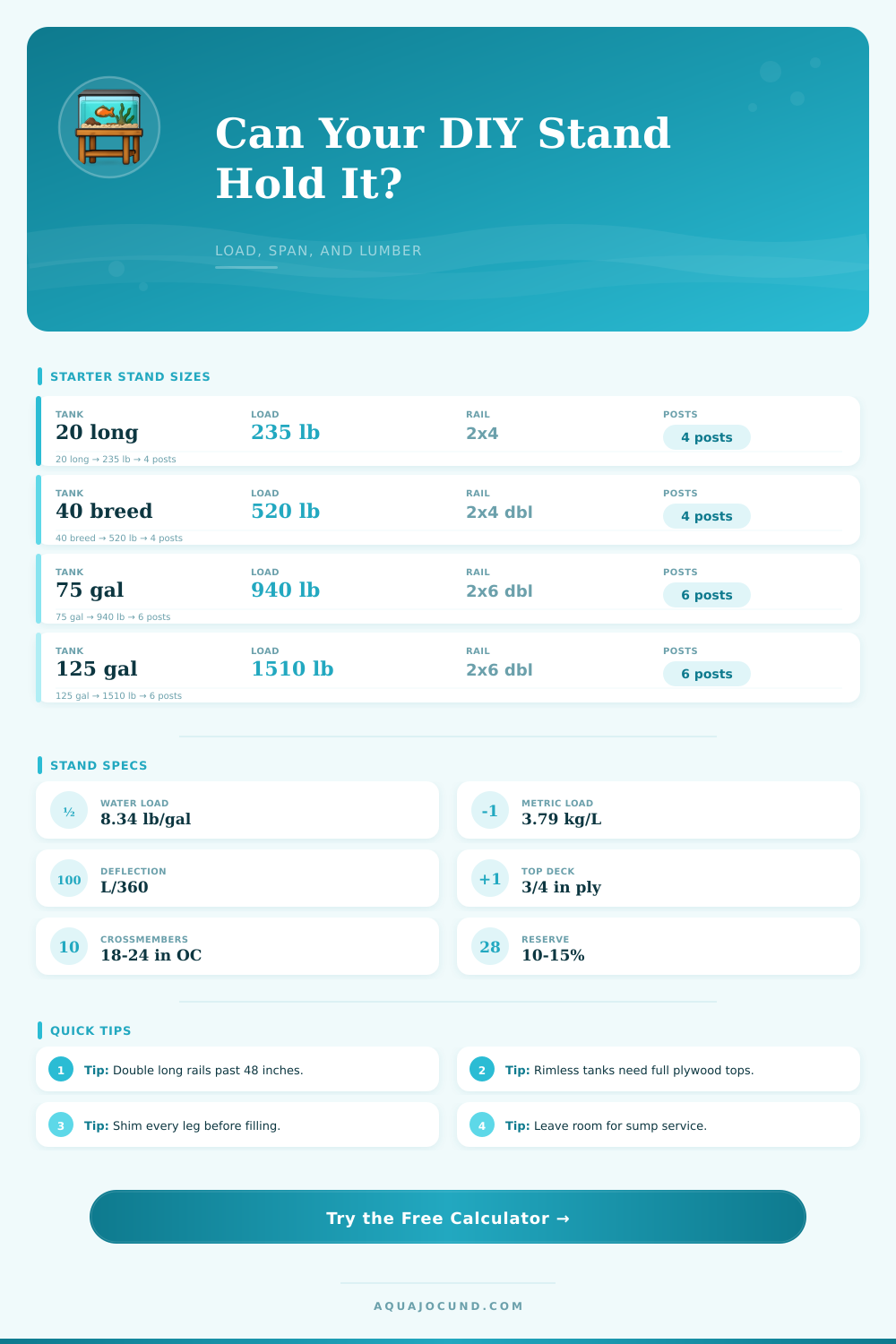
Estimate wet tank load, safe rail span, upright count, plywood top needs, and lumber quantities before you build a wood aquarium stand for a freshwater, reef, or rimless setup.
| Profile | Shell Load | Decor Load | Stand Note |
|---|---|---|---|
| Nano Freshwater | 1.1 lb/gal | 0.7 lb/gal | Light trim and modest hardscape |
| Community Freshwater | 1.3 lb/gal | 1.0 lb/gal | Typical glass tank with gravel |
| Heavily Planted | 1.4 lb/gal | 1.7 lb/gal | Deeper substrate and wood |
| Rocky Cichlid | 1.5 lb/gal | 2.2 lb/gal | Heavy stone layouts drive stand load |
| Mixed Reef | 1.7 lb/gal | 2.0 lb/gal | Rock, sump plumbing, and cabinet gear |
| SPS Heavy Rock | 1.8 lb/gal | 2.6 lb/gal | Dense aquascapes reward tighter spans |
| Acrylic Predator | 0.9 lb/gal | 1.0 lb/gal | Lighter tank shell but full top support |
| Paludarium / Turtle | 1.6 lb/gal | 2.4 lb/gal | Terraces and dry land weight add fast |
| Tank | Footprint | Wet Load | Starter Frame |
|---|---|---|---|
| 10 gal | 20 x 10 in | 110-140 lb | 2x4 frame |
| 20 long | 30 x 12 in | 220-280 lb | 2x4 frame |
| 40 breeder | 36 x 18 in | 480-620 lb | Double 2x4 |
| 55 gal | 48 x 13 in | 650-820 lb | Double 2x4 |
| 75 gal | 48 x 18 in | 880-1050 lb | Double 2x6 |
| 125 gal | 72 x 18 in | 1450-1650 lb | Double 2x6 |
| Member | Actual | Section Mod. | Best Use |
|---|---|---|---|
| 2x4 | 1.5 x 3.5 | 3.06 in3 | Small rimmed tanks |
| Double 2x4 | 3.0 x 3.5 | 6.13 in3 | 40 breeder to 55 gal |
| 2x6 | 1.5 x 5.5 | 7.56 in3 | Long spans with few posts |
| Double 2x6 | 3.0 x 5.5 | 15.13 in3 | 75 gal and larger |
| 2x8 | 1.5 x 7.25 | 13.14 in3 | Tall or heavy reef stands |
| 4x4 | 3.5 x 3.5 | 7.15 in3 | Short posts and stout corners |
| Support | Top Requirement | Front Rail Share | Builder Note |
|---|---|---|---|
| Rimmed Perimeter Frame | No full sheet required | 46% | Tank trim rides the rail grid, so a flat perimeter frame matters most. |
| Rimless Full Deck | 3/4 in plywood minimum | 38% | The deck spreads load, but rail sag still telegraphs into the glass seams. |
| Acrylic Foam Top | 3/4 in plywood plus foam | 35% | Acrylic wants uniform bearing and hates isolated high spots or twisted tops. |
| Eurobrace with Deck | 5/8 in plywood typical | 40% | Useful for braced glass systems where you still want a continuous cabinet top. |
| Peninsula Braced | 3/4 in plywood and back spine | 43% | Open sides change racking and access, so extra lateral stiffness helps. |
| Cabinet Skin + Shear Panels | 1/2 in skins and top deck | 37% | Skinned stands gain racking resistance, but rails and posts still carry gravity load. |
An aquarium stand has to be strong because the aquarium can hold a significant amount of weight. Aquariums contain water that weigh approximately eight pounds per gallon. Additionally, there is teh weight of the substrate, the rocks in the aquarium, and the livestock in the aquarium.
The stand has to be able to support this much weight. If it isnt strong enough, the stand will break, and a broken aquarium stand will result in a flood of water from the aquarium. The front rail is a long horizontal beam that spans the length of the aquarium.
How to Build a Strong Aquarium Stand
The front rail carry a significant portion of the weight of the aquarium. If a person use too few posts to support the front rail, the front rail will bow. However, if a person uses too many posts, they wont have access to the equipment that are in the aquarium stand.
The lumber that the builder uses for the aquarium stand have to be of a specific type. Spruce-pine-fir is the most common lumber for aquarium stand. However, spruce-pine-fir has modest strength.
For heavy reef aquariums, southern pine has more strength and will hold up better to the weight of the aquatic life. Deflection is a measurement of how much a beam bend under a load. For aquarium stands, deflection is important to minimize.
Aquatic stand seam should not stress, and stand doors should not become stuck in there open positions. The top deck should be of a type and thickness that can support the aquarium that will be used on the stand. If it is a rimmed aquarium, it can rest on a frame grid.
If it is a rimless aquarium, it will need a full sheet of plywood on top of the stand. The plywood must be at least three-quarters of an inch thick to ensure it will be able to bridge the crossmembers of the stand. Aquarium stands have to account for the extra weight that is place upon them.
In addition to the weight of the water and the living things in it, aquarium stands has to support the weight of the sump, the battery backup, and other accessories. The weight of this extra equipment can add as much as twenty percent to the total weight of the aquarium. To account for this extra weight, aquarium stands must include a reserve of ten to fifteen percent in the calculations of the weight of the aquarium.
Aquarium stands must use shims under their leg to ensure that they are level with the floor. Floors are rarely level, so using shims ensures that the stand will not develop a twist in relation to the floor. Aquarium stands have to use strong fasteners.
The builder uses structural screws instead of finish nails to ensure that there is more strength against shear force. Additionally, stand joinery must be strong enough to lock the rails of the stand together more effective than the nails used for the stand. Finally, the capacity of the floor where the stand will be placed must be taken into account.
For instance, if a builder is to place an aquarium stand in an upstairs apartment, the floor joist must be able to support the weight of the aquarium stand. Following these step and using the proper math will ensure that the aquarium stand that is built will be stable and the aquarium will remain safe.