Aquarium Dimensions Calculator
Estimate water volume, glass area, filled weight, and headroom from common aquarium shapes, then compare presets for fast planning.
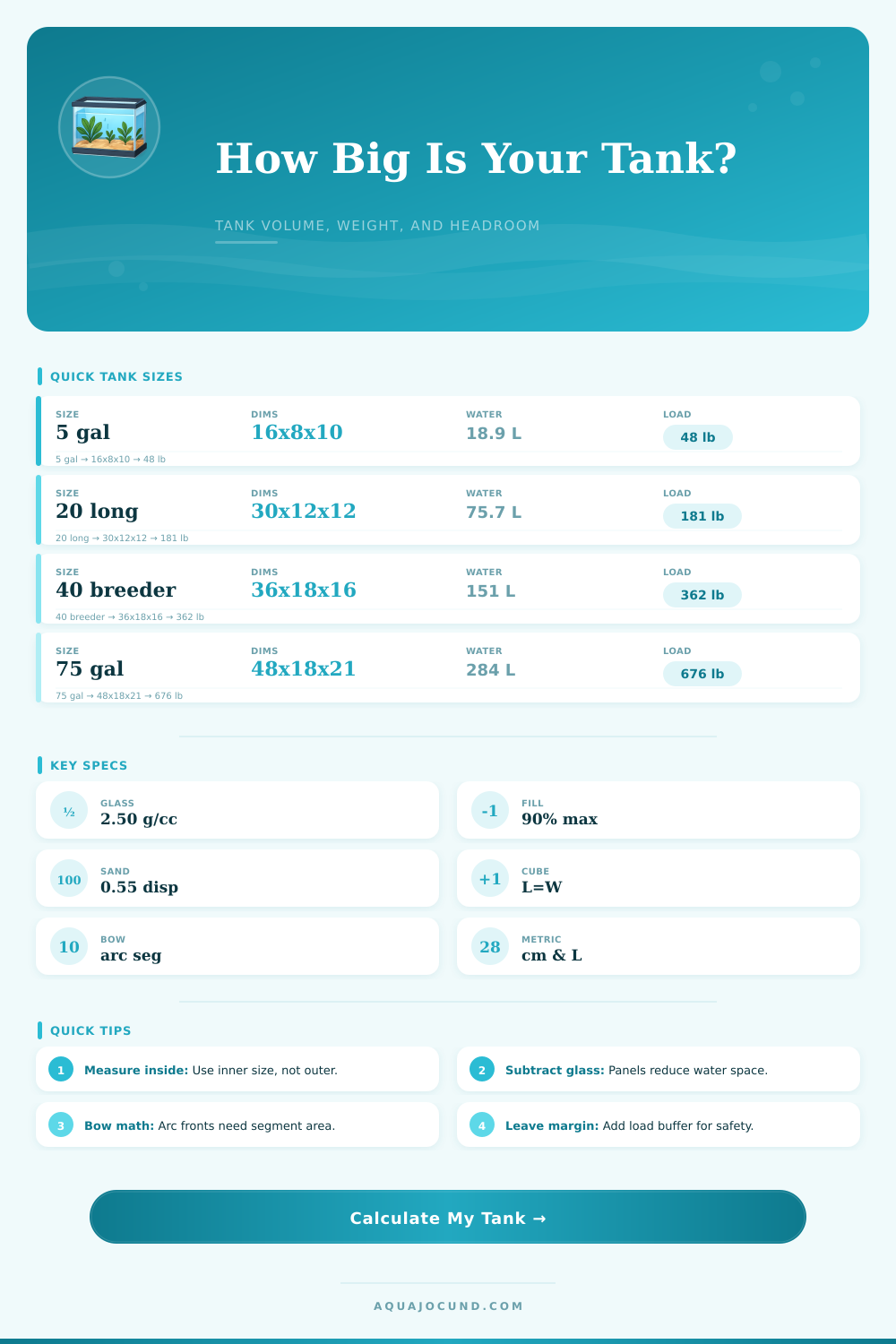
| Size | Outer Dimensions | Water | Load |
|---|---|---|---|
| 5 gal | 16 x 8 x 10 in | 18.9 L | 48 lb |
| 20 long | 30 x 12 x 12 in | 75.7 L | 181 lb |
| 40 breeder | 36 x 18 x 16 in | 151 L | 362 lb |
| 75 gal | 48 x 18 x 21 in | 284 L | 676 lb |
| Height | Typical Thickness | Inner Loss | Note |
|---|---|---|---|
| 12 in | 1/4 in | 0.5 in | Shallow build |
| 16 in | 3/8 in | 0.75 in | Mid height |
| 21 in | 3/8 in | 0.75 in | Common large tank |
| 30 in | 1/2 in | 1.0 in | High panel load |
| Shape | Footprint | Volume Rule | Use Case |
|---|---|---|---|
| Rectangle | L x W | Area x H | Standard tanks |
| Cube | S x S | S³ | Compact display |
| Cylinder | π r² | π r² x H | Round accent |
| Bow Front | Rect + seg | Area x H | Curved front |
| Type | Density | Disp. Factor | Best For |
|---|---|---|---|
| Bare | 0.00 | 0.00 | No bed |
| Fine sand | 1.55 | 0.58 | Soft floor |
| Gravel | 1.72 | 0.44 | Low plant load |
| Aquasoil | 0.90 | 0.62 | Planted tank |
When you plan to create an aquarium for your home, you must understand that the external dimension of the aquarium are not the same as the amount of water that will be contained within the aquarium. While you can measure the size of the aquarium by measuring the outside of the tank, you must also take into account the thickness of the aquarium glass. The thickness of the glass will reduce the amount of water that can be contained within the tank, so the volume of water in the aquarium will be less than that of the aquarium calculated from the external dimensions.
Thus, you must subtract the thickness of the aquarium glass from the external measurements of the aquarium to determine the true capacity of the aquarium. Another factor in determining the amount of water that will be contained within the aquarium is the amount of substrate that you will place within the tank. The substrate will contain some of the same space as water, so there will be less water within the aquarium than if there was no substrate.
How to Calculate Aquarium Water Volume and Weight
For instance, if you plan on adding sand or gravel to the bottom of the aquarium, there will be less space for the fish to swim in. Additionally, because each type of substrate have a different density, it will impact the number of gallons of water that will be within the aquarium. You must account for the volume of substrate that will be placed into the aquarium.
The fourth and last factor to consider when calculating the amount of water that will be within the aquarium is the shape of the aquarium. For instance, rectangular aquarium is the most common aquarium shape because it is easier to calculate the size of the aquarium, and it provides a more straightforward area for the fish to live in. Cube aquarium are often used for homes with small areas for aquariums.
However, the thick glass required for those aquariums can be an issue for the standing of the aquarium. Bow front aquarium have a curved front to the aquarium. Additionally, the curve to these aquariums increase the amount of water contained within the tank, but does not increase the length of the aquarium on the shelf.
Finally, cylindrical aquariums have a circular base. They are often used due to the way the water move through the aquarium, but can be more difficult for adding decorations within the aquarium. The type of material that you choose for your aquarium will impact both the weight of the aquarium as well as the way that the audience view the water within the aquarium.
For instance, you can make aquariums with glass or acrylic. The density of glass is higher than that of acrylic. Thus, the aquarium made out of acrylic will weigh less than the aquarium made of glass.
Because the aquarium made of acrylic is less heavy, it will reduce the amount of stress placed upon the aquarium stand. Additionally, the aquariums of either material can be of any thickness. The taller the aquarium, the more thicker the material must be.
If the aquarium is too thin, the water will exert a bowing force upon the glass, which poses a health risk for the inhabitants of the aquarium. One of the most critical factor to consider in the creation of an aquarium is the weight of the aquarium. The weight of the water alone is approximately eight pound per gallon.
Additionally, the weight of the substrate will be additional pounds to the total weight of the aquarium. Finally, any decorations within the aquarium will additionally add to the total weight. If you dont calculate the total weight of the aquarium, it is possible that the stand upon which you plan to place your aquarium will not be able to support the aquarium.
Thus, you must calculate the total weight. Additionally, it is common for individuals to leave a gap between the top of the water in the tank and the top of the aquarium. This gap is called freeboard.
An individual should utilize freeboard so that the water will not spill out of the aquarium. When calculating the total weight of the aquarium, you should of include a safety margin. A safety margin in this instance means that you must calculate a weight that is higher than the total weight that you plan to make the aquarium.
You need to account for the weight of the water, the substrate, and any decoration that you plan to add to the aquarium in the future. If you plan the aquarium without considering all of these factor, you will have an inaccurate understanding of the aquarium. Thus, you must measure the dimension of the aquarium, calculate the weight of each element, and make sure that you account for each element.