
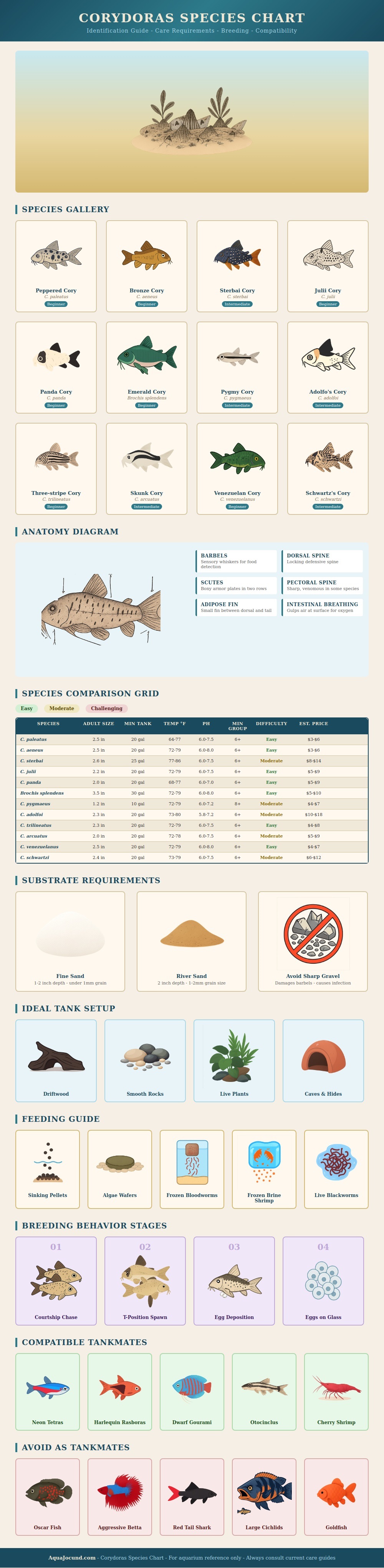
Corydoras is small fishs that live on the bottom of an aquarium. Corydoras are known for sifting through a sand in the aquarium to find food. Many people choose to keep corydoras in their aquarium due to the activity that they contribute to the bottom of the tanks.
Unfortunatly, many people experience difficulty in caring for these fish due to there improper selection of the species of Corydoras that they choose to keep. Within this article, a species chart will be presented that will allow readers to determine which species of corydoras will best suit the conditions of their existing aquarium. Corydoras fish species originate from the soft river of South America.
How to Care for Corydoras
In their native home, Corydoras eat both the insect larvae and the plant matter that is found within the fine sediments of these rivers. There are over 170 species of Corydoras, but aquarium owners most commonly keep a few dozen species due to the fact that some species are more hardy than others. Each species has its own physical appearance that can help to identify the type of Corydoras that is being kept in the aquarium.
For instance, three-stripe Corydoras have black stripes along their bodies, and panda Corydoras have patches near their eye that appear to be masks. Some species require cooler water temperature than others, thus it is important to identify the requirements regarding the water temperature prior to purchasing the fish. A species chart can contain the common and scientific names for each species of Corydoras, as well as the skill level required for care of those species.
The anatomy of a Corydoras includes features that is necessary for its survival. For instance, Corydoras have armor made of bony plates along their sides in the form of scutes. Additionally, Corydoras have spines located along their dorsal and pectoral fins that can lock in place in cases of threats to their lives.
Corydoras also have feelers, or barbels, that are used to find food within the substrate of the aquarium. It is important to ensure that the substrate is made of fine sand for these fish, as sharp gravel can damage the barbels of the Corydoras and lead to potential infection in those fish. Corydoras have a special intestine that allows them to breathe the oxygen from the water’s surface, as well as an adipose fin that aids in their ability to remain stable in their aquarium while they swim.
In order to care for Corydoras fish, it is important to create an environment within the aquarium that mimics their native home and the substrate upon which they live. You should provide fine sand substrates that are less than one millimeter in size for Corydoras; this will ensure that their barbels dont get injured while they search for food within the substrate. Gravel should be avoided due to the sharpness of some grain of gravel in contrast to sand.
Additionally, driftwood and rocks of smooth texture can be included in the aquarium as territories for the Corydoras to claim, as well as the inclusion of plants like anubias to provide shade for the fish. Corydoras are social fish. Thus, they should be kept in groups of at least six fish.
However, you should ensure the size of the aquarium to meet the requirements of the species of Corydoras that are to be kept. Since Corydoras are fish that live upon the substrate of the aquarium, it is important to feed them foods that will sink to the bottom of the aquarium. The Corydoras will not eat foods like flakes but other fish that may share the tank with the Corydoras can eat them.
Therefore, sinking foods like pellets or algae wafers should be provided. Frozen foods like bloodworms and brine shrimp can also be fed as an occasional treat but you should not overfeed to the Corydoras; overfeeding can lead to excess waste in the water but underfeeding can cause the Corydoras to begin to nibble upon the plants in the aquarium. In addition to ensuring that the aquarium and its environment meet the requirements for Corydoras, it is also important to ensure that the other inhabitant of the same aquarium are compatible with the Corydoras.
The other fish that are kept in the aquarium should also be peaceful in their behaviors and fish that swim in the middle of the aquarium. Therefore, fish like neon tetras and harlequin rasboras is compatible with Corydoras. Additionally, otos and cherry shrimp can also be kept in the same aquarium with Corydoras since they performs some of the same duty within the aquarium.
However, aggressive species of fish should not be kept in the same aquarium as Corydoras since those aggressive species may bully the Corydoras. Furthermore, the types of large cichlids and red-tail sharks should be avoided with Corydoras since they may eat the Corydoras or chase after them in the aquarium. Finally, another species that should not be kept in the same aquarium as Corydoras are goldfish since they require different water temperature than Corydoras and produce a large amount of waste in their tanks.
