💨 Pond Aeration Calculator
Calculate CFM, horsepower, and diffuser requirements based on pond size, fish load, depth, and temperature
| Pond Size | Avg Depth | Acre-Feet | Base CFM |
|---|---|---|---|
| 500 gal Garden Pond | 3 ft | 0.0015 | 0.5–1.0 |
| 3,000 gal Koi Pond | 4 ft | 0.009 | 1.0–2.0 |
| 1/4 Acre Farm Pond | 6 ft | 1.5 | 1.5–3.0 |
| 1/2 Acre Pond | 8 ft | 4.0 | 4.0–8.0 |
| 1 Acre Fish Pond | 8 ft | 8.0 | 8.0–15.0 |
| 2 Acre Catfish Pond | 6 ft | 12.0 | 12.0–30.0 |
| 5 Acre Lake | 10 ft | 50.0 | 50.0–100.0 |
| Stocking Density | lbs/Acre | CFM Multiplier | Typical Species |
|---|---|---|---|
| None | 0 | 0.5× | Decorative, wildlife |
| Low | <500 | 1.0× | Bass, bluegill |
| Moderate | 500–1,500 | 1.5× | Mixed sport fish, koi |
| Heavy | 1,500–3,000 | 2.5× | Catfish, tilapia |
| Very Heavy | >3,000 | 3.5× | Commercial aquaculture |
| Season | Temp Range | Aeration Factor | Notes |
|---|---|---|---|
| Winter | <50°F | 0.4–0.6× | Keep hole open for gas exchange |
| Spring | 50–65°F | 0.7–0.9× | Watch for turnover events |
| Summer | 75–90°F | 1.3–2.0× | Peak oxygen demand, run 24/7 |
| Fall | 55–70°F | 0.8–1.0× | Monitor during fall turnover |
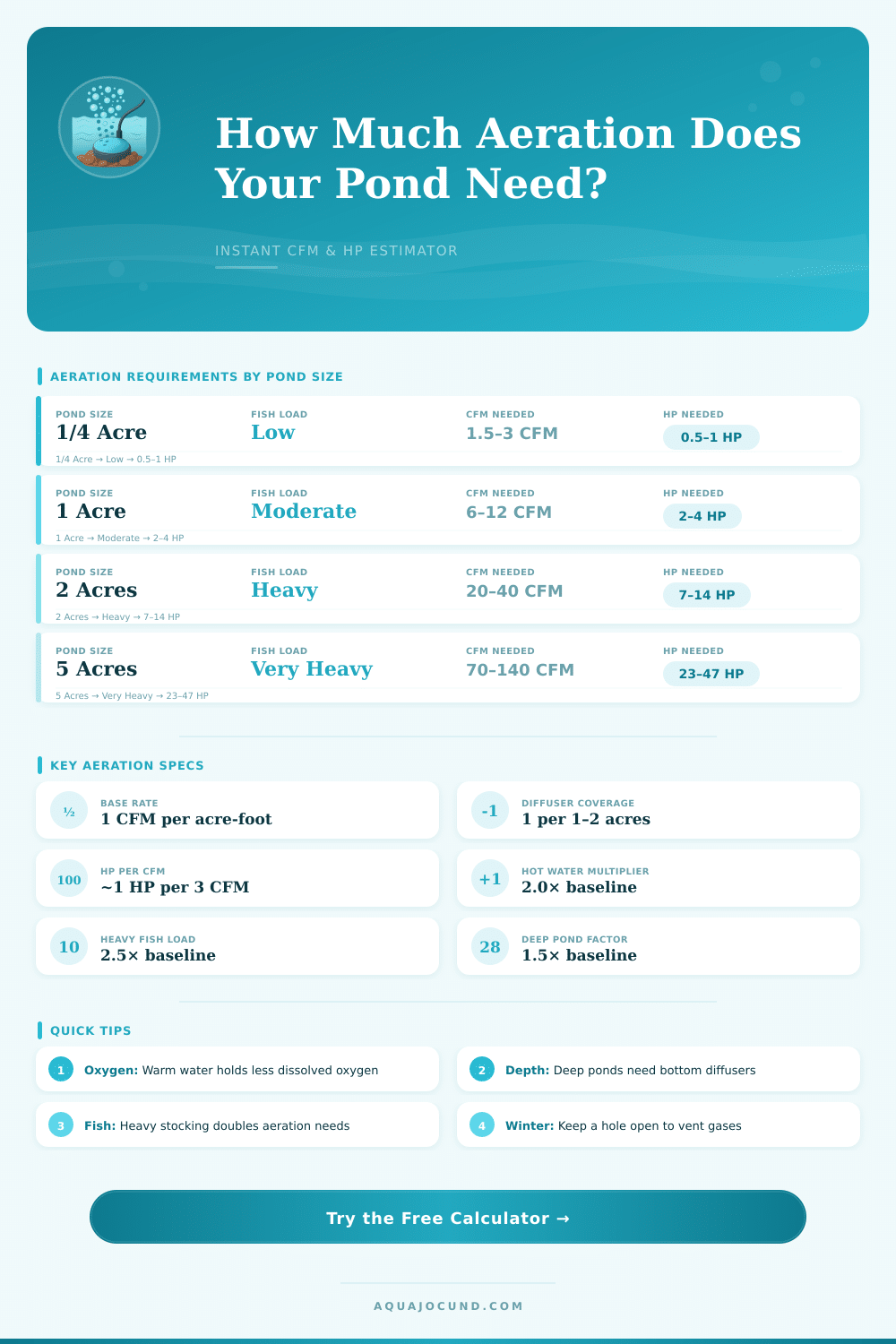
| Pond Acres | Min CFM | Min HP | Diffusers |
|---|---|---|---|
| 0.1–0.25 | 1–3 | 0.25–1 | 1 |
| 0.25–0.5 | 2–5 | 1–2 | 1 |
| 0.5–1.0 | 4–12 | 1.5–4 | 1–2 |
| 1.0–2.0 | 8–25 | 3–8 | 2–3 |
| 2.0–5.0 | 20–70 | 7–24 | 3–5 |
| 5.0–10.0 | 50–150 | 17–50 | 5–10 |
For keep Pond healthy everything depends on two basic elements: moving the water and making sure that it carries enough dissolved oxygen. Both parts matter a lot, especially if you have fish in your Pond. Pond without proper Aeration soon becomes a problem.
Still water becomes an ideal place for mosquito larvae, allows muck to build up on the bottom and gives algae species perfect conditions for spreading.
Keep Your Pond Healthy: Move Water and Add Oxygen
Every process in Pond requires oxygen to happen. Fish clearly require dissolved oxygen to live, but so do the bacteria that work in the water. Those tiny organisms indeed take on themselves the main work; they break down all organic material floating around.
Without enough oxygen, slime and muck simply build up. Aeration helps to keep everything aerobic, so oxygen-rich and well working.
There are two main kinds of Aeration: subsurface (sometimes called bottom-up or diffused) and surface. Surface aerators stir the water up, at the surface, thus letting oxygen from the air mingle naturally. They circulate well, but cannot reach deep enough to oxygenate the lower layers.
Subsurface Aeration works differently, a shore compressor pumps strong air down to a diffuser, that sits directly on the bottom of the Pond. The deeper the Pond, the more well this method works. Even so, for subsurface Aeration to bee efficient, you need at least three feet of depth.
Most folks lay the diffuser in the deepest available place. Pumping air over there gives more time for contact between water and air, to exchange oxygen. But here is the problem…
If you lay it too deeply, you can unlock nutrients from the bottom muck, and suddenly they mingle through the whole Pond, making everything look murky and dirty.
Continuous Aeration around the clock really makes the difference. Nothing beats 24/7 running, if you truly care about good results. Starting Aeration in spring after the winter needs attention, because too fast a boost can shock and even kill fish.
If fish are in the Pond, introduce the Aeration step by step.
Plants offer ways to aerate without cost. Local lotus, water lilies, arrowhead and other water grasses naturally clean the Pond, while they create habitat for fish, that no device can copy.
Waterfalls help also at the surface. Air pumps with diffusers usually oxygenate the water better than only water pumps, because they blow bubbles directly in it. Little bubbles transfer oxygen more quickly, although average diffusers are enough for most garden ponds.
Too much Aeration past saturation only wastes energy through warming and evaporation. There are various models: diffused, surface, solar andwindmill, for ponds of up to nine acres and bigger.