
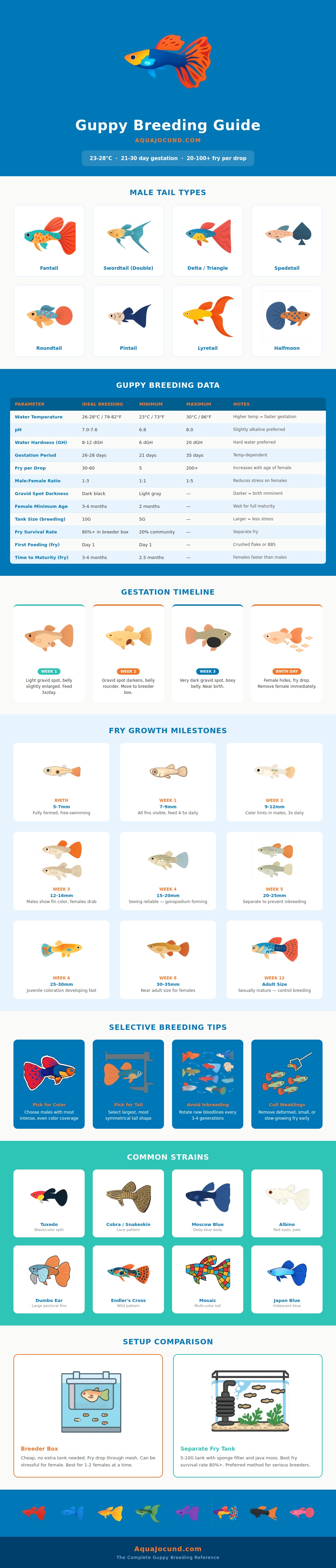
Guppy breeding require careful planning. Guppies are a species of livebearing fish that will have numerous offspring in short period. Guppies are prolific breeder and can lead to a major overpopulation of the aquarium if not managed proper.
Therefore, to manage breeding in guppies, it is essential to understand the physical feature that indicate pregnancy in the female guppy and the environmental requirement that support breeding in guppies. Signs of pregnancy in the female guppy include change in her physical appearance. The first indication of pregnancy is that the female’s belly begins to round out.
How to Breed and Care for Guppies
Further, a dark spot will appear on the female guppys abdomen, known as a gravid spot. As the female guppy reach the point of being almost fully pregnant, the gravid spot will deepen in color, signaling that the female guppy is about to give birth. When the spot is very dark and the female’s abdomen is almost square, the female guppy is ready for give birth.
As with most species of fish, they mother will eat guppy fry when they are born, so you should move the pregnant female to a breeder box or fry tank prior to her give birth. Water condition play a significant role in the breeding of guppies. For instance, higher water temperature will shorten the gestation period for the female guppy.
Conversely, lower temperature will stall the development of the fry. Guppies require water that is hard with a neutral pH level. Additionally, you must maintain a specific ratio of male to females in the breeding tank.
A ratio of one male to three female has been proven to work effective in breeding programs. This ratio minimize the harassment of the females by the males while ensuring that each female is fertilized. To raise the guppy fry successfuly, specific care are required.
Guppy fry are fully formed when born into the world. As such, the fry need to be feed after they are born. Crushed flake food or baby brine shrimp will be required to feed the fry.
Additionally, to increase the survival of the fry, you should isolate them in their own tank. This fry tank will require a sponge filter to clean the water and live plant like Java moss to provide the fry with cover and food to eat. By selectively breeding guppies, you can improve the quality of the fish.
Selective breeding allow individuals to choose specific trait from the guppy to breed into the next generation of guppies. For instance, individuals can select a fantail male to produce fry with fuller body. To avoid deformities in the guppy population, individuals must rotate the bloodline of the guppies every few generations.
If individuals do not rotate the bloodlines of the guppies, the deformities will manifest in the guppy population. Additionally, you must monitor the growth of the guppy fry, and you must separate the males from the females once the fry reach one month of age to avoid inbreeding between the two gender of guppies. To breed guppies successfuly, the breeding tank must have the appropriate equipment.
The hanging breeder box will save space in the aquarium and allow the fry to drop through the mesh into the tank. However, a dedicated fry tank is better for the fry then a breeder tank. A dedicated fry tank allow for less stress for the fry when there are multiple fry in the tank.
Additionally, ten gallon of water is the minimum tank size for a group of guppies, but as the population of guppies increase, the tank size has to be enlarged accordingly. Overcrowding the tank can cause several problem for the guppies, so ensuring that the tank is the appropriate size for the number of guppies in the tank is essential.
