🐚 Aquarium Live Sand Calculator
Calculate the exact amount of live sand your saltwater or reef tank needs by weight and volume
| Sand Type | Density (g/cm³) | Grain Size | Best For |
|---|---|---|---|
| Fiji Pink | 1.45 | 0.5–1.5 mm | Reef tanks, soft corals |
| Bahamas Oolite | 1.50 | 0.25–1 mm | SPS reefs, wrasses |
| Special Grade Reef | 1.48 | 1–2 mm | Mixed reef, high flow |
| Hawaiian Black | 1.55 | 0.5–2 mm | Dramatic reef display |
| Arag-Alive Reef | 1.42 | 0.5–1.5 mm | Quick cycle, nano reefs |
| Sugar-Fine Oolite | 1.52 | 0.1–0.5 mm | Jawfish, gobies, DSB |
| Bio-Activ Live Aragonite | 1.46 | 0.5–1.7 mm | Biological filtration |
| Ocean Direct | 1.44 | 0.25–6.5 mm | Natural diversity, FOWLR |
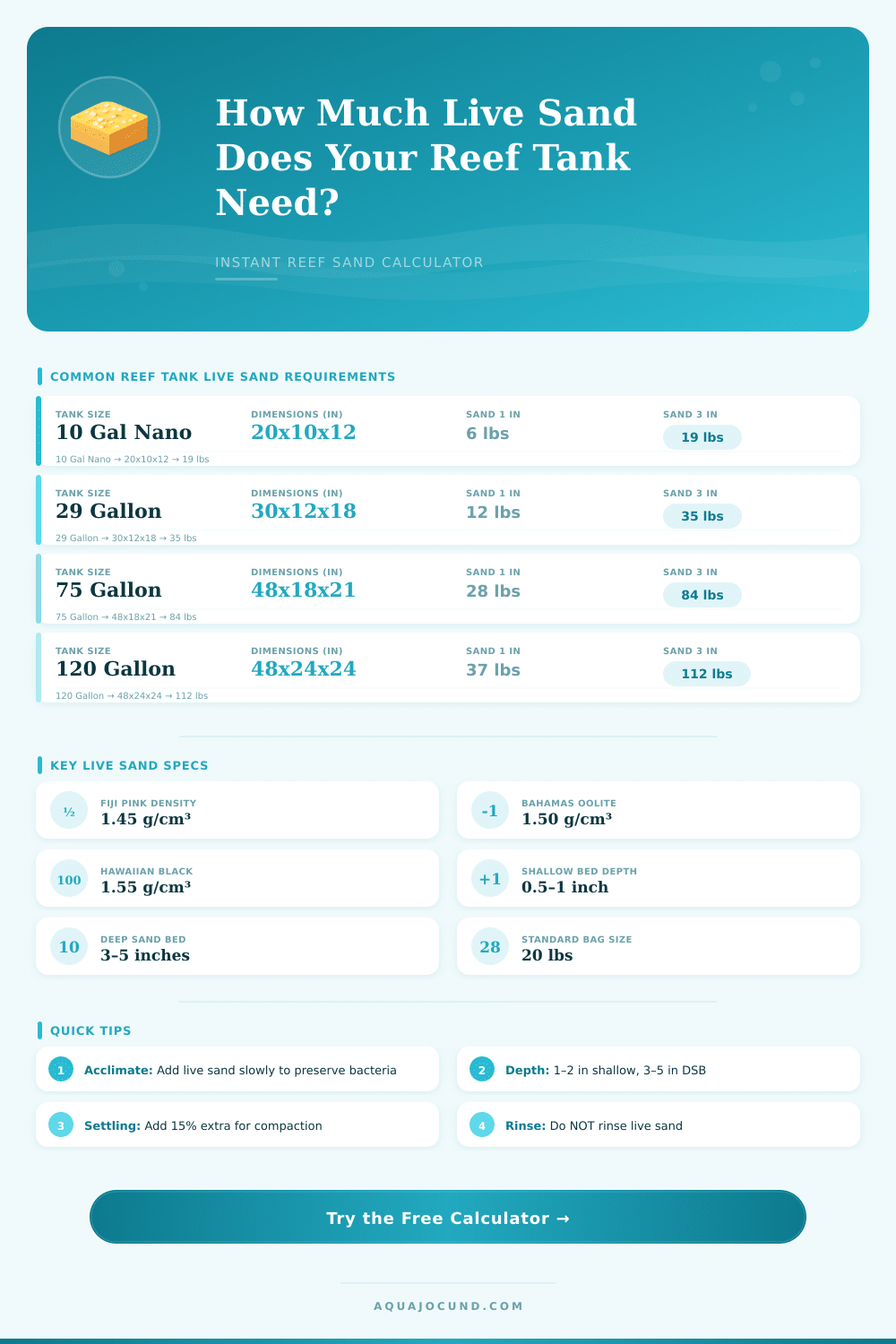
| Tank | Dimensions (L×W×H in) | Volume | Live Sand at 2 in Depth |
|---|---|---|---|
| 10 Gal Nano | 20 × 10 × 12 | 10 gal / 38 L | 13 lbs (5.8 kg) |
| 20 Long | 30 × 12 × 12 | 20 gal / 76 L | 23 lbs (10.6 kg) |
| 29 Biocube | 30 × 12 × 18 | 29 gal / 110 L | 23 lbs (10.6 kg) |
| 40 Breeder | 36 × 18 × 16 | 40 gal / 151 L | 42 lbs (19.0 kg) |
| 55 Gallon | 48 × 13 × 21 | 55 gal / 208 L | 40 lbs (18.3 kg) |
| 75 Gallon | 48 × 18 × 21 | 75 gal / 284 L | 56 lbs (25.3 kg) |
| 90 Gallon | 48 × 18 × 24 | 90 gal / 341 L | 56 lbs (25.3 kg) |
| 120 Gallon | 48 × 24 × 24 | 120 gal / 454 L | 74 lbs (33.7 kg) |
| 180 Gallon | 72 × 24 × 24 | 180 gal / 681 L | 112 lbs (50.6 kg) |
| Bed Type | Depth (in) | Depth (cm) | Purpose |
|---|---|---|---|
| Shallow Bed | 0.5 – 1 | 1.3 – 2.5 | Aesthetic only, easy maintenance |
| Standard Bed | 1 – 2 | 2.5 – 5.1 | General reef, moderate filtration |
| Deep Sand Bed (DSB) | 3 – 5 | 7.6 – 12.7 | Anaerobic denitrification zone |
| Plenum System | 4 – 6 | 10.2 – 15.2 | Jaubert method, nutrient export |
| Bare Bottom | 0 | 0 | SPS dominant, easy detritus removal |
| Remote DSB | 4 – 6 | 10.2 – 15.2 | Placed in sump or refugium |
Live Sand is made up of natural sea sand that is full of useful bacteria and tiny organisms. It matters for creating and keeping healthy biological filters in saltwater and reef Aquarium setups. The sand comes packed in water, that keeps all those bacteria alive during the transfer.
In that sand live mainly helpful bacteria. They work as the main workers that break down the dangerous ammonia from the water and start the nitrogen cycle. Most Live Sand either comes straight from the ocean, or one enriches it with wild sand to form strong groups of bacteria.
Live Sand for Saltwater Aquariums
Some stores grow their sand in facilities that have been running for 15 years or even more, so the sand is already rich in bacteria and other tiny creatures.
Here is the main point: folks often choose Live Sand because it starts the nitrogen cycle from the first day. Starting with Live Sand means that the first phases of the cycle go much more quickly than with regular dry sands. What about dry Aquarium sand?
It is totally sterile right out of the bag. In it there are no useful bacteria, so it simply sits there without any activity, until biological life builds up on its own over weeks or months. On the otehr hand, Live Sand starts to work the moment it enters your Aquarium.
Some producers developed separate methods to preserve it. One brand claims too have almost a hundred times more useful bacteria than competing methods, with every grain covered in germs. Another product was born from work with big public Aquarium setups and zoos, trying to copy what one finds in the natural world.
Besides the bacteria, Live Sand helps also in other important ways. It supports the stability of the pH in your Aquarium and acts as a buffer for calcium and magnesium. The grains of good quality range from small to medium, and you will not find broken shells or random junk, as often happens with bagged sands.
As for looks, it gives nice decor for reef Aquarium setups, that really catches the eye.
If you put Live Sand in a fully running Aquarium, prepare for a bit of cloudiness. Use a hang-on filter with polishing pads to remove the slime from the water pretty well. It usually lasts two or three days, until the water clears, though you might use four to seven pads before they no longer fill upwith fine particles.
Live Sand is only used in saltwater Aquarium setups. If you put reef sand in a freshwater system, you risk ammonia and nitrite spikes, those bacteria simply cannot live in fresh water. Also, the crushed shells and coral bits can raise your GH and KH levels.
In saltwater Aquarium setups gravel is a really bad idea, because it traps junk and becomes a focus for cleaning. Sand based on aragonite works much better, and helpful crews of snails and hermit crabs take care of everything without your help. Using Live Sand in new Aquarium setups helps to build the microbiome, and Live Sand ranks among the cheapest starting points, right along with bottled bacteria cultures.