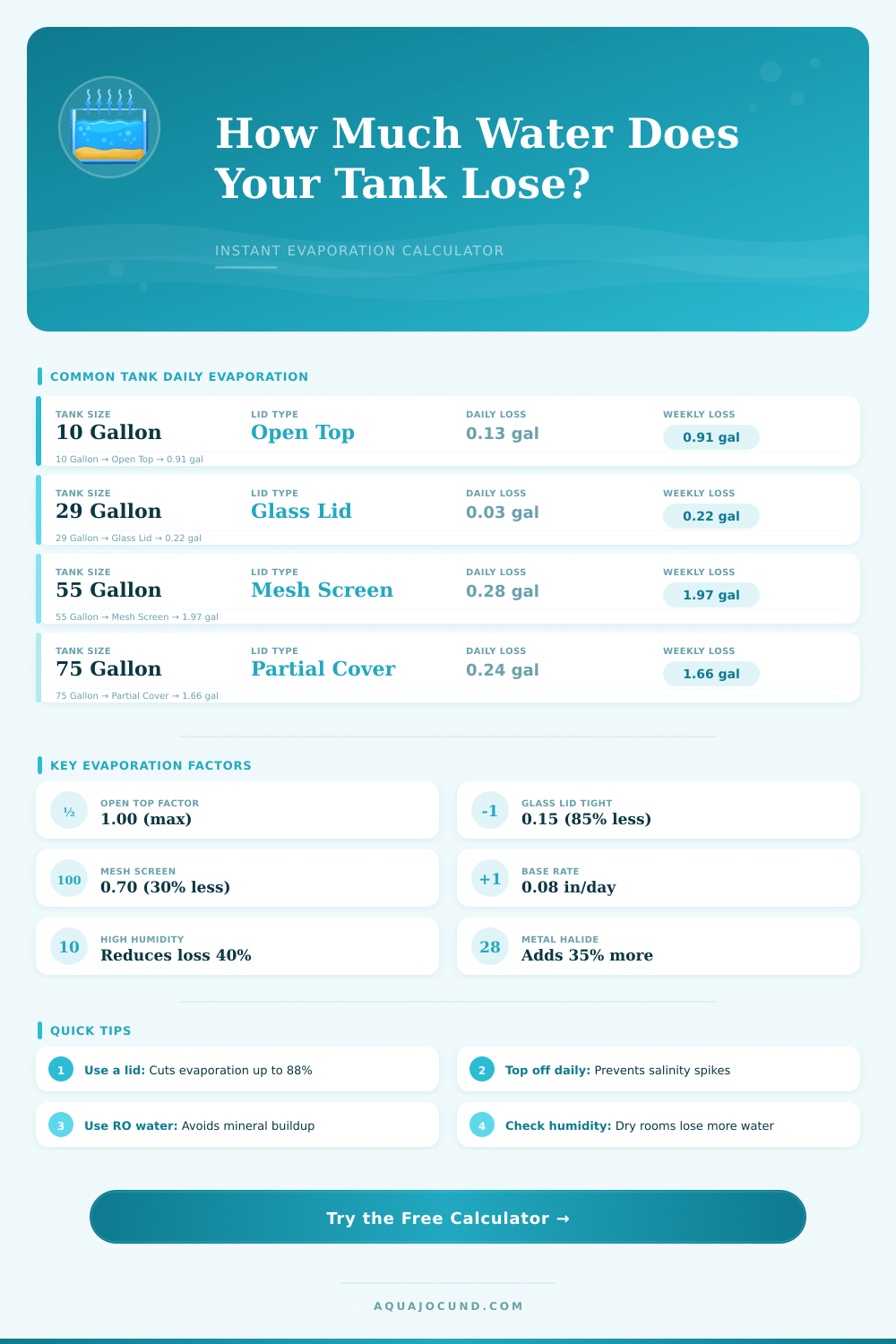
💧 Aquarium Evaporation Calculator
Estimate how much water your fish tank loses to evaporation based on size, lid, temperature, and humidity
| Lid Type | Factor | Evap Reduction | Best For |
|---|---|---|---|
| Open Top (no lid) | 1.00 | 0% reduction | Rimless aquascapes, emergent plants |
| Glass Lid (tight) | 0.15 | 85% reduction | Most freshwater setups |
| Glass Lid (loose) | 0.35 | 65% reduction | Tanks needing airflow with coverage |
| Mesh Screen | 0.70 | 30% reduction | Jumping fish, some airflow needed |
| Partial Cover (50%) | 0.50 | 50% reduction | HOB filter tanks, partial access |
| Acrylic Lid | 0.12 | 88% reduction | Reef tanks, high humidity retention |
| Tank Size | Open Top (gal/day) | Glass Lid (gal/day) | Mesh Screen (gal/day) |
|---|---|---|---|
| 5 Gallon (16×8) | 0.07 | 0.01 | 0.05 |
| 10 Gallon (20×10) | 0.14 | 0.02 | 0.10 |
| 20 Long (30×12) | 0.25 | 0.04 | 0.17 |
| 29 Gallon (30×12) | 0.25 | 0.04 | 0.17 |
| 40 Breeder (36×18) | 0.45 | 0.07 | 0.31 |
| 55 Gallon (48×13) | 0.43 | 0.06 | 0.30 |
| 75 Gallon (48×18) | 0.60 | 0.09 | 0.42 |
| 125 Gallon (72×18) | 0.90 | 0.13 | 0.63 |
| Season | Typical Humidity | Evap Rate Change | Recommended Action |
|---|---|---|---|
| Winter (heated home) | 15–30% (Low) | +30–50% increase | Top off more frequently, use a lid |
| Spring | 40–55% (Moderate) | Baseline rate | Standard top-off schedule |
| Summer | 50–70% (Average–High) | −10–20% decrease | Monitor temp, may need fan cooling |
| Autumn | 35–50% (Moderate) | Baseline rate | Prepare for winter increase |
In every Aquarium happens Evaporation of water. That is a process where the liquid water turns to steam. A similar cause shows at oceans, lakes and rivers, that lost water to the atmosphere.
Even so rain turns water to those natural places, while in an Aquarium it never returns.
Why Aquarium Water Evaporates and How to Reduce It
Without a cover, open Aquariums lose only little water. The amount of loss depends on the surrounding conditions beside the tank. If the temperature of air and water a lot differs, that can boost the speed of Evaporation.
The warmth most strongly affects it, so colder surroundings reduce the water loss. Aquariums at higher degrees, for instance 80 until 84 according to Fahrenheit, lose water more quickly. Goldfish like colder water, what naturally reduces Evaporation compared with tropical tanks.
The simplest way to slow Evaporation is to lay a cover on the Aquarium. Without it, tanks lose water much more quickly. For instance, one Aquarium without a cover lost around 2 cm of water during one week, but with a cover the loss was much more slow.
Also covered Aquariums still a bit lose water. If one leaves an opening in the cover for more light, Evaporation can noticeably speed up.
Also the movement of water matters. Movement above the surface expands it, what allows faster Evaporation. Air stones and pumps, that move the water in the tank, cause bigger loss.
Reducing the flow and surface activity really helps against Evaporation. A filter, that sheds water as a fall, adds oxygen and adds humidity too the air. For Evaporation no heat is needed, because only movement already helps.
Seasons also affect the cause. The dryness of winter can cause higher speed of Evaporation. In summer one could use dehumidifiers to keep the humidity around 60 percent, but in winter it commonly mounts.
Warm weather rushes the loss, and the rate changes according to seasons. Common air can lower the humidity, but at the same time boost Evaporation.
Here is the difficult part. During Evaporation, only the pure water goes. Salts, minerals and other dissolved things stay in the tank.
Because of that, the focus of everything in it grows when the level sinks. It is harmful for fish, that need stable surroundings. Better to add distilled or cleaned water from the tap.
Regular water from the tap adds extra minerals, what makes the focus even higher. Top-off water should not be remineralized, because that would do theopposite of what is needed.
Floating plants can reduce Evaporation by covering the surface, almost like a lid. Avoid sunshine directly and use light made for Aquariums, that gives less heat, also helps to control the situation.