
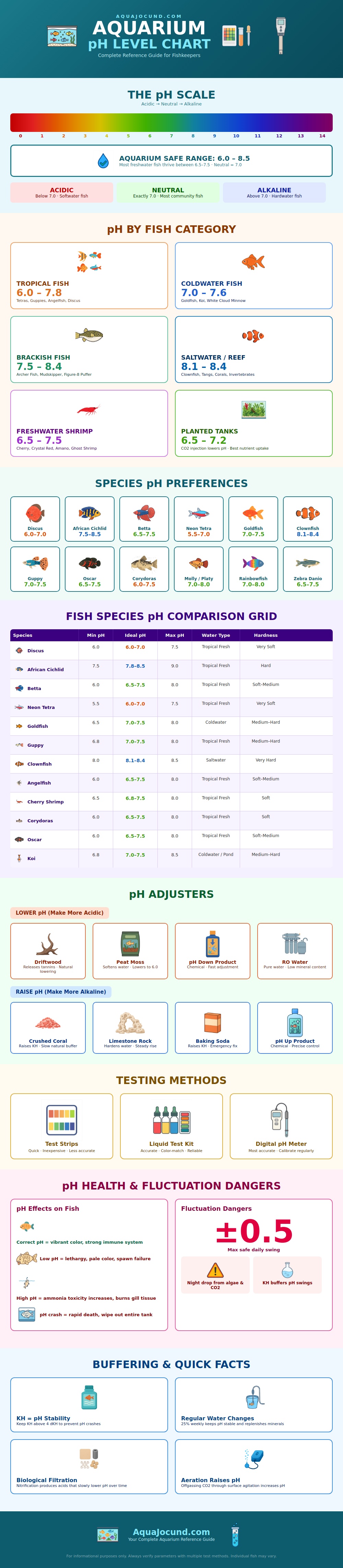
The pH of water measure how acidic or alkaline the water is. The pH is measured on a scale from 0 to 14. A pH level of 7 is consider to be neutral as it contains neither acidic nor alkaline properties.
If the pH level is less than 7, the water is said to be acidic. Species that is native to soft water environment prefer acidic water. If the pH level is above 7, the water is alkaline and preferred by species native to hard water environments.
Aquarium pH and Fish Health
Aquarium setup usually have a pH between 6 and 8.5. However, community aquariums needs a pH level between 6.5 and 7.5. If the pH level is 7 (neutral), most freshwater fish can eat and thrive.
In order to maintain the health of the fish, it is important to ensure that the pH level in the aquarium matches the species of fish that are living within the aquarium. For instance, tropical fish prefer slightly acidic water with a range between 6 and 7.8, as these fish are native to slightly acidic environment. Coldwater fish, such as goldfish, prefer a neutral pH range as they are native to ponds with a neutral pH.
Fish that live in brackish water, such as puffers and archers, need a pH between 7.5 and 8.4. Saltwater reef tanks require a pH between 8.1 and 8.4 as the fish in these tanks, such as corals and clownfish, require higher pH levels to build their calcium skeleton. Lastly, shrimp and planted tanks have specific pH requirement.
Cherry shrimp need a pH between 6.5 and 7.5 while planted tanks using CO2 require a pH between 6.5 and 7.2. If the incorrect pH range is used for the aquarium, the fish may display faded color or fail to spawn. Discus have unique pH requirement as do most other species of fish.
Discus fish require water that is soft and acidic with a pH level as low as 6. If the pH level is not maintained at this level, then the discus fish will become unhealthily. African cichlid species require alkaline water with a pH between 7.5 and 8.5.
These fish require the minerals that is naturally present in hard water. Neon tetras require soft and acidic water, similar to the requirements of discus fish. Goldfish and guppies do best in water with a neutral pH level, making these two type of fish suitable for beginners to set up and maintain there aquarium.
Lastly, clownfish require high pH level in there tank as they live in saltwater environment. You can use a comparison grid to determine the minimum, ideal and maximum pH levels for each species of fish. Additionally, a comparison grid can help to show which species of fish can live in the same tank as other species of fish within the community aquarium.
For example, mollies and platies can live in water with a pH of 8, but they may not be compatible with tetras if the pH level is too high for the tetras. Testing the pH levels of the water in the aquarium regularly will allow you to ensure that the pH remains stable. You can use test strips to test the pH levels of the aquarium water.
However, the test strips are not precise in there measurement of the pH. Liquid test kits are more reliable in matching the color to the precise pH level of the water, but digital meter provide the highest level of precision when measuring the water pH levels in the aquarium. However, digital meters require regular calibration.
Testing the pH of the water weekly will allow you to ensure that the pH levels is within the ideal range for your species of fish. Additionally, testing the pH after performing a water change will help to maintain the stable pH in your aquarium. If the pH levels are not within the correct range for the fish in your aquarium, the fish may go into shock.
If the pH level is too low, the fish may experience lethargic. Additionally, if the pH level is too high the toxicity of the ammonia in the aquarium may increase. If the pH is maintained in the proper range, the fish will display vibrant colors and be healthy.
The pH levels of the water in the aquarium can be adjusted. However, it is better for the fish in the tank if you focus upon maintaining the correct pH level rather than attempting to adjust it to a perfect number. To lower the pH of the water in the aquarium, you can add driftwood to the tank.
Additionally, you can also add peat to the aquarium to lower the pH of the water. Lastly, chemical product can also be used to lower the pH of the water. If you wish to raise the pH of the water in your aquarium, you can add crushed coral or limestone to the tank.
Additionally, you can add baking soda to the aquarium to raise the pH of the water during emergencies. Carbonate hardness or KH is one of the most important factor in maintaining proper aquarium water. The KH level should always be above 4 dKH to ensure that the pH of the water does not swing when caused by CO2 or nitrifying bacteria.
You should perform aquarium water changes each week at a rate of 25% of the water in the tank. Lastly, you can also use aeration as a means of increasing the pH levels of the aquarium water by removing CO2 from the water. Many crashes in aquariums are the result of KH being too low or the water being too soft.
If you perform a large water change with tap water, this can also be an issue as well. Before you begin to fine tune the pH of your water, you should always build a buffer in the water. If you use biological filter, the pH of the tank can become more acidic over time.
It is important to monitor the pH of the tank very closely. While fish are able to adapt to changes in pH, they are not able to adapt to drastic change in the pH of there water. You should of checked the levels more often.
Many people dont realize how fast it can change.
