Fish Length to Weight Calculator
Estimate fish weight from length, girth, species, and body shape. Compare the result in grams, ounces, pounds, or kilograms with a breakdown you can audit.
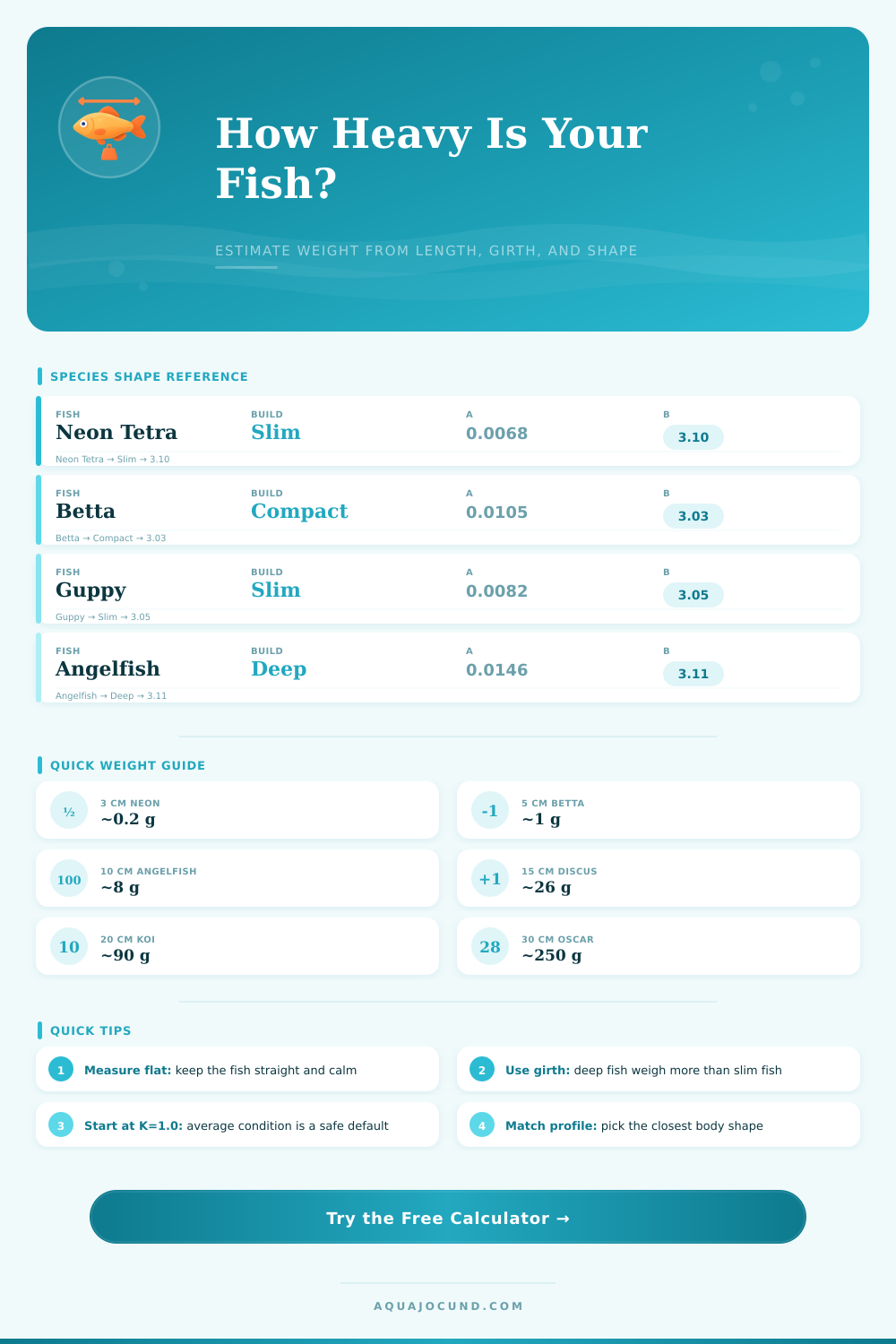
| Species | Profile | a | b | Girth |
|---|
| Profile | Typical Fish | a Mul | b Add | Girth |
|---|
| Type | What It Means | Factor | Best For |
|---|
| Length | Slim | Streamlined | Round |
|---|
Fish weights can be estimated by using a length to weight calculation. A length to weight calculation will allows you to estimate the mass of a fish if a scale are not available to you. A length to weight calculation is helpful for several reason.
First, you can use it to track the growth of a fish. Additionally, a length to weight calculation will allow you to plan the amount of foods that you must provide to the fish. You can use the length to weight calculation to prepare for fish shows.
How to estimate fish weight from length and girth
However, you must know that the weight of a fish depend on more than just the length of the fish. A person can determine the weight of a fish by using the length of the fish and the shape of the fish. The shape of the fish will have an impact on the weight of the fish because a long and slender fish will weigh less than a short and wide fish.
For instance, discus fish has a round body that contains more mass than tetra fish, which have a slim body shapes. You can increase the accuracy of the length to weight calculation by using the girth of the fish. The girth of the fish will tell you the mass of the fish in the belly area of the fish.
To estimate the weight of the fish, you must first identify the species of the fish. The species of the fish will determine the mathematical curve that you will use for the length to weight calculation. Additionally, you must determine the body profile of the fish so that you can calculate the correct mathematical coefficient for the weight of the fish.
Additionally, you must decide whether you will measure the length of the fish from nose to tail or the length of a specific part of the fish. You can also use the girth of the fish to improve the accuracy of the length to weight calculation. Additionally, if you are trying to estimate the weight of a group of fish, you can count the total number of fish.
Finally, you can use a K factor to adjust the weight of the fish. If the fish are lean, the K factor will be lower for the weight of the fish. However, if the fish have more mass due to having a full stomach, the K factor will be more higher.
To measure the length of the fish accurately, you must measure the length of the fish while the fish is flat and calm. If the body of the fish is curved or the tail is moving, the length measurement will not be accurate. Additionally, wet the ruler that you will use to measure the length of the fish so that it is easy to use with the fish.
Additionally, straighten the fish so that it is as straight as possible. Note the widest part of the girth of the fish behind the fishs gills. However, you can skip measuring the girth of the fish if you are in a hurry to measure the length of the fish.
The results of the length to weight calculation will show the weight of each individual fish in the group and the total weight of all the fish in the group. Additionally, note the life stage of the fish. For example, note whether the fish in the group is comprised of juvenile fish only or adult fish only.
Additionally, include the formula that you used to calculate the weight of the fish. Create a table that compares the different body profiles of the fish in the group. By comparing the body profiles of the fish, you can see how the shape of the fish impact the weight of the fish.
Lastly, remember that the length to weight calculation is merely an estimation of the weight of each fish. For example, if the fish has a full stomach, the calculated weight may be higher then the actual weight of the fish. Additionally, if the fish is stressed or does not have food in its stomach, the calculated weight will be lower than the actual weight of the fish.
Use an average K factor for the weight of the fish if you are not sure of the condition of the fish. For instance, if the fish looks lean, dont use a high K factor for the weight of the fish. The length to weight calculation is a more accurate calculation of the weight of the fish than merely looking at the fish to determine it’s weight.