
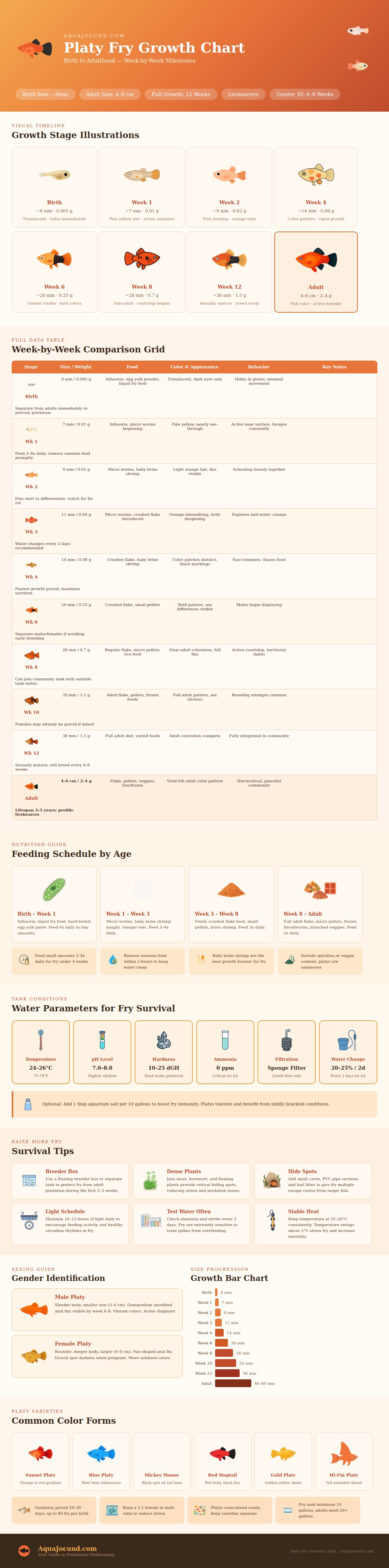
Platy fry are the newly born fry that require specific cares for the platy fry as they are very small and fragile for platy fry. Platy fish are livebearer which means that they give birth to the fry rather than laying eggs. Therefore, because platy fish are livebearers, they will eat there fry if they are not separated from the adult platy fish.
Thus, the adult platy fish must immediate separate the fry. A small tank, such as a ten-gallon tank is suitable for platy fry and a sponge filter is necessary to cycle the tank without exhausting the platy fry. Platy fry will be translucent for the first week of there life and will be very small.
How to Care for Platy Fry
Therefore, feed the platy fry small amounts of food four times each day. Offer foods like infusoria or liquid fry food as these foods is small enough for the platy fry to eat. Avoid feeding the adult platy fish flakes to the fry too early as the flakes will cloud the water and cause ammonia spike in the tank.
Ammonia spikes can kill platy fry. For the second week after birth the platy fry will develop their fins and exhibit some color. Feed the platy fry foods like micro worms or baby brine shrimp which are small enough for the fry to eat and which will promote the growth of the platy fry.
By the fourth week the platy fry will rapidly grows and begin to display their colors and black markings. At this point feed them crushed platy flakes mixed with brine shrimp as the fry will require the protein in the brine shrimp for growth. Perform water changes every two days.
The water in the tank should be kept between 75 and 79 degrees Fahrenheit, have a slightly alkaline pH and contain zero ammonia. Ensure that you keep the water at a stable temperature as any deviation from the correct temperature can kill the fry. Around the sixth week, the sex of the fry will become visible.
The male fry will be slimmer with a gonopodium while the female fry will be round with fan shaped anal fins. By the eighth week, the fry will begin to exhibit territorial behavior or courtship behaviors towards other fish in the aquarium. By the twelfth week, the fry will reach sexual maturity and be able to begin breeding.
The feeding requirements for the fry will change as the fry fish reach different ages. During the first four weeks of the life of the platy fry, feed the fish three to four time per day. After four weeks, however, the fry should only be fed twice per day.
During the first four weeks, provide microscopic live foods to the fry. After four weeks, however, transition the fry to platy flakes and then to adult platy pellets. Baby brine shrimp can be provided to the fry of any age as they increase the size of the fish.
Spirulina should also be provided to the fry as they are omnivores and require a balanced diet to thrive. Ensure that you remove any leftover food quick from the tank as leftover food can rot and release ammonia into the water. In order to ensure the survival of the fry, hiding spot should be provided for the fry.
Dense plants, like java moss or hornwort, will allow the fry to hide from other fish in the aquarium. While breeder boxes can provide hiding spots for fry, plants are often considered to be the better hiding spot as they reduce the stress experience by the fry. The water in the tank should be frequently tested for ammonia and nitrites as platy fry can die from unseen spikes in these substances.
Finally, aquarium salt can be added to the water to support the immunity of the platy fry.
