Brine Salinity Calculator
Mix, test, and adjust brine by salinity, weight percent, specific gravity, or density. Size salt mass, freshwater additions, and batch totals for kitchen, lab, and process brines.
0.2-0.8 mm grain, 359 g/L solubility, best for general food and lab brines.
Fine grain, 359 g/L solubility, dissolves quickly for crisp food brines.
Larger crystal range, 359 g/L solubility, good for broad kitchen batch work.
Trace minerals, 350 g/L solubility, useful for marine-style test brines.
Hygroscopic flakes, very dense brines, common in de-icing and process mixes.
Milder heat release, lower-temperature melt brines, and controlled spray mixes.
Lower sodium option with good solubility for specialty food and process brines.
Balanced profile for custom brines where speed, density, and cost all matter.
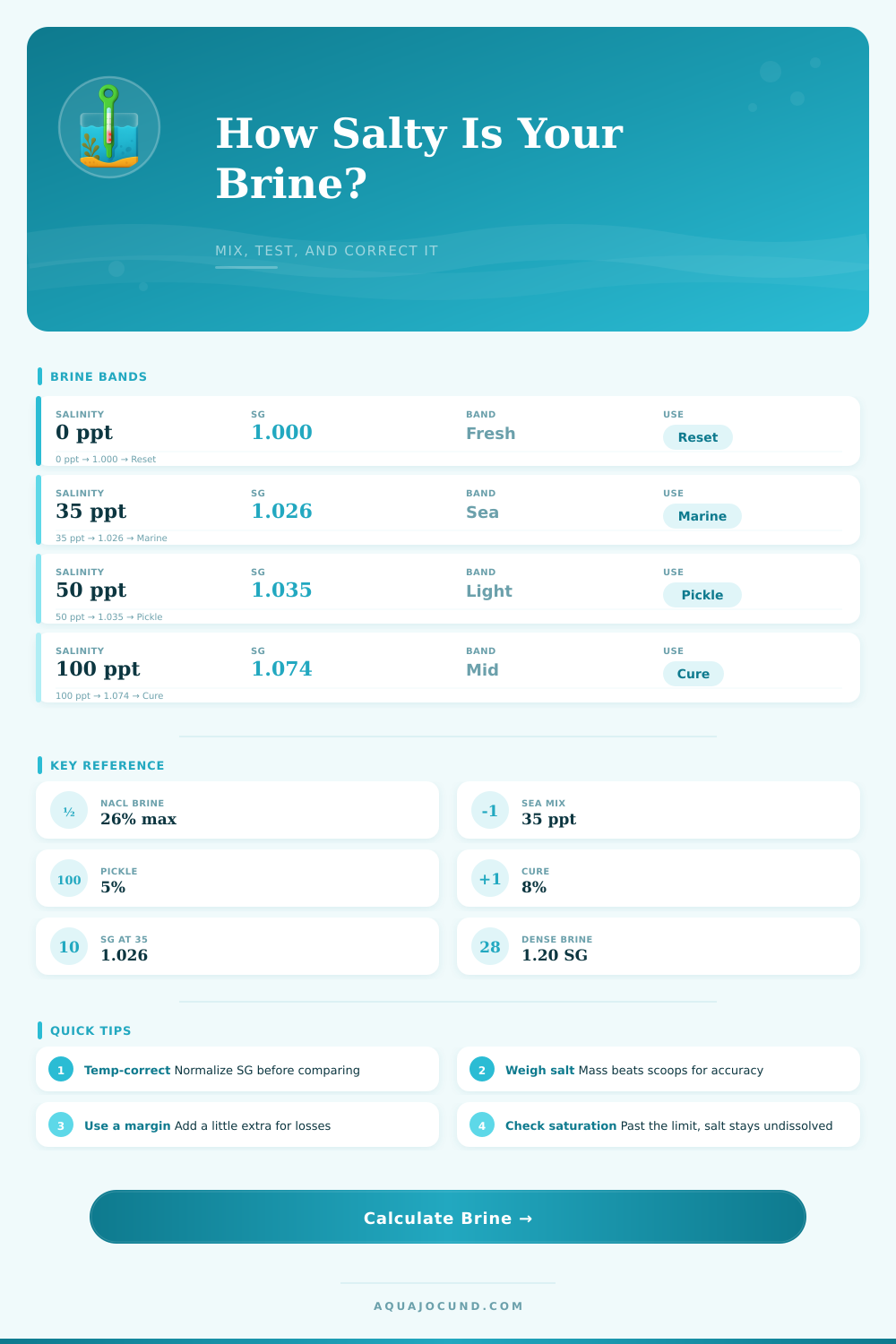
| Band | Ppt | Wt% | Use |
|---|---|---|---|
| Fresh | 0 | 0.0 | Reset |
| Light | 25 | 2.5 | Ferment |
| Sea | 35 | 3.5 | Marine |
| Pickle | 50 | 5.0 | Food |
| Cure | 80 | 8.0 | Brine |
| Dense | 260 | 26.0 | Sat NaCl |
| Batch | 5% | 10% | 23% |
|---|---|---|---|
| 1 L | 53 g | 111 g | 299 g |
| 5 L | 264 g | 550 g | 1484 g |
| 1 gal | 200 g | 417 g | 1125 g |
| 5 gal | 997 g | 2.08 kg | 5.61 kg |
| Salt | Grain | Solubility | Note |
|---|---|---|---|
| NaCl | Fine | 359 g/L | General brine |
| Pickling | Very fine | 359 g/L | Fast dissolve |
| Kosher | Large | 359 g/L | Big flakes |
| Sea mix | Mixed | 350 g/L | Trace minerals |
| CaCl2 | Flakes | 740 g/L | Hot dissolve |
| MgCl2 | Flakes | 540 g/L | Milder melt |
Brine are a solution that is made up of water and dissolved salt, and brine can be utilized for a variety of different purposes. Brines can be utilized for fermenting vegetables, for instance, or for de-icing road in the winter. In order to create a brine that fulfills some desired purpose, it is important to understand the relationship between salt and water, particulary in relation to the amount of salt that will be dissolved in the water to create a brine.
The salinity of the brine will have a correlation with the behavior of the microbe in the brine, as well as the texture of the food that is treated with that brine. If the salinity level are too low, the vegetables will become mushy after being treated with the brine. In contrast, if the salinity levels are too high, the brine will draw too many moisture out of the food that is treated with that brine.
How to Make and Measure Brine
Different types of salt has different properties, and will reach saturation at different levels. For instance, sodium chloride is one type of salt that can be added to water to create a brine, but sodium chloride can only reach saturation levels of approximately 26% by weight. Another type of salt is calcium chloride, which create denser brines than sodium chloride does.
Magnesium chloride is a third type of salt that exists, and it is a milder type of salt than the other two. Each of these salts have different functions, though, so the type of salt that is added to the water will affect the density of the brine, as well as the function that the brine can exhibit when utilized. The temperature at which the brine is prepared will impact the salinity of the brine, as cold water is able to hold less salt than warm water.
The salinity of the brine will differ based on the temperature at which the brine is measured. To ensure accuracy, it is recommended, though, to normalize the measurements to 20°C. At this temperature, you can measure the salinity with a hydrometer to determine the specific gravity of the brine, or with a refractometer to determine the parts per thousand (ppt) of the brine. The parts per thousand is a means of measuring the salinity of the brine, and is a measurement that is roughly ten times than the weight percent of the brine for the lightest of brines.
In order to prepare the brine, the cook should weigh the salt on a scale. This is an accurate way of measuring the salt compared to measuring it by volume. It is also recommended to use fresh water, and to add the salt to the water.
Additionally, the water should be stirred throughout the addition of the salt to ensure that the salt completely dissolves into the water to form the brine. For vegetable fermentation, the salinity of the brine should be between 2.5% and 5%. For meat, however, the salinity should be 8%.
For use in an aquarium, on the other hand, the salinity should be 35 ppt. In the case that the brine is not of the correct salinity, it is still possible to adjust the brine. If the brine is too salty, water can be added to the brine in order to dilute it.
It is not recommended, though, to add water from a tap to the brine without measuring the amount of water that is being added. Similarly, if the brine is too weak (lacks enough salt), more salt can be added to the brine. The cook should dissolve the salt in some water prior to being added to the brine, though, in order to avoid the formation of salt crystals within the brine.
There are a few common mistakes in the preparation of brines. One of the most common is the attempt to reach saturation of the brine by adding too much salt. The excess salt will simply not dissolve in the water and will remain as crystals at the bottom of the container.
Second, it is common for individuals to fail to correct for the temperature in the preparation of the brine. It is recommended that the brine is measured at 20°C. Finally, it is common for individuals to fail to stir the brine after adding salt to the water, as well as to fail to account for evaporation. Both of these issues will have an impact upon the salinity of the brine over time.
By following these rules regarding the density and measurement of brines, however, an individual can create a brine of the correct salinity for there specific purpose and need.