Seawater Salinity Calculator
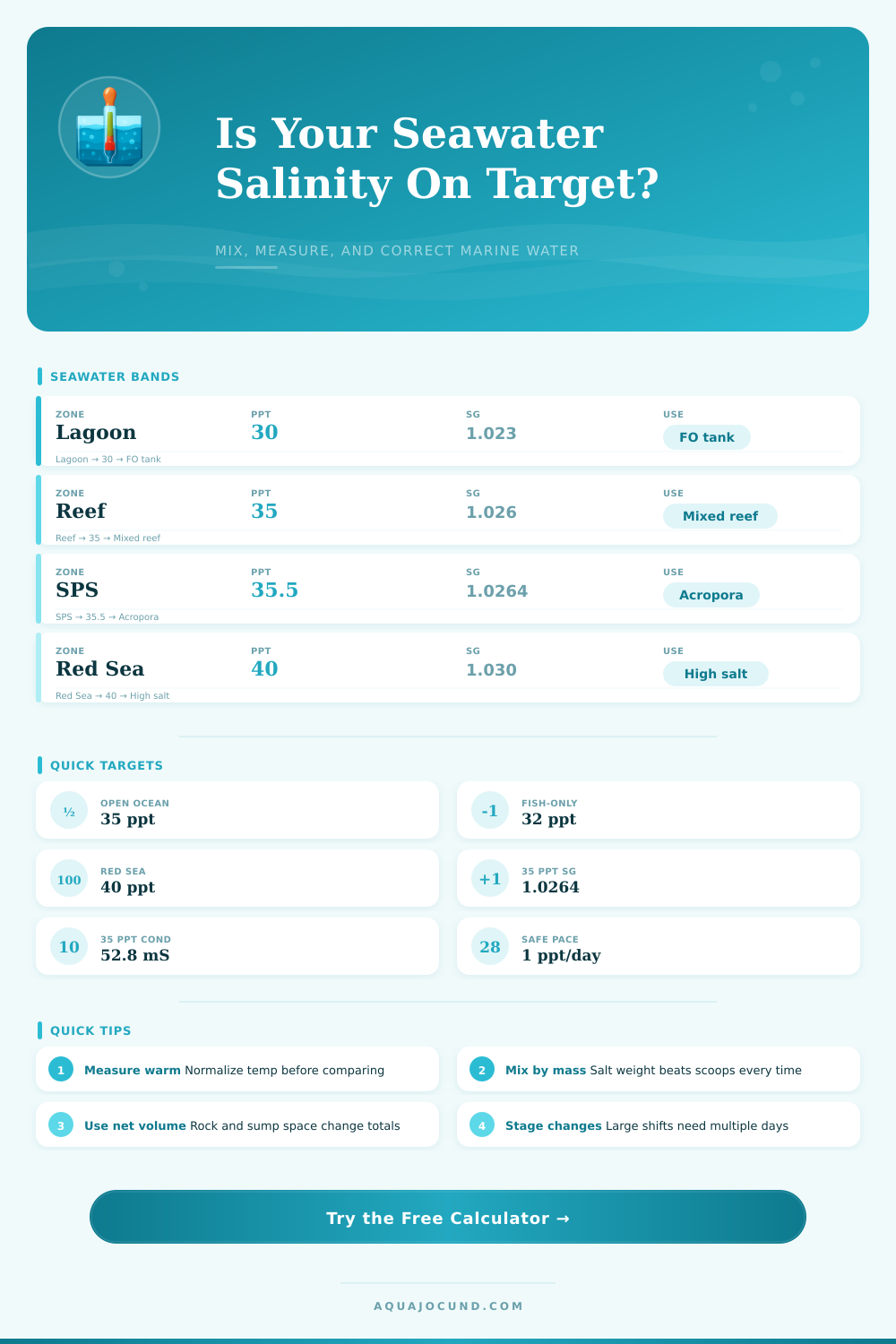
Convert marine readings, size a full seawater batch from real geometry, and plan staged correction water for reef, fish-only, lagoon, and Red Sea style systems.
Stable baseline salt for broad marine use.
Higher alk mix for coral-heavy systems.
Lower alk profile for tight SPS control.
Hot mix for big replenishment changes.
| Profile | ppt | SG 25C | Cond | Use |
|---|---|---|---|---|
| Lagoon fish | 30 | 1.0225 | 45.1 | Hardy fish |
| Fish-only | 32 | 1.0240 | 48.2 | FOWLR |
| Mixed reef | 35 | 1.0264 | 52.8 | Reef baseline |
| SPS reef | 35.5 | 1.0268 | 53.6 | Acropora |
| Red Sea | 40 | 1.0303 | 60.5 | High salt |
| Tank | Dimensions | Volume | 35 ppt mix |
|---|---|---|---|
| 10 gal | 20 x 10 x 12 in | 37.9 L | 1.45 kg |
| 20 long | 30 x 12 x 12 in | 75.7 L | 2.90 kg |
| 40 breeder | 36 x 18 x 16 in | 151.4 L | 5.78 kg |
| 75 gal | 48 x 18 x 21 in | 283.9 L | 10.85 kg |
| Salt mix | g/L | Alk | Ca | Mg | Max ppt |
|---|---|---|---|---|---|
| Instant Ocean | 38.2 | 10.5 | 400 | 1350 | 39 |
| Reef Crystals | 38.8 | 12.0 | 440 | 1440 | 40 |
| Tropic Marin Pro | 37.5 | 7.5 | 440 | 1350 | 38 |
| Coral Pro | 39.5 | 12.2 | 465 | 1390 | 41 |
| Current | Target | Freshwater for 100 L | Change water |
|---|---|---|---|
| 36 ppt | 35 | 2.86 L | None |
| 37 ppt | 35 | 5.71 L | None |
| 33 ppt | 35 | None | 45 ppt |
| 32 ppt | 35 | None | 50 ppt |
Seawater salinity are one of the main parameters to control in a marine aquarium. You must measure and maintain the salinity of the seawater in high precision in order to ensure the health of the livestock of the aquarium. If the salinity of the water is too low for the fish and invertebrate living in the aquarium, the fish will experience stress.
Too high salinity in the aquarium can also adversely impact the corals ability to absorb calcium. Each type of aquarium have a specific required salinity. For instance, lagoon style tanks require a salinity of 30 parts per thousand (ppt), and fish-only tanks require a salinity of 32 ppt.
Keeping Salt Levels Right in a Marine Aquarium
Reef tanks containing acropora corals, on the other hand, require a salinity of 35.5 ppt. The temperature of the aquarium can impact the salinity measurement of the water. For instance, an refractometer measures the salinity of the water through measuring the specific gravity of the water, while a probe measure the salinity through the conductivity of the water.
Because the density of the water change with the temperature of the water, each of these devices will provide a different reading if the temperature of the water changes. Therefore, you should record the temperature of the water when measuring the salinity in order to compensate for the effect of temperature on the reading. Otherwise, the salinity of the seawater will be inaccurately measured, which will lead to incorrect dosing the aquarium with salt.
The total volume of the aquarium, also known as the net volume, is not the same as the gross volume of the aquarium. The gross volume is the total volume of the aquarium as measured by multiplying the length, width, and height of the tank. However, this does not take into account the space that is occupied by the rocks and the aquarium equipment.
To find the net volume of the tank, you should multiply the gross volume by the volume of the tank that is occupied by the rocks and equipment. If the gross volume is used instead of the net volume, too much salt will be added to the water. The same is true of adding salt to the tank; it is recommended that the salt be measured by mass instead of volume in order to account for the fact that salt can compress when scooping it from a bag.
Different brands of salt contains different chemical compositions. For instance, some brands contain more alkalinity than others. Additionally, the salt manufacturer should not allow the chemical composition of the salt to drop to a salinity that is more high than the maximum salinity that is recommended.
Instead, if you perform a water change, the salinity of the aquarium should be changed slowly; it is recommended to not change the salinity of the water more than 1 part per thousand (ppt) per day. If the salinity of the aquarium is changed too quick, the livestock will experience stress. Presets can assist in calculating the amount of salt that is required to be added to the aquarium.
The preset feature of the aquarium calculator allow for the dimensions of the tank to be entered. Thus, the calculation of the volume of the tank is eliminated. The tank can also use the “mix mode” to calculate the dry weight of the salt that is required to reach the desired salinity.
Additionally, the aquarium calculator can use the “correction mode” to calculate the amount of replacement water that is required for a water change in the aquarium. When using “correction mode,” the tool will project the salinity of the tank after the water change has occur. The way in which the salinity of the water in the aquarium changes is important for the survival of the livestock in the tank.
Corals, for instance, can only tolerate a change in salinity of 0.5 ppt per day while fish can handle change in salinity of 2 ppt per day. In order to lower the salinity of the water in the tank, fresh water can be added. However, adding too much fresh water at once can lower the salinity too far.
When performing any calculation regarding the amount of fresh water to be added, it is important to use the net volume of the tank rather than the gross volume; using the gross volume will introduce errors into the calculations for salinity. Some common error in maintaining the salinity of the aquarium include ignoring the temperature of the tank, guessing at how much volume the rocks in the tank take up, and ignoring the sump in the calculation. Additionally, it is important to remember that the evaporation of the water will increase the salinity of the aquarium while adding RO/DI water will have the opposite effect on the salinity.
Thus, the salinity will increase over time due to evaporation. Additionally, the probes can drift out of calibration and the refractometers can lose accuracy over time. Therefore, it is important to measure the salinity using a variety of method each week.
If the salinity is maintained in a stable manner, the livestock will remain healthy and the maintenance of the aquarium will be made easy.