Saltwater Fish Weight Calculator
Estimate live weight for common saltwater targets with NOAA reef-fish length-weight factors, a saltwater-specific girth model, and practical profile adjustments for lean pelagics, thick reef fish, and pre-spawn bruisers.
Saltwater Weight Build
Use a preset as a fast starting point, then fine-tune body shape and seasonal fullness to match the exact fish on deck, at the dock, or in the photo.
Calculation Breakdown
These cards show exactly how the final number was built: which species curve ran, how your measured length was normalized to fork length, what girth source was used, and how profile or seasonal modifiers nudged the result.
Preset Comparison Grid
Each preset is descriptive, not generic, so you can match the fish body in front of you. Reef fish carry more shoulder and belly mass, while offshore speedsters stay narrower for the same fork length.
Gulf Red Snapper
Deep-bodied reef fish with a strong belly response. Best when girth is measured after a quick dock photo.
Mutton Snapper on Edge
Longer and cleaner through the tail than a red snapper, but still carries meaningful shoulder depth.
School Vermilion Snapper
Lean schooling snapper. Smaller fish often look lighter than casual guesses suggest.
Yellowtail Reef Cruiser
Fast, narrow-bodied snapper profile. Use a slim setting if the fish is especially sleek.
Red Grouper Ledge Fish
Chunky reef structure fish with a thick head and shoulder. Girth changes the answer quickly.
Reef-Edge Greater Amberjack
Powerful but less deep than grouper. Torpedo profile usually fits best unless the fish is unusually broad.
Almaco Pinnacle Jack
Compact jack with a shorter, deeper feel than a fast-run amberjack. Good wreck and pinnacle preset.
Cobia Sight-Cast Cruiser
Broad shoulders and dense mid-body. One of the strongest girth-sensitive profiles in the set.
Bluewater Mahi-Mahi Bull
Long, lean, fast-growing fish. Torpedo profile plus measured girth gives the best offshore read.
Blackfin Tuna Sprinter
Dense muscle but narrow shape. Lean setting is common outside heavy feeding windows.
Reference Tables
The first three tables carry length-weight factors from NOAA Technical Memorandum NMFS-SEFSC-693. The fourth table shows the profile and measurement adjustments used in this calculator so you can audit every modifier.
Reef Snapper and Grouper Factors
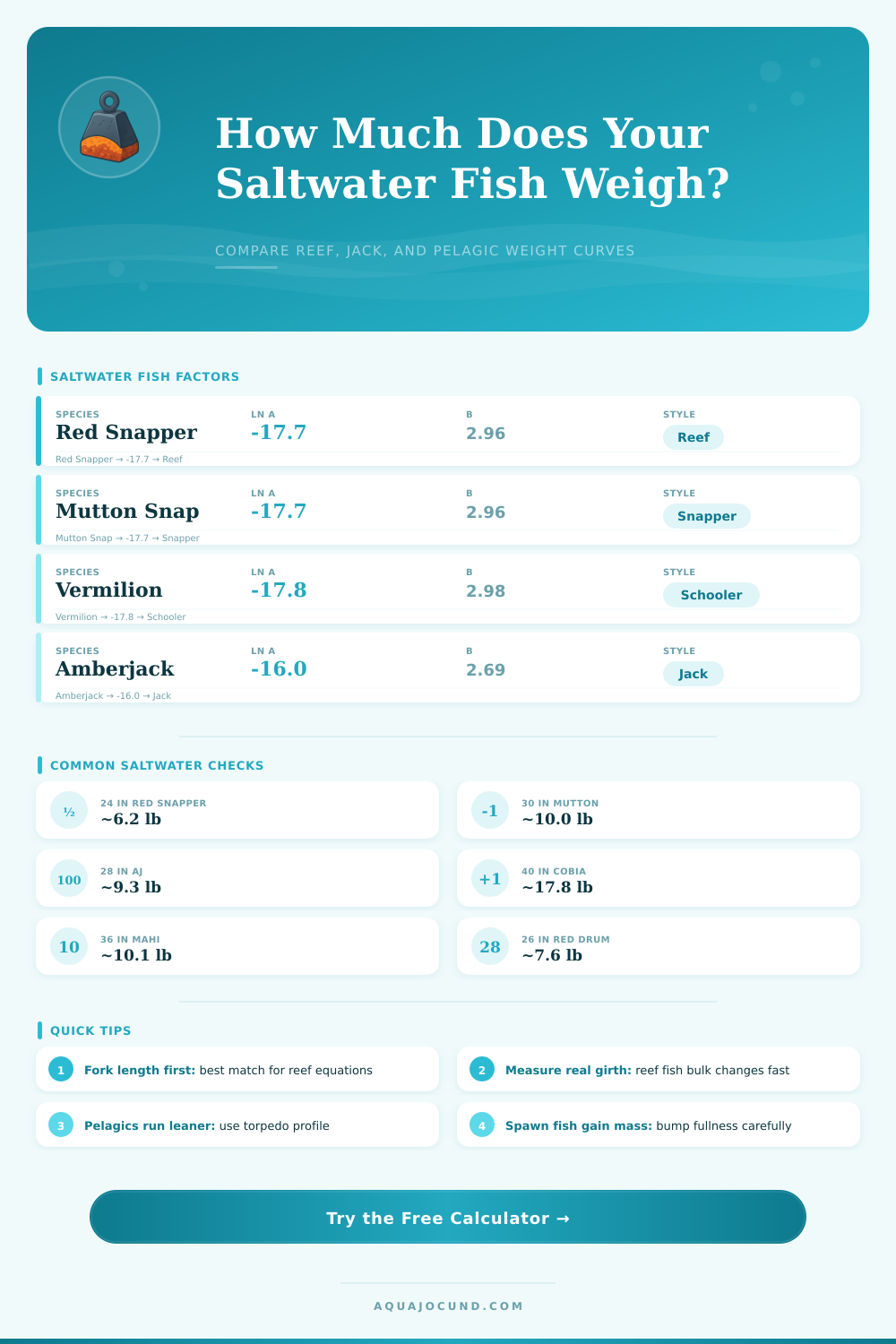
| Species | Ln a | b | N | Length mm |
|---|---|---|---|---|
| Red Snapper | -17.7 | 2.96 | 110,897 | 172-990 |
| Mutton Snapper | -17.7 | 2.96 | 2,502 | 378-864 |
| Vermilion Snapper | -17.8 | 2.98 | 117,080 | 106-624 |
| Yellowtail Snapper | -17.6 | 2.95 | 7,740 | 168-512 |
| Red Grouper | -18.8 | 3.13 | 254,416 | 199-924 |
Jacks and Pelagic Offshore Factors
| Species | Ln a | b | N | Length mm |
|---|---|---|---|---|
| Greater Amberjack | -16.0 | 2.69 | 2,323 | 222-1600 |
| Almaco Jack | -16.2 | 2.73 | 2,058 | 165-1302 |
| Cobia | -20.1 | 3.26 | 165 | 400-1330 |
| Dolphin | -17.0 | 2.74 | 329 | 292-1227 |
| Blackfin Tuna | -16.6 | 2.83 | 255 | 499-890 |
Coastal and Mixed Saltwater Factors
| Species | Ln a | b | N | Length mm |
|---|---|---|---|---|
| Red Drum | -19.2 | 3.14 | 100 | 538-1143 |
| Gray Triggerfish | -16.8 | 2.85 | 3,211 | 178-694 |
| Black Seabass | -14.4 | 2.42 | 642 | 134-457 |
| Sheepshead | -19.7 | 3.36 | 238 | 277-562 |
| Florida Pompano | -20.3 | 3.45 | 111 | 300-426 |
Adjustment Grid Used by This Calculator
| Control | Choice | Factor | Purpose |
|---|---|---|---|
| Length mode | Fork | 1.00 | Direct match to NOAA form |
| Length mode | Total | 0.96 | Approximates fork from total |
| Length mode | Standard | 1.12 | Rebuilds tail section to fork |
| Profile | Slim / torpedo | 0.94-0.98 | Prevents overcalling fast fish |
| Profile | Thick reef | 1.08 | Adds bulk for dense frames |
| Season | Winter to summer | 0.96-1.05 | Shifts average fullness |
| Fullness | Lean to spawn | 0.92-1.12 | Captures gut and roe weight |
In order to estimate the weight of an saltwater fish, a person must consider the body shape of the saltwater fish. Many saltwater fish has masses in their bellies, such as red snapper, which can make the red snapper appear to weigh more then it does. Other saltwater fish, like cobia and mahi mahi, have body shapes that hide the true weight of the fish; cobia hide their weight with the flatness of their backs, while mahi-mahi have long, lean bodies that may cause a person to underestimate the weight of the mahi-mahi.
Due to the variety in body shapes of saltwater fish species, a person must utilize species curves, girth measurement, and body profiles to determine the weight of the fish. To calculate the weight of a saltwater fish, a person can use length weight regressions to determine the weight of the saltwater fish species. Length-weight regressions for saltwater fish species is based upon the measurements of thousands of fish from the National Oceanic and Atmospheric Administration (NOAA).
How to Estimate the Weight of a Saltwater Fish
Length-weight regressions will allow a person to understand how different species of fish distributes there weight. For example, the red snapper and the blackfin tuna has different length-weight regressions due to the differences in the two species of fish. To use length-weight regressions to calculate the weight of a saltwater fish species, a person should measure the fork length of the saltwater fish from the snout of the fish to the fork in the tail.
Additionally, a person can use the total length of the saltwater fish, but the person must scale the total length to ensure that the estimated weight of the fish isnt too high based off the total length measurement. The second step in calculating the weight of a saltwater fish is to measure the girth of the fish. The girth of the saltwater fish provides more accurateley information about the weight of the fish than its length measurements alone.
To measure the girth of the fish, measure around the thickest part of the body of the saltwater fish. The girth measurement will allow for more precise estimation of the weight of the fish. Many people may choose to skip the measurement of the girth of the saltwater fish.
However, if the person skips the measurement of the girth of the saltwater fish, the estimation of the weight of the saltwater fish will be based only upon the species curve that is used to calculate the weight of the saltwater fish. For example, groupers and cobia may have a large chest when the fish are feeding heavy, but a mahi-mahi will always have a sleek body even if the saltwater fish reaches thirty-six inch in length. Thus, measuring the girth of the saltwater fish is necessary for accurate calculation of the weight of that saltwater fish.
The third and final step in calculating the weight of a saltwater fish is to consider its body profile and the weight of the saltwater fish based upon the season in which the fish is captured. A person can observe the body profile of the saltwater fish to determine if it is a thick-bodied species or a lean-bodied species. Additionally, by considering the season in which the saltwater fish was captured, a person can estimate the weight of the saltwater fish due to the way in which the saltwater fish may gain or lose weight during specific season of the year.
For example, saltwater fish may gain weight during the spring and summer months due to spawning, but may lose weight during the fall and winter months. However, a person should of take care when adjusting for the weight of the saltwater fish due to the body season because the species curves indicates the average weight of the saltwater species during each season. In addition to the three steps that can be used to calculate the weight of a saltwater fish, a person should also understand the confidence score associated with the estimation of the weight of that saltwater fish.
The confidence score associated with a weight estimation will be higher if the species of the saltwater fish is common, like red snapper, and if a person accurately measure the length and girth of the saltwater fish. In contrast, the confidence score will be lower if the species of the saltwater fish is rare, like cobia, or if the person guesses the girth of the saltwater fish rather than measured. Overall, though, because the estimation of the weight of the saltwater fish is an estimate, a person should always use a measuring tape for the length and girth of the fish rather than using a persons eye.
Thus, if a person measures the length, girth, and species of the saltwater fish, the estimate of the weight will be more accurate than if the person only used there eyes to determine the length and girth of the fish.