
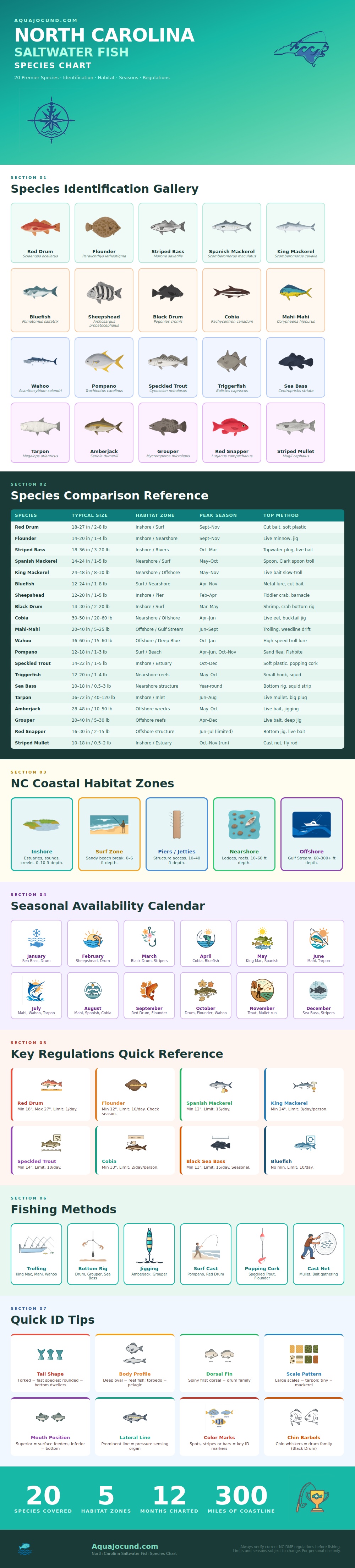
North Carolina’s coastline stretch over three hundred miles and contains much different species of saltwater fish. There are twenty different saltwater fish species in North Carolina, and each of these species live in various locations in the state. In order to successfully fish for these saltwater fish species in North Carolina, there is three important steps to take: identifying the species of fish, finding the locations of these fish species, and following the fishing regulation for these species.
You can identify the fish species by looking at the physical characteristic of the fish. For example, the shape of the tail fin of the fish can indicate the species of the fish. Fish with forked tail fin generally can swim fastly and live in open water, while fish with rounded tail fins live near the bottom of the water.
How to Catch Saltwater Fish in North Carolina
Additionally, the body shape of the fish can also help to identify the species. Fish with deep and oval body shape live within structures in the water, while fish with slender, torpedo body shape live in open water. Other physical features of the fish that can help to identify the species include the presence of chin barbels on species like drum fish, or the presence of spiny dorsal fin on species like groupers.
Matching each species of fish to the specific zone the species live in is necessary to successfully catch the fish. For example, species like trout and red drum live in calm estuary in marsh grass area, while pompano live in surf breaks where they sift through sand to find there food. Triggerfish and sea bass live in nearshore areas on ledges, while mahi mahi live in offshore area in blue water near weed line.
The fishing rig that the fisherman uses for a species of fish is also important. Each species of fish has its specific fishing rig; using the wrong fishing rig will result in a waste of the fuel and bait in the fishing boat. The timing of the trip to fish for these saltwater fish species is also important.
For example, red drum and flounder fish species move through the inlets of the state during the fall when the water is cooling. Cobia fish species live near buoys in the spring. Mahi mahi and king mackerel live in the Gulf Stream in the summer season, while sea bass live near structures in the winter season.
Additionally, the time of the tide and phases of the moon also dictate the movement of some of the fish species. For example, during new moon and full moons, there is an increase in the amount of activity of the fish. If you dont consider the timing of the tide and the phases of the moon prior to fishing, it is possible that the fish will be found in areas with no activity from the targeted saltwater fish species.
You must choose a fishing method that resemble the fishing method of the fish species you wish to catch. For instance, trolling spoons will catch Spanish mackerel, but you’ll require live minnow to catch flounder. Bottom rigs with shrimp or crab bait will catch black drum, and jigs will catch pompano in the surf.
Using too much fishing tackle will make it more harder to catch the species you want; simpler tackle is generally more effective. Follow all fishing regulation to ensure that the fish populations are sustainable. Many fish species has slot limits to ensure that fishermen are not heavily targeting breeders.
All fish must be measured from snout to tail fork, and any fish that is smaller than the slot limit must be released into the water. Species like snapper and grouper has closed seasons; during these period, no fishing is permitted to allow the fish stocks to replenish. By following these regulations, fishermen will ensure that there are still fish species for the future generation to enjoy.
There are many different location to fish in North Carolina. Focus on the location and the fishing timing of the species you wish to catch. These two factor are the most important in the fishing process.
By choosing the correct zone and the correct time of year to fish, the target species will be easierer to catch.
