
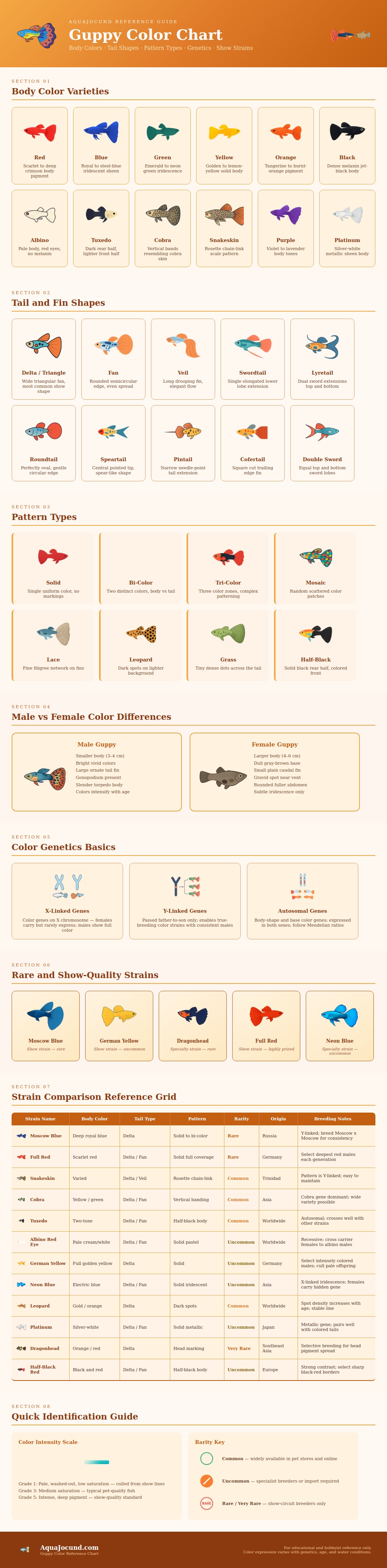
The body colors and tail shape of guppies are the main characteristic that is considered of these fish when performing identification of guppy species. Guppies is a small fish species that can be categorized according to their body color and tail shapes. Each fish can be identify using a color chart, and color charts can also be used to determine the breeding of guppies to achieve desired characteristics.
The body colors of guppies are the main source of the appearances of guppies. These body colors are create by the pigments within the skin cells of the guppies. Some guppy body colors include scarlet red and metallic blue.
Guppy Colors, Tail Shapes and Patterns
Other colors that guppies may display include green, yellow, orange, black, and purple. Additionally, some guppies may be albinos, which mean that they have pale cream bodies and red eyes. Because the albinism of guppies is a recessive trait, it is possible for the albino trait to skip generations when breeding guppies.
Some guppies also have platinum colors, which shine a shimmering silver white color. The body color of a guppy can have a major impact on the appearance of the fish; weak body colors can make a guppy less impressive then a guppy with more vibrant colors and large fins. The tail shapes of guppies are also a main identifying characteristics of these fish, and the tail shapes can impact the way that the colors of the guppies appear.
For example, delta tails is triangular in shape, veil tails are long and flowing, and sword tails has a single spike that extends from the bottom of the tail. Lyretails have spikes at both the top and bottom of the tail, and roundtails are oval in shape. Additionally, some guppies have tails that are spears in shape, pintails in shape, and cofertails in shape.
Each of these tail shapes will reflect the colors of the guppies differently. Additionally, the tail shape of a guppy must be consider when purchasing the fish for an aquarium; the filter for the aquarium or other fish in the same tank can tear certain tail shapes. Guppy patterns add another layer of complexity to these fish.
The patterns found on guppies is genetically determined. Solid colors are the most common and cover the fish uniformly. Bi-color guppies has their color restricted to either the body or the tail.
Tri-color guppies have three different colors on their bodies. Mosaic colors is randomly patched throughout their bodies. Other colors include lace, leopard spots, and grass patterns.
Tuxedo colored guppies have solid colors on their rear end; half-black guppies only partially color their bodies. These colors are the result of genetic processes. Some colors are Y-linked, which means that they are reliably passed from father to sons.
If one guppy strain with solid colors is crossed with another with a colored pattern, the offspring will have stippled colors. The appearance of guppies differs between the male and females of the species. Male guppies grow to be 3 to 4 centimeters in length.
They have slender bodies and vivid color. Female guppies grow to be 4 to 6 centimeters in length. They have more subdued gray brown colors on their bodies and tails.
The males has larger, brighter fins to show off to the females. The females have more subdued colors as they dont need to show them off. The genetics determine the color of the offspring.
Any X-linked colors will be hidden in the females but will be visible in the offspring that are male. A comparison grid can be use to identify the various strains of guppies. A comparison grid can allow individuals to identify the various types of guppies, such as snakeskin or dragonhead guppies.
A comparison grid can display the rarity of each strain of guppy. Some strains is common while others are very rare. Another feature of a comparison grid is the ability to compare color intensities.
High saturation of colors indicates the quality of guppies. While beginners may look for guppies with bright colors, professional breeders may look for guppies with specific genetic trait. Thus, by understanding the colors, shapes, and patterns of guppies, individuals can breed these guppies more effectively or buy them from breeders with better genetic make-up.
