🧬 Guppy Genetics Calculator
Predict offspring color, pattern, and genotype from parent guppy crosses using real Mendelian genetics
| Gene | Inheritance | Alleles | Effect |
|---|---|---|---|
| Body Color | Autosomal | B+ (wild), b (gold), a (albino) | Controls melanophore production |
| Tail Pattern | Y-linked | Cobra, Grass, Leopard, Lace, Solid | Pattern on caudal fin, father to sons |
| Color | X-linked | Red, Blue, Green, Purple, Yellow, Multi | Iridophore color on tail and body |
| Moscow | Autosomal Dominant | Mc (moscow), + (wild) | Full body metallic sheen |
| Half Black | Autosomal Incomplete | Hb (half black), + (wild) | Hb/+ partial, Hb/Hb full black rear |
| Metal/Platinum | Autosomal Recessive | mt (metal), + (wild) | Metallic head and shoulder sheen |
| Full Gold | Autosomal Recessive | fg (full gold), + (wild) | Enhanced gold across entire body |
| Cross | Male Offspring | Female Offspring | Key Notes |
|---|---|---|---|
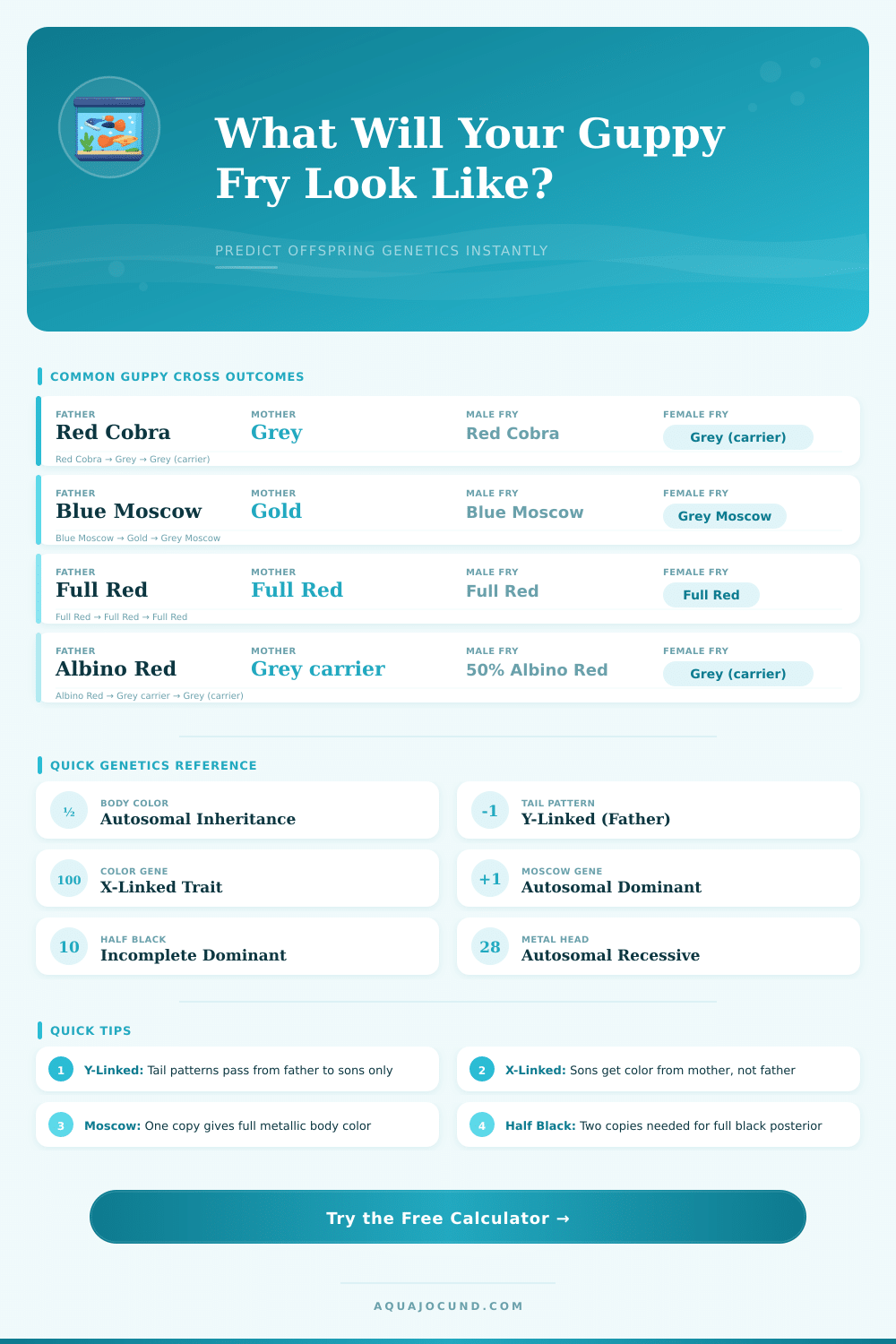
| Red Cobra × Grey | Red Cobra (100%) | Grey, carry Red (100%) | Y-pattern passes to all sons |
| Blue Moscow × Gold | Blue Moscow or carrier | Moscow carriers | Moscow gene is autosomal dominant |
| Full Red × Full Red | Full Red (100%) | Full Red (100%) | Both parents homozygous |
| Albino × Grey carrier | 50% Albino, 50% Grey carrier | 50% Albino, 50% Grey carrier | Autosomal recessive cross |
| HB Red × Grey | 50% HB Red, 50% Red | 50% HB carrier, 50% Grey | Incomplete dominance for HB |
| Green Grass × Blue | Green Grass (100%) | Carry Green, show Blue (100%) | Sons get mother X-color |
| Feature | Y-Linked (Tail Pattern) | X-Linked (Color) | Autosomal |
|---|---|---|---|
| Passed By | Father → Sons only | Both parents | Both parents |
| Visible In | Males only | Males show mother’s X | Both sexes |
| Daughters | Carry hidden, not expressed | Get one X from each parent | Standard Mendelian |
| Sons | Express father’s pattern | Express mother’s X only | Standard Mendelian |
| Carrier State | Females carry from father | Females can carry 2 alleles | Heterozygotes possible |
| Examples | Cobra, Grass, Leopard | Red, Blue, Green, Purple | Moscow, Half Black, Body Color |
| Genotype | Phenotype | Melanin Level | Eye Color |
|---|---|---|---|
| B+/B+ or B+/b | Grey (Wild Type) | Full melanin | Black |
| b/b | Gold / Blond | Reduced melanin | Black |
| a/a | Albino | No melanin | Red / Pink |
| fg/fg | Full Gold / Tiger | Reduced, golden hue | Black |
| B+/b (carrier) | Grey (carries Gold) | Full melanin | Black |
| B+/a (carrier) | Grey (carries Albino) | Full melanin | Black |
Guppy Genetics can seem hard at first, but really the basic ideas are not that difficult when one digs into this topic. Breeders use planned crossbreeding to create separate color types and strengthen wanted traits. Everything comes down to knowing how the genes combine to form the shades and patterns that one sees on the fishes.
Some key ideas in Genetics deserve that one thinks about them. The terms “dominant” and “recessive” describe how traits become visible. For instance, the gray body tone dominates the golden.
How Guppy Colors and Traits Are Passed On
When one crossbreeds a gray Guppy with a golden, the offspring results in four possible gene types. Some children have two gray genes, other one of every kind and the rest both golden. That mix of genes decides the look of the fish when it grows up.
The colors do not happen randomly, although sometimes it seems like that. The surprise enters when one breeds fishes whose Genetics one does not well know. Even if one has a bit of info about the background, the color combiantions however can surprise.
Here the key spot: many shades show fully only when testosterone acts, hence the males usually shine more than the females. Some traits depend on the X- or Y-chromosomes. Only males show Y-bound traits, but they also can inherit X-bound or mix from both.
Some traits require only one or two genes to appear. Others, like strong red, maybe require up too four genes, that all must be present. If the fish owns only one or two of those red genes, it will not pass that deep crimson color to its offspring.
To reach that, one usually crossbreeds with a separate red line. The snake skin seems to be recessive. Red mostly is dominant, but it is not fully fixed.
Purples and greens developed through selective farming from blue line.
Guppy Genetics are surprisingly rough and unclear, many parts stay a riddle. The genes hide themselves easily, so unless both parents come from pure, truly bred line, predicting the results is almost not possible. Without knowledge about the genetic background of every parent, one gets fully different results.
Wild Guppy populations have much more genetic diversity than tank-bred types. Even pet store Guppy fish are genetically quitea lot limited.
Selective farming and line crossing work anyway, whether one fully understands the Genetics or not. Even so choosing fishes only because of their look, without thinking how their genes relate, is not the wisest method. The Genetics of females also matter, although they do not show the colors as bright.
Curved spines sometimes appear after years of inbreeding or bad tank conditions. To have healthier offspring, one adds wild genes instead of staying with domestic lines. Domestic fishes have weaker immune systems.