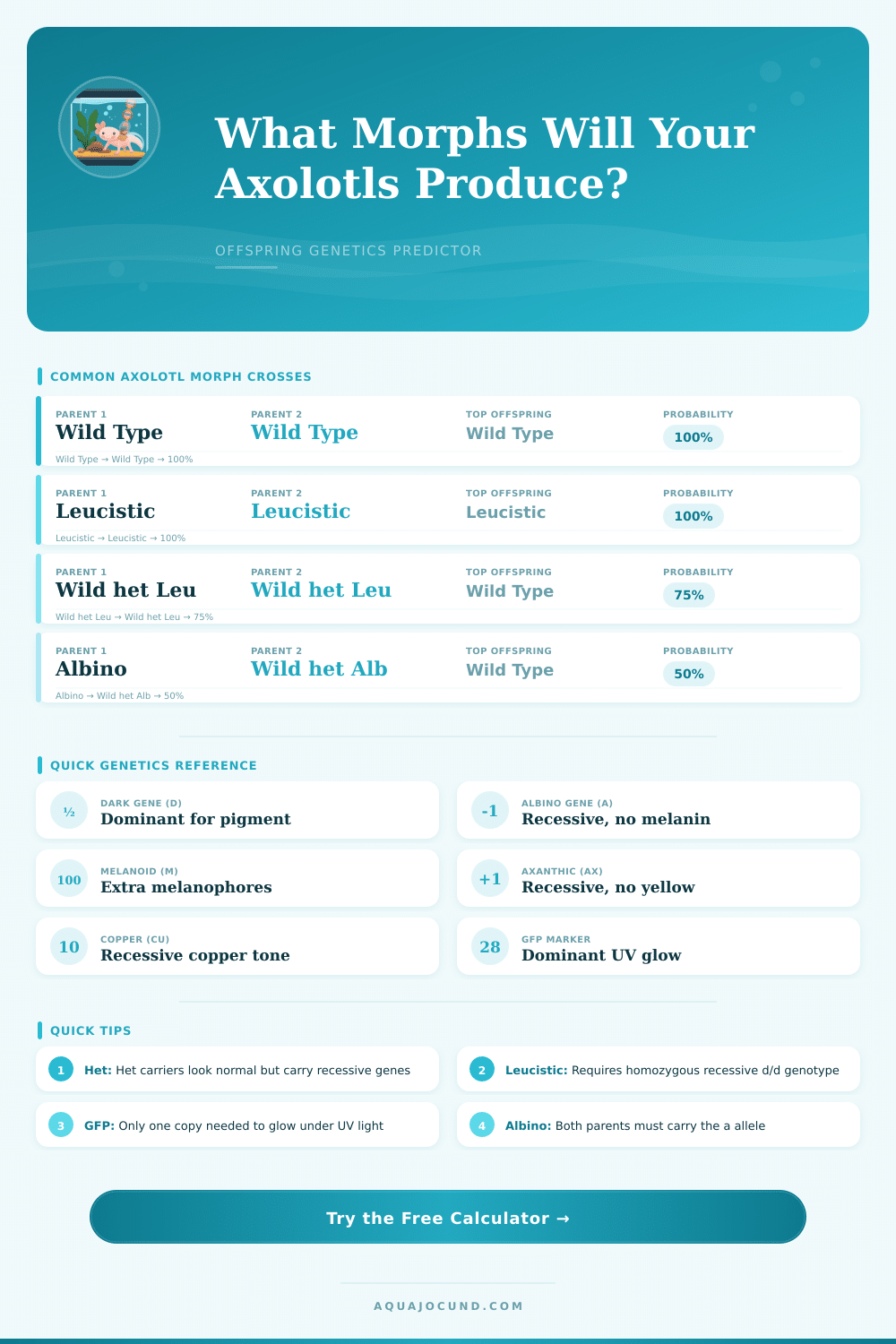
🧬 Axolotl Genetics Calculator
Predict offspring morphs from axolotl breeding pairs using real color genetics and Punnett square analysis
| Gene | Alleles | Dominance | Morph Effect |
|---|---|---|---|
| Dark (D) | D, d | D dominant over d | D/- = dark pigment; d/d = leucistic base |
| Albino (a) | A, a | A dominant over a | a/a = no melanin (albino); A/- = normal |
| Melanoid (M) | M, m | M dominant over m | M/- = extra melanophores, no iridophores |
| Axanthic (ax) | Ax, ax | Ax dominant over ax | ax/ax = no xanthophores (no yellow) |
| Copper (Cu) | Cu+, Cu | Cu+ dominant over Cu | Cu/Cu = copper pigmentation |
| GFP | GFP, + | GFP dominant over + | GFP/+ or GFP/GFP = glows under UV |
| Morph Name | Dark (D) | Albino (a) | Melanoid (M) | Notes |
|---|---|---|---|---|
| Wild Type | D/- | A/- | m/m | Dark with gold speckles and iridophores |
| Leucistic | d/d | A/- | m/m | White/pink body with dark eyes |
| Albino (White) | d/d | a/a | m/m | White/golden with red eyes |
| Golden Albino | D/- | a/a | m/m | Golden body with red eyes |
| Melanoid | D/- | A/- | M/- | All dark, no iridophore shine |
| Black Melanoid | D/D | A/A | M/M | Very dark, homozygous melanoid |
| Axanthic | D/- | A/- | m/m | No yellow pigment, gray/silver look |
| Copper | D/- | Cu/Cu | m/m | Copper/tan body with light eyes |
| Lavender | d/d | A/- | M/- | Light purple/gray, melanoid leucistic |
| GFP variants | any | any | any | Any morph + GFP = glows under UV light |
| Cross | Primary Offspring | Het Carriers | Ratio |
|---|---|---|---|
| Wild × Wild | Wild Type | None | 100% Wild |
| Leucistic × Leucistic | Leucistic | None | 100% Leucistic |
| Wild het Leu × Wild het Leu | Wild Type + Leucistic | 66% het Leu | 75% Wild : 25% Leu |
| Albino × Wild het Alb | Wild het Alb + Albino | 100% het Alb | 50% Wild : 50% Alb |
| Melanoid × Wild | Wild het Mel or Melanoid | Varies | Depends on M genotype |
| Golden Alb × Leucistic | Wild het Leu het Alb | 100% double het | 100% Wild (het) |
| GFP Wild × Leucistic | Wild het Leu ± GFP | 100% het Leu | 50% GFP : 50% non-GFP |
| Copper × Wild | Wild het Copper | 100% het Cu | 100% Wild (het Cu) |
| Pattern | Inheritance | Carrier Visible? | Example |
|---|---|---|---|
| Leucistic (d/d) | Autosomal recessive | No | Two Wild het Leu → 25% Leucistic |
| Albino (a/a) | Autosomal recessive | No | Two Wild het Alb → 25% Albino |
| Melanoid (M/-) | Autosomal dominant | Yes (partial) | Melanoid × Wild → 50% Melanoid |
| Axanthic (ax/ax) | Autosomal recessive | No | Two het Ax → 25% Axanthic |
| Copper (Cu/Cu) | Autosomal recessive | No | Two het Cu → 25% Copper |
| GFP (GFP/+) | Dominant transgene | Yes (UV glow) | GFP × non-GFP → 50% GFP |
Axolotl are very amazing creatures. All captured copies come from only 34 original individuals. That makes the genetics pool surprisingly small.
Not all of those 34 could breed, so the real amount is even lower. If two random axolotl share around 35% of their DNA that shows their level of inbreeding. To understand that, think about the Habsburg monarchs, who were known for their high inbreeding and many health problems, but axolotl have double that percentage.
Axolotl Genetics, Inbreeding and Color Types
Some groups now track the genetic traits of axolotl. The Centre for Supply of Axolotl urged the community of home breeders to action, but apparently nothing happens for now. Knowing the genetic sources of the parents and their traits helps breeders understand what they work with and what they intend to produce.
It requires attention, planning and mapping of genetic lines to lower the inbreeidng and maximize the genetics diversity.
If the two parents are genetically related or carry genetic damages, then breeding between them would not help the children. It could reduce their quality of life and pass problems too future generations. One should keep males and females in separate aquariums, to escape excessive breeding, that can be very hard or even deadly for the female.
The white variant is a recessive gene, that changes the spread of pigment cells. One single white male among the first axolotl brought to Paris in 1868 probably became the ancestor of all white copies in labs globally. Leucism is a genetic change, that causes white, pale or patchy coloring on the skin, but does not touch the eyes.
Leucistic axolotl are recessive to the wild type, but dominant over albinism, and they always are homozygous. Golden albino axolotl always carry the recessive albino gene. If one breeds golden with golden, all children will be albino, but not all have the golden color.
Axanthic axolotl carry an imprecise name. It implies “without xanthophores”, but they actually have a bit of those cells. Only because of genetic damage they can not produce pteridines.
The melanoid gene, that gives solid black color, already existed in the natural population. Wild type axolotl must have at least one copy of the wild allele for every gene spot. Because of genetic dominance, one can not guess the hidden allele only from the outer look.
GFP axolotl are genetically altered to have pigments, that glow green under ultraviolet light. The green fluorescent protein works separate from other colors, so there are GFP wild type and GFP white albino variants. The genome of axolotl is huge, with 32 gigabases.
Scientists found that it lacks the developmental gene Pax3, that other vertebrates own. In natural surroundings, insecticides from farmlands pollute the lakes through drainage, which sharply raises the deathrate among embryos and larvae of axolotl, causing big loss of genetic diversity.