🐟 Redfield Ratio Reef Tank Calculator
Compare nitrate and phosphate using the classic 16:1 atomic N:P reference, then translate it into the reef-friendly NO3:PO4 ratio you can actually test and adjust.
⚡ Quick Presets
🧪 Tank Inputs
📊 Live Results
🧫 Full Breakdown
| Step | Value | Meaning |
|---|---|---|
| Tank volume | -- | Converted to liters for dosing math. |
| Current NO3 | -- | Input as ppm nitrate ion. |
| Current PO4 | -- | Input as ppm phosphate ion. |
| Current ratio | -- | Mass NO3:PO4 from the readings. |
| Atomic ratio | -- | Converted to N:P for Redfield context. |
| Target used | -- | Manual input or suggested reef target. |
| Ratio gap | -- | Percent above or below the target. |
| NO3 if PO4 fixed | -- | What nitrate must be for balance. |
| PO4 if NO3 fixed | -- | What phosphate must be for balance. |
| NaNO3 estimate | -- | Approximate dose if nitrate is low. |
| KH2PO4 estimate | -- | Approximate dose if phosphate is low. |
💡 How to read the output
A ratio above target usually means phosphate is the limiting side. A ratio below target usually means nitrate is the limiting side. The correction move shows the fastest direction, while the breakdown shows the exact ppm and dose estimate for the full tank.
📖 Reference Tables
Target Bands by Reef Type
Use these as starting points, not rigid rules.
| Type | N:P | NO3:PO4 | Note |
|---|---|---|---|
| SPS | 18:1 | 26:1 | Clean but stable |
| Mixed | 16:1 | 23:1 | Classic Redfield |
| LPS | 12:1 | 17:1 | Slightly richer |
| Soft | 9:1 | 13:1 | Keep nutrients up |
| Macro | 7:1 | 10:1 | Lower nitrate bias |
Conversion Constants
These bridge the test kit numbers to Redfield math.
| Item | Value | Meaning | Use |
|---|---|---|---|
| NO3 to N | 0.226 | N from nitrate | Atomic ratio |
| PO4 to P | 0.326 | P from phosphate | Atomic ratio |
| Atomic to mass | 1.444 | Redfield factor | 16:1 to 23:1 |
| NaNO3 | 1.37x | Product factor | Raise NO3 |
| KH2PO4 | 1.43x | Product factor | Raise PO4 |
Common Correction Moves
Pick the smallest change that solves the bottleneck.
| Scenario | Likely issue | First move |
|---|---|---|
| High ratio | PO4 low | Increase PO4 |
| Low ratio | NO3 low | Increase NO3 |
| Both near zero | Starved tank | Feed or dose both |
| Fast swings | Test drift | Verify kits first |
| Stuck PO4 | Adsorption | Trim GFO or export |
Reef Chemistry Notes
Small shifts are usually safer than aggressive corrections.
| Tool | Effect | Best use |
|---|---|---|
| Water change | Resets both | When both are off |
| Feeding | Lifts both | Very low nutrients |
| Export | Trims both | High nutrients |
| GFO | Pulls PO4 | Phosphate spike |
| Carbon dose | Pulls NO3 | Nitrate spike |
Species and Material Comparison Grid
Match the ratio to the tank mix, not just the number on the screen.
| Group | Prefers | Too low | Too high | Notes |
|---|---|---|---|---|
| SPS coral | Cleaner water | P starvation | Brown film | Likes stability most |
| LPS coral | Mid nutrients | Pale tissue | Algae build | Watch phosphate first |
| Soft coral | Richer water | Slow growth | Closed polyps | Handle swings poorly |
| Macroalgae | Some nitrate | Stalls | Can crash | Needs both in range |
| Live rock | Flow and balance | PO4 lock | Film algae | Media can bind PO4 |
| Biomedia / GFO | Controlled use | Skims NO3 | Skims PO4 | Can skew the ratio |
The Redfield ratio is a method of balancing nutrients in an reef tank. The Redfield ratio are based upon the nitrogen to phosphorus ratio. In the natural ocean waters, the ratio of nitrogen to phosphorus is 16:1 due to the fact that phytoplankton consumes the nutrients in this specific ratio.
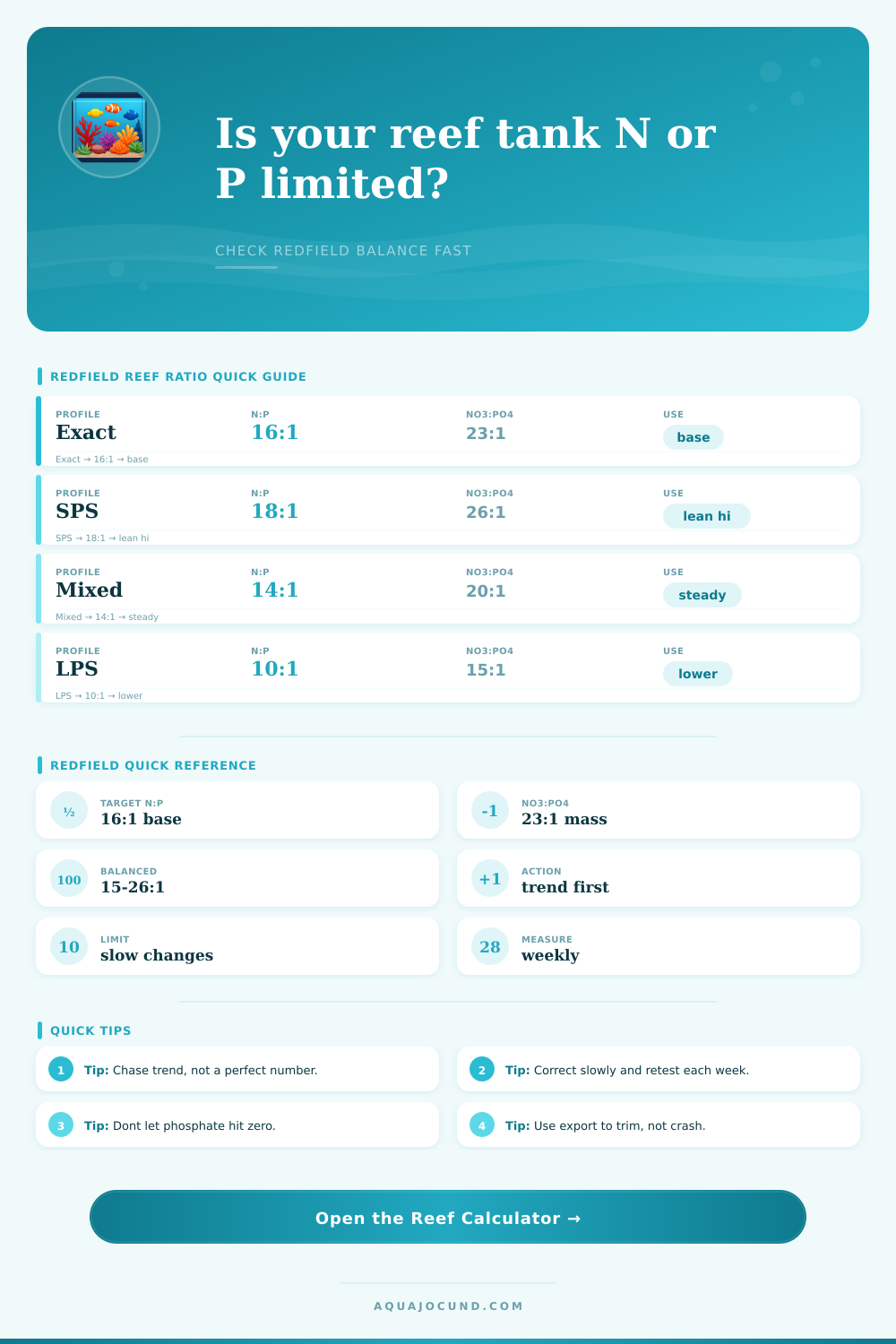
In the reef tank, the ratio of nitrate (NO3) to phosphate (PO4) should be 23:1. If the nitrate to phosphate ratio are not balanced in the reef tank, one nutrient will become too low while the other nutrient become too high. If the nutrient that is too low is the one that the corals require, the corals will experience stunted growth.
Balancing Nitrate and Phosphate in a Reef Tank
If the nutrient that is too high is the one that the corals require, there will be algae growth in the reef tank. The specific ratio of nitrate to phosphate that you should use in a reef tank will depend upon the type of corals that is kept in the reef tank. If the tank keeps SPS corals, the ratio should be 26:1 as SPS corals thrives in water that is low in nutrients.
If LPS or soft corals are kept in the reef tank, the ratio may be lower at 15:1 or 12:1 as these corals can tolerate higher level of nutrients. The type of food that you feed to the reef tank and the methods that the tank uses to export the waste from the reef tank can alter the levels of nitrate and phosphate in the tank. For instance, feeding meaty food will increase the amount of nitrogen (nitrate) in the tank while using a protein skimmer will decrease the amount of nitrate in the tank.
Therefore, monitoring the nitrate to phosphate ratio in the reef tank will allow you to monitor the reef tank inhabitants to determine if the tank is nitrate-limited or phosphate-limited. A nitrate-limited tank will have a low ratio in that nitrates is too low in the tank. A phosphate-limited tank will have a high ratio in that phosphates is too low in the tank.
Rather than focusing upon the nutrient ratios to determine whether adjustments should of been made to the reef tanks nutrients, focusing upon the trends of those ratios is the best way to ensure that the reef tanks health. If there is a rapid change in ratio from one week to the next, such as from a ratio of 10:1 to 40:1, it is likely due to an error in testing the water. Therefore, using water changes every few weeks will ensure that the nutrients in the tank remains within the required parameters.
In addition, ensuring that the nutrient parameters are balanced will ensure that the iron in the tank does not lock up. Therefore, you can accomplish maintaining the nutrient ratio through water changes, carbon dosing to reduce nitrate, or the targeted dosing of nutrients like sodium nitrate or potassium phosphate. However, ensuring that you export nutrients from the tank at the same rate as they are introduced will ensure that methods like Granular Ferric Oxide (GFO) do not remove all of the phosphate from the tank while the nitrate continues to rise.
Overall, the goal of maintaining the Redfield ratio of nitrate to phosphate in the reef tank is to maintain stability of the corals in the reef tank. By plugging into the nitrate and phosphate tests, you can calculate and adjust the ratio according to the specific type of reef tank. By maintaining the ratio of nitrate to phosphate, the corals will exhibit better color and the algae will be kept at bay.
Stability is the main focus rather than maintaining the most perfect 16:1 ratio as the corals are expected to adapt to the parameters of the reef tank. It is actualy alot of work to keep things stable. Youll need to monitor things carefully to make sure nothing dissapears from the balance.
If you dont keep a close eye on it, the balance can change more quick than you’d think. Its important to make sure you recieve accurate test results so you can manage the reef tank’s health. Maintaining the moddern reef tank requires patience and consistancy.