Aquarium KH Calculator
Plan carbonate hardness with tank size, water source, and a buffer that fits your setup.
Full Breakdown
Softwater fish
Planted tank
Cichlid tank
Reef tank
| Type | Ideal KH | Range | Notes |
|---|---|---|---|
| Softwater | 2.5 | 1.5-3.0 | Low swing |
| Planted | 3.5 | 2.5-5.0 | CO2 stable |
| Community | 4.5 | 3.0-6.0 | Balanced |
| Cichlid | 8.0 | 6.0-10.0 | Hard water |
| Reef | 8.5 | 7.5-11.0 | Alk control |
| Brackish | 9.0 | 8.0-12.0 | Firm buffer |
| Product | Eq/g | 100L dose | Effect |
|---|---|---|---|
| Sodium bicarbonate | 0.595 | 3.0 g | Gentle rise |
| Sodium carbonate | 0.943 | 1.9 g | Fast rise |
| Potassium bicarbonate | 0.500 | 3.6 g | Softer pH |
| Potassium carbonate | 0.723 | 2.5 g | Stronger pH |
| Marine buffer | 0.700 | 2.5 g | Marine fit |
| Reef mix | 0.650 | 2.7 g | Alk support |
| Cichlid blend | 0.550 | 3.2 g | Hard water |
| Plant buffer | 0.450 | 3.9 g | Moderate KH |
| Tank size | Dimensions | Volume | Use |
|---|---|---|---|
| 10g | 20 × 10 × 12 in | 38 L | Small soft |
| 20g long | 30 × 12 × 12 in | 76 L | Planted |
| 29g | 30 × 12 × 18 in | 110 L | Community |
| 40 breeder | 36 × 18 × 16 in | 151 L | Cichlid |
| 75g | 48 × 18 × 18 in | 284 L | Mixed |
| 120g | 48 × 18 × 24 in | 454 L | Reef |
| Source | KH | Impact | Note |
|---|---|---|---|
| RO/DI | 0-1 | None | Needs mix |
| Soft tap | 1-3 | Low | Gentle |
| Hard tap | 4-10 | Strong | Test first |
| Mineral water | 3-6 | Medium | Watch drift |
| Reef mix | 7-11 | High | Marine use |
Carbonate hardness, which is often call KH for short, measures the buffering capacity of water in aquarium fish tank. Carbonate hardness work to balance the pH level in the tanks. Carbonate hardness prevents the pH level from changing in response to waste produce by the fish in the tanks, respiration from the plants in the aquariums, or carbon dioxide that can be inject into the tanks.
Should carbonate hardness level be too low in the tanks, the pH level will fluctuate frequent, which can be harmful to the fish and the plant in those tanks. If carbonate hardness are maintained at a stable level in the tanks, the pH levels will remain stable. The need of the inhabitants of the tanks require different level of carbonate hardness.
Carbonate Hardness in Aquarium Water
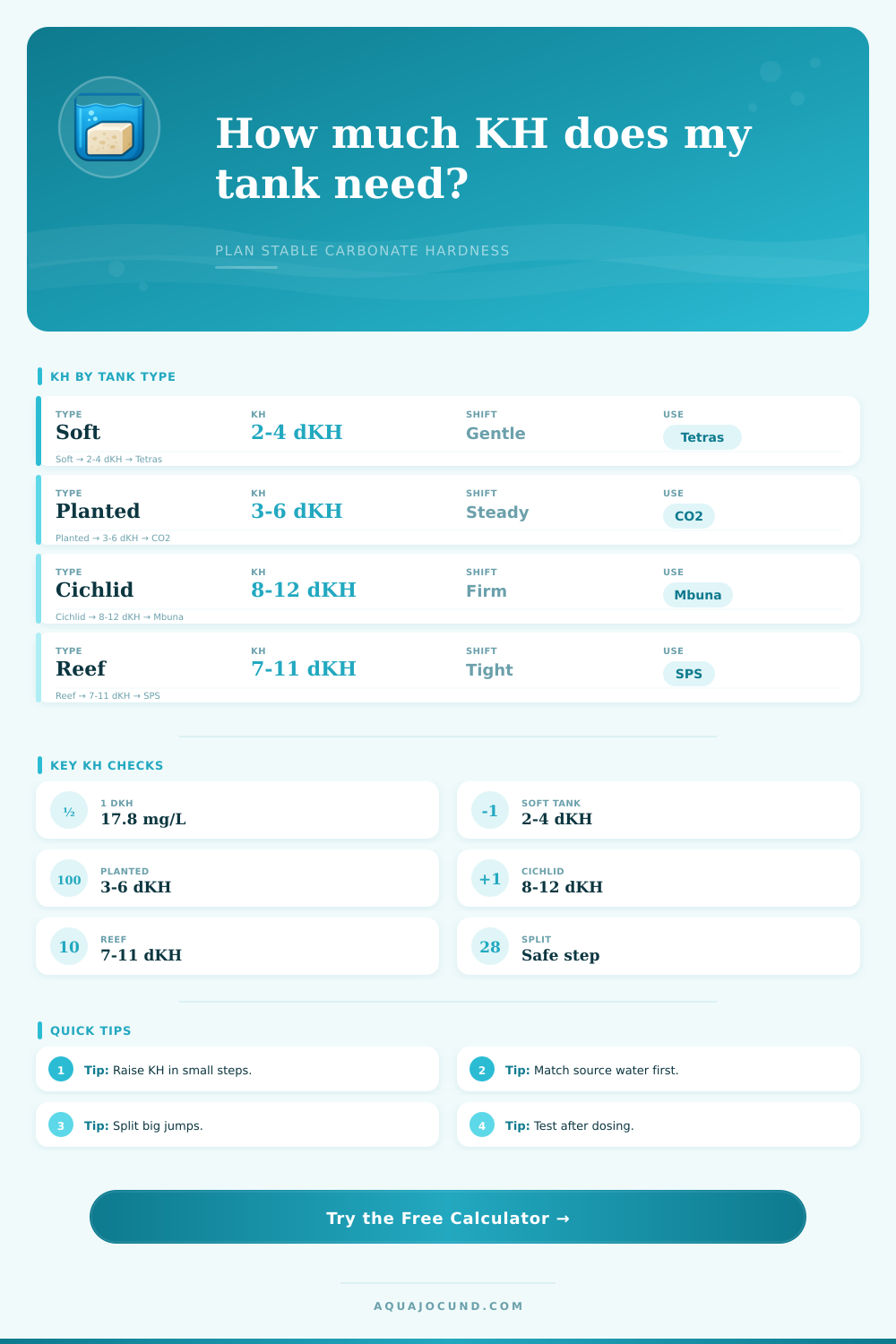
For example, tetras prefers to live in soft water tanks with 2 to 4 dKH of carbonate hardness. The African cichlid require higher level of carbonate hardness at between 8 and 12 dKH levels because the African cichlids need high levels of carbonate hardness in there water to survive. Tank habitat that contain plants require 3 to 6 dKH of carbonate hardness.
This level of carbonate hardness is sufficient to prevent dose carbon dioxide gas into the water to lower the pH of the water from getting too high. Reef tanks require between 7 and 11 dKH of carbonate hardness so that the coral can create their skeleton without depleting the carbonate hardness of the aquarium water. The type of water that is use to fill the aquarium tanks affect the starting carbonate hardness level in the tanks.
For example, water made with reverse osmosis or deionized process is soft water with near zero carbonate hardness. Conversely, tap water may have high carbonate hardness level with readings of 10 dKH or higher. Because the source water for the tanks has a specific level of carbonate hardness to start with, you must account for the carbonate hardness when calculating how much buffer product to add to an aquarium.
There are calculation that can be used to determine how much buffer to add to the water in the aquarium. The dimension of the aquarium must be considered in the calculations along with the current and desired level of carbonate hardness in the water. Additionally, the level of carbonate hardness of the source water must be considered in these calculation.
Different buffer contain different level of potency. The carbonate hardness buffer can be sodium bicarbonate or soda ash to name a few option. Soda ash contain a higher carbonate hardness that will raise the carbonate hardness of the aquarium water more aggressive than sodium bicarbonate.
Sudden increase in carbonate hardness can shock the inhabitants of the tank, thus carbonate hardness should only be increased by no more than 1 dKH at a time. Many people do not maintain carbonate hardness because they dont test the carbonate hardness of their aquarium water enough. To maintain carbonate hardness, you should test the carbonate hardness regularly with test performed after adding buffers to the water.
The plant in the tanks will consume the carbonate hardness level of the water while the lights is on in the aquarium. Additionally, the cichlid fish will leach the carbonate hardness from the rock in the tanks. Therefore, carbonate hardness should be dose into the aquarium in small amount over a period of several day in amounts of half of the recommended dose.
By monitoring the carbonate hardness level of the tanks and carefully dose the carbonate hardness buffer to the water, carbonate hardness can be maintained providing the stable environment that the fish and plant require to thrive.