Saltwater to Freshwater Converter
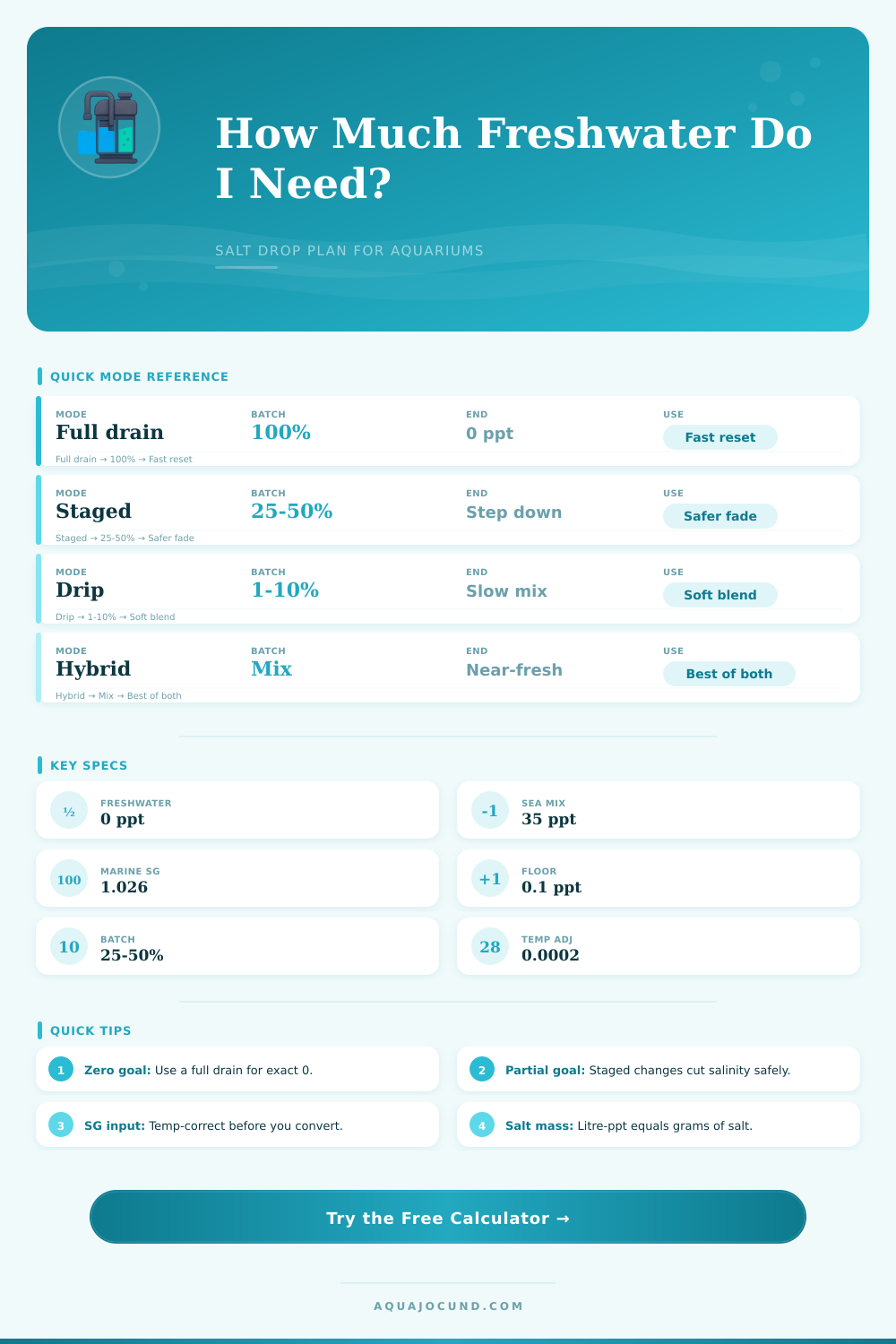
Plan a full tank reset, staged dilution, or drip blend with salinity math that tracks gallons, liters, ppt, and SG.
Full Drain
Staged Dilution
Drip Blend
Hybrid Reset
| Format | SG @25C | Ppt | Note |
|---|---|---|---|
| Freshwater | 1.000 | 0 | Full reset |
| Near-fresh | 1.002 | 3 | Rinse zone |
| Light brackish | 1.010 | 13 | Fade zone |
| Marine | 1.020 | 27 | Saltwater |
| Reef | 1.026 | 35 | Sea mix |
| Mode | Per Pass | Math | Best For |
|---|---|---|---|
| Full drain | 100% | C x 0 | Zero goal |
| Staged | 25-50% | C x (1-f)^n | Safer fade |
| Drip | 1-10% | Tiny steps | Delicate stock |
| Hybrid | Mix | Plan steps | Mixed jobs |
| Tank | Liters | Gal | Typical Job |
|---|---|---|---|
| 10 gal | 38 L | 10 | Nano reset |
| 20 gal | 76 L | 20 | QT freshen |
| 40B | 151 L | 40 | Brackish fade |
| 55 gal | 208 L | 55 | Sump rinse |
| 75 gal | 284 L | 75 | FOWLR fade |
| 125 gal | 473 L | 125 | Big swap |
| Goal | SG | Ppt | Use |
|---|---|---|---|
| Exact fresh | 1.000 | 0.0 | Full drain |
| Near-fresh | 1.002 | 3.0 | Rinse |
| Soft salt | 1.005 | 6.7 | Low brackish |
| Marine | 1.025 | 33.3 | Sea water |
When transitioning a saltwater aquarium to freshwater, it is important to control the salinity levels in the aquarium. Salinity is a measure of how much salt are dissolved in the water of the aquarium. If the salinity levels are altered to quick, the fish and invertebrate inhabitants of the tank will experience stress.
Furthermore, you must reduce the salinity levels of the aquarium in a control manner, since rapidly changing the salinity will have an impact upon the osmoregulation of the inhabitants of the tank. Osmoregulation is the process that fish and invertebrates uses to maintain the salt levels in their bodies in balance with the salt levels in the water surrounding their bodies. If the salinity of the tank water is changed quickly, the fish and invertebrates will experience stress as their bodies attempt to perform their osmoregulatory function.
How to Slowly Change a Saltwater Aquarium to Freshwater
To reduce the salinity of the tank, it is necessary to drain the saltwater from the aquarium and replace that saltwater with freshwater. The salinity level of the aquarium tend to follow a logarithmic curve when freshwater is added to the tank. This means that each successive addition of freshwater will remove a different amount of salt from the tank than the previous change of water removed.
For instance, if you drain half of the saltwater in the tank and replace it with an equivalent volume of freshwater, the salinity will be reduced by 50%. However, the next volume of water to be added to the aquarium will remove less salt than the first water change removed. Consequently, additional water change will be required to reach the target salinity level.
There is a variety of methods for performing water changes to reduce the salinity of the tank. For instance, performing large water change, or performing drip-blending of the water, can change the salinity of the tank. With the method of large water changes, a significant percentage of the water in the tank is drained and replaced with freshwater.
Large water changes are faster than drip blending, but may be more stressful for the fish and invertebrates of the aquarium. With drip blending, freshwater is slowly added to the aquarium; drip blending may be performed, for instance, to replace 1 to 10 percent of the water in the tank per hour. Drip blending is a gentler form of changing salinity and it is often used in aquariums that contain more delicate species of fish or corals.
One factor to consider in the change of salinity is the impact of temperature upon salinity measurement. You can measure salinity using a refractometer to determine the parts per thousand (ppt) of the tank water. However, the temperature of the water can impact the salinity measurements performed with the refractometer; changing the water temperature will change the specific gravity of the measurement made with the refractometer.
Thus, prior to measuring the salinity of the aquarium water with a refractometer, the temperature of the water should of be normalized. One part per thousand (ppt) is equal to one gram of salt per liter of water. This unit of measurement of salinity can assist in calculating the amount of salt that will be removed from the aquarium during a water change.
The type of fish and invertebrates that live in the aquarium may have an impact upon the rate at which the salinity should be changed. For instance, fish that are more hardy, such as certain types of tang fish, may be able to tolerate larger changes in salinity than more delicate fish. Additionally, the behavior of the fish and invertebrates can indicate to the caretaker of the aquarium the salinity of the tank; more stress for the fish or invertebrates indicates that the salinity are changing too quickly for those organisms to tolerate.
If the fish or invertebrates in the tank exhibit sign of stress during the salinity change, the rate of changing the salinity should be slowed. Some of the mistake that may occur during a salinity change include not accounting for the efficiency of mixing the freshwater and saltwater in the tank, and not accounting for any residual salt that may remain in the tank. For instance, certain areas of the tank may allow for the water to not move well within the aquarium; these areas referred to as dead spots within the tank will allow the freshwater to not mix good with the saltwater in the tank.
If the freshwater does not mix well with the saltwater, the salinity of the tank will not drop as much as is desired. Additionally, care must also be taken to ensure that there isnt too much residual salt left within the tank; if too much salt remains in the tank, the tank may become a brackish water tank instead of a freshwater tank. Finally, the planning of the salinity change of an aquarium will depend upon the total volume of the aquarium and the salinity change that is to be performed.
For instance, larger aquariums may require more frequent water changes to achieve the target salinity level of the tank than smaller-sized aquariums. By calculating the mass of the salt within the tank and planning how much freshwater will be added to achieve the target salinity, you can ensure the successful changing of the salinity levels in the tank.