🧪 Reef Tank Magnesium Calculator
Calculate the exact magnesium supplement dose to maintain optimal Mg levels in your reef aquarium
| Parameter | Ideal Range | NSW Value | Test Frequency |
|---|---|---|---|
| Magnesium (Mg) | 1250 – 1350 ppm | 1280 ppm | Weekly |
| Calcium (Ca) | 400 – 450 ppm | 420 ppm | Weekly |
| Alkalinity (dKH) | 7 – 11 dKH | 7 dKH | 2–3x per week |
| Salinity (SG) | 1.024 – 1.026 | 1.025 | Daily |
| pH | 8.0 – 8.4 | 8.2 | Daily |
| Temperature | 76 – 80 °F | 77 °F | Continuous |
| Supplement | Concentration | Dosing Rate | Pros / Cons |
|---|---|---|---|
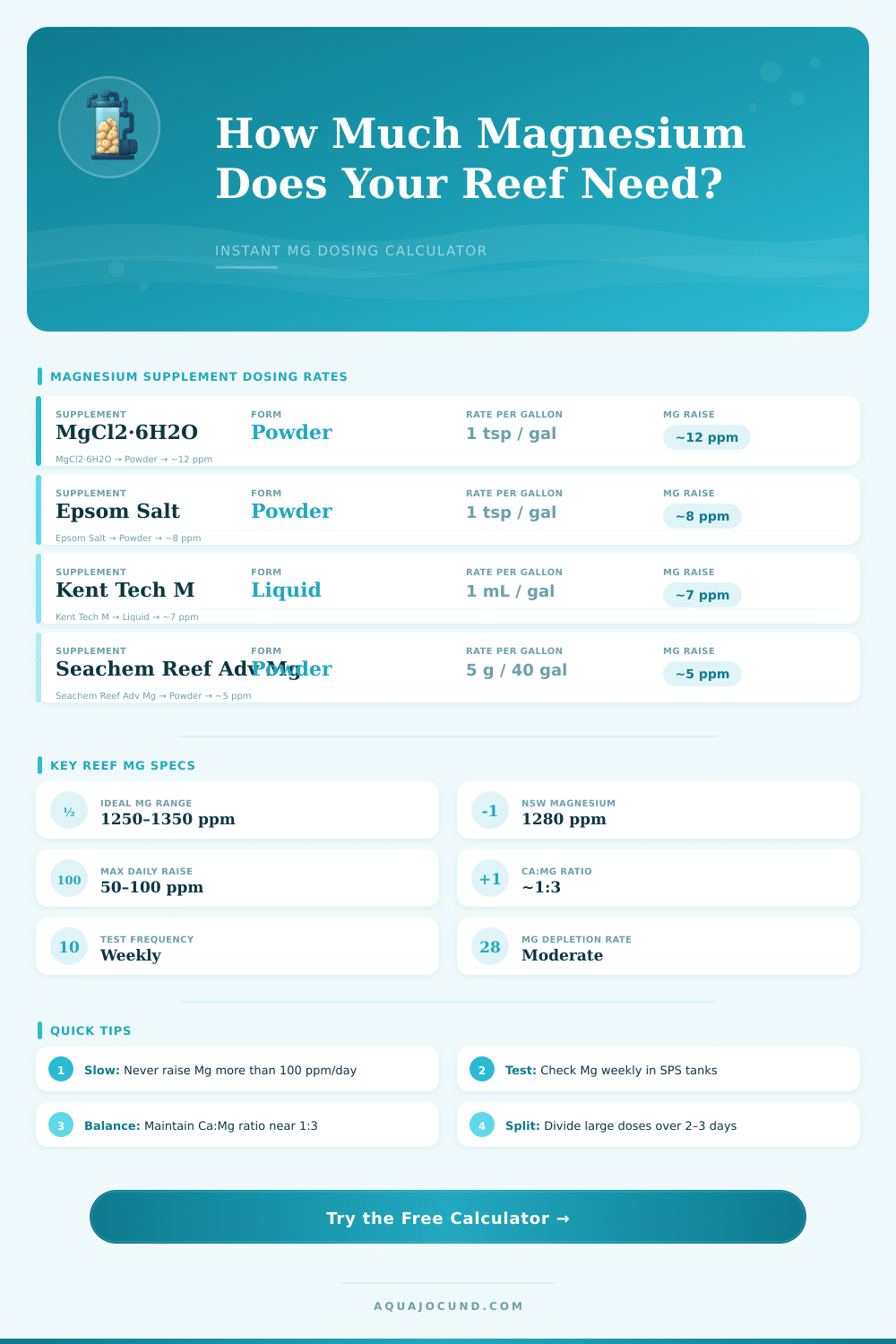
| MgCl2·6H2O | 3.17 ppm/g/gal | ~5.5 g (1 tsp) per 17 ppm/gal | Cheapest; raises chloride slightly |
| MgSO4·7H2O (Epsom) | 2.09 ppm/g/gal | ~5.0 g (1 tsp) per 10 ppm/gal | Inexpensive; raises sulfate |
| Kent Tech M | 7 ppm/mL/gal | 1 mL per gallon per 7 ppm | Convenient liquid; moderate potency |
| Seachem Reef Adv Mg | 0.025 ppm/g/gal | 5 g per 40 gal for 5 ppm | Balanced Mg blend; slower acting |
| Brightwell Magnesion | 7 ppm/mL/gal | 1 mL per gallon per 7 ppm | Concentrated liquid; easy dosing |
| ESV B-Ionic Mg | 8 ppm/mL/gal | 1 mL per gallon per 8 ppm | High potency; balanced ionic |
| TLF MagnifiMag | ~10 ppm/tsp/gal | 1 tsp per gallon per 10 ppm | Fast dissolving powder; versatile |
| Tank Size | Dimensions (L×W×H in) | MgCl2 for +100 ppm | Epsom for +100 ppm |
|---|---|---|---|
| 10 Gallon | 20 × 10 × 12 | 32 g (5.8 tsp) | 48 g (9.6 tsp) |
| 20 Gallon | 24 × 12 × 16 | 63 g (11.5 tsp) | 96 g (19.1 tsp) |
| 40 Breeder | 36 × 18 × 16 | 126 g (22.9 tsp) | 191 g (38.3 tsp) |
| 55 Gallon | 48 × 13 × 21 | 174 g (31.5 tsp) | 263 g (52.6 tsp) |
| 75 Gallon | 48 × 18 × 21 | 237 g (43.0 tsp) | 359 g (71.8 tsp) |
| 90 Gallon | 48 × 18 × 25 | 284 g (51.6 tsp) | 431 g (86.1 tsp) |
| 125 Gallon | 72 × 18 × 21 | 394 g (71.7 tsp) | 598 g (119.6 tsp) |
| 180 Gallon | 72 × 24 × 25 | 568 g (103.2 tsp) | 861 g (172.2 tsp) |
magnesium ranks among the main elements that one must control in a reef tank. It stands together with calcium and alkalinity; those three together form what all call the big trio. And here the spot: caring about them is the one part of the hobby where real agreement exists between folks.
So, what actually does magnesium here? It stops calcium and alkalinity from joining and falling out of the solution. When calcium carbonate starts to form, molecules of magnesium attach to the surface of those growing crystals and basically stop the whole process.
Why Magnesium Is Important in a Reef Tank
If one skips proper levels of magnesium, then calcium together with alkalinity simply will drop and fall out. That causes trouble in the water chemistry, and ultimately your corals will grow more slowly because of that.
Correct magnesium to the proper level gives many benefits for the whole system. It helps to stabilise both calcium and alkalinity, which leads to better growth of corals and brighter colour. Coralline algae benefits at the right magnesium levels, invertebrates stay healthier and the whole water chemistry becomes steadier.
The reason is simply nice: calcium and alkalinity genuinely deepnd on magnesium to work correctly, so caring about this one element matters more than it could seem.
Most folks aim for magnesium between 1200 and 1400 ppm. Even so, a narrower range of 1250 to 1350 ppm commonly gets recommended, and honestly, a level around 1310 works very well. Magnesium and calcium work best when they stay in the three-to-one ratio that one finds on natural reefs.
If magnesium falls too low, corals hardly grab calcium correctly. Even so, if one pushes it too 1600 ppm, then one risks chemical imbalance, tissue damage in soft corals and even actual tissue separation in SPS varieties.
Some tanks use magnesium more quickly than others. A reef tank full of acropora corals can drop from 1300 ppm to 1200 ppm in only two or three weeks, even while regular dosing happens. Magnesium chloride stands as the main choice for dosing, because it copies what naturally happens in sea water, and it fits well with the whole chemistry.
When powders do not dissolve quite quickly enough in top-off water, one can switch to liquid products that solve that problem entirely.
The choice of your salt mix matters more than one would think. Cheap salt that skimps on magnesium will leave your levels jumping around. Different brands range everywhere across the world.
Making sure that the new water matches the magnesium level of your tank during changes helps to escape those annoying swings, water changes do not replenish what thetank already used up.
Build the reef slowly with a few small corals first to get real sight about the special needs of your tank. Regular testing and water changes show how magnesium moves as your collection grows. Most reef keepers start with manual dosing, later move to pumps or reactors when they feel more confident.
Ready products skip the blending entirely and make the whole routine genuinely simple.