🐠 Reef Dosing Calculator
Calculate exact doses of alkalinity, calcium, and magnesium supplements to reach your target parameters.
⚡ Quick Presets
🧪 Tank & Parameter Inputs
📋 Dosing Results
Breakdown by Parameter
| Parameter | Deficit | Formula Used | Daily Dose | Total Needed |
|---|
📖 Supplement Data Reference
| Supplement | Raises | Amount per 100L | Safe Max/Day |
|---|---|---|---|
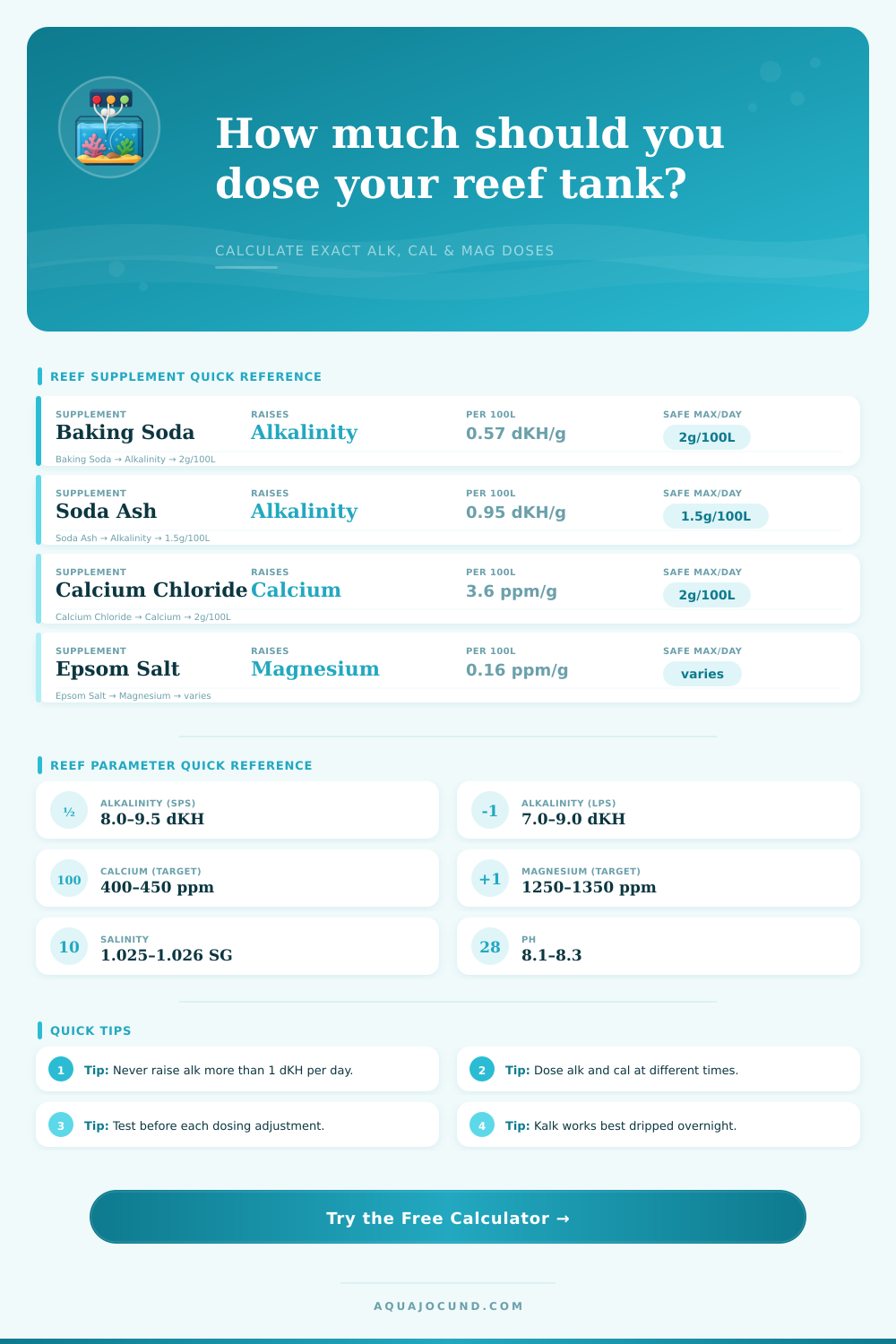
| Baking Soda (NaHCO3) | Alkalinity | 0.57 dKH per gram | 2 g / 100L |
| Soda Ash (Na2CO3) | Alkalinity | 0.95 dKH per gram | 1.5 g / 100L |
| 2-Part Alk Solution | Alkalinity | 1.0 dKH per 100 mL | 2 mL / 100L |
| Calcium Chloride (CaCl2) | Calcium | 3.6 ppm per gram | 2 g / 100L |
| 2-Part Cal Solution | Calcium | 14 ppm per 100 mL | 2 mL / 100L |
| Kalkwasser Ca(OH)2 | Alk + Calcium | 0.6 dKH + 8.5 ppm per gram | 2 g / 100L |
| Epsom Salt (MgSO4) | Magnesium | 0.16 ppm per gram (approx) | varies |
| All For Reef | Alk + Ca + Mg | 10 mL raises 0.5 dKH per 100L | per label |
🎯 Target Parameters by Reef Type
| Reef Type | Alk (dKH) | Calcium (ppm) | Magnesium (ppm) |
|---|---|---|---|
| SPS Dominant | 8.0–9.5 | 420–450 | 1300–1400 |
| Mixed Reef | 7.5–9.0 | 400–450 | 1250–1350 |
| LPS Dominant | 7.0–9.0 | 380–440 | 1200–1350 |
| Soft Coral | 7.0–8.5 | 380–430 | 1200–1300 |
| FOWLR | 7.0–8.0 | 360–420 | 1200–1300 |
| Nano Reef | 7.5–8.5 | 400–440 | 1250–1350 |
📏 Common Tank Volume Reference
| Tank Size | Typical Net Volume | 1 dKH Alk Dose (NaHCO3 g) | 1 dKH Alk Dose (2-Part mL) |
|---|---|---|---|
| 20 gal (Nano) | ~17 gal / 64 L | 1.1 g | 0.6 mL |
| 30 gal | ~25 gal / 95 L | 1.7 g | 0.9 mL |
| 50 gal | ~42 gal / 159 L | 2.8 g | 1.6 mL |
| 75 gal | ~63 gal / 238 L | 4.2 g | 2.4 mL |
| 100 gal | ~85 gal / 322 L | 5.6 g | 3.2 mL |
| 120 gal | ~100 gal / 380 L | 6.7 g | 3.8 mL |
| 200 gal | ~170 gal / 643 L | 11.3 g | 6.4 mL |
📊 Dosing Method Comparison
| Method | Raises Alk | Raises Ca | Raises Mg | Ease | Risk |
|---|---|---|---|---|---|
| 2-Part (A+B) | ✅ | ✅ | ❌ | Easy | Low |
| Kalkwasser | ✅ | ✅ | ❌ | Moderate | Medium |
| All For Reef | ✅ | ✅ | ✅ | Very Easy | Low |
| Baking Soda | ✅ | ❌ | ❌ | Easy | Low |
| Soda Ash | ✅ | ❌ | ❌ | Easy | Medium |
| Calcium Chloride | ❌ | ✅ | ❌ | Easy | Low-Med |
| Epsom Salt | ❌ | ❌ | ✅ | Easy | Low |
| Calcium Reactor | ✅ | ✅ | ✅ | Complex | Low |
Maintaining a reef tanks requires monitoring the levels of alkalinity, calcium, and magnesium. Corals uses alkalinity, calcium, and magnesium to form there skeletons. If the levels of alkalinity, calcium, and magnesium is low, the corals may stop grow or their tissues may bleach.
Alkalinity is necessary to maintain the pH level of the water and to provide the components required for the corals to calcify. Calcium compounds with alkalinity to form aragonite. However, if too many calcium and alkalinity are added at the same time, the two will precipitate and make a cloudy mess in a sump of the reef tank.
How to Keep Alkalinity, Calcium and Magnesium Right in a Reef Tank
Magnesium is required for keeping both calcium and alkalinity soluble in the water. Therefore, you must maintain magnesium levels to prevent calcium and alkalinity from precipitating in the water. Using a dosing tool, it is possible to calculate how much alkalinity, calcium, and magnesium must be add to the reef tank.
To do this, you must enter the total volume of the reef tank into the dosing tool. Additionally, you must also enter the current levels of alkalinity, calcium, and magnesium in the reef tank into the dosing tool. These levels can be compared with the target levels of alkalinity, calcium, and magnesium, which can vary depending on the type of coral in the reef tank.
For example, the alkalinity level for small polyp stony corals should be between 8 and 9.5 dKH, while the alkalinity level for large polyp stony corals should be between 7 than 9 dKH. A timeframe for dosing these substances must also be chosen, such as three or seven days. The levels should not be increased quick, as this can cause swings in the pH of the water, which is detrimental to the corals in the reef tank.
The substances that are dosed into the reef tank will contribute to the levels of alkalinity, calcium, and magnesium in different ways. For example, calcium chloride will increase the calcium level by 3.6 ppm per 100 liters of water. Additionally, soda ash will contribute more alkalinity per gram then baking soda will.
However, soda ash can cause the pH level of the water to spikes. Depending on how alkalinity and calcium are to be dosed, different methods can be used to dose these substances. For example, you can add two part solutions through an automatic pump, or you can drip kalkwasser into the reef tank while it is rest overnight.
If kalkwasser is to be used, it should be dripped slow into the tank to ensure that the pH level does not rise above 8.4. The consumption rates for alkalinity, calcium, and magnesium will depend on the contents of the reef tank. For example, a tank that contain many small polyp stony corals will deplete its levels of alkalinity, calcium, and magnesium at a much more faster rate than a tank that contains only fish.
Therefore, the levels of alkalinity, calcium, and magnesium should be tested every week. Small amount of alkalinity, calcium, and magnesium should be dosed into the reef tank and the levels should be retested. It is important to be consistent in dosing these substances.
Additionally, alkalinity and calcium should be dosed several hour apart from one another. Finally, the level of magnesium should always be ensured to be in the correct range, because magnesium must remain at the proper level in order for the alkalinity and calcium to remain soluble in the water. You should of checked the magnisium levels more regular.
It’s easy to lose track of things when your managing alot of chemcials. The reef tanks health depends on it.