🐠 All For Reef Dosing Calculator
Calculate your exact daily AFR dose based on tank volume, coral load & chemistry goals
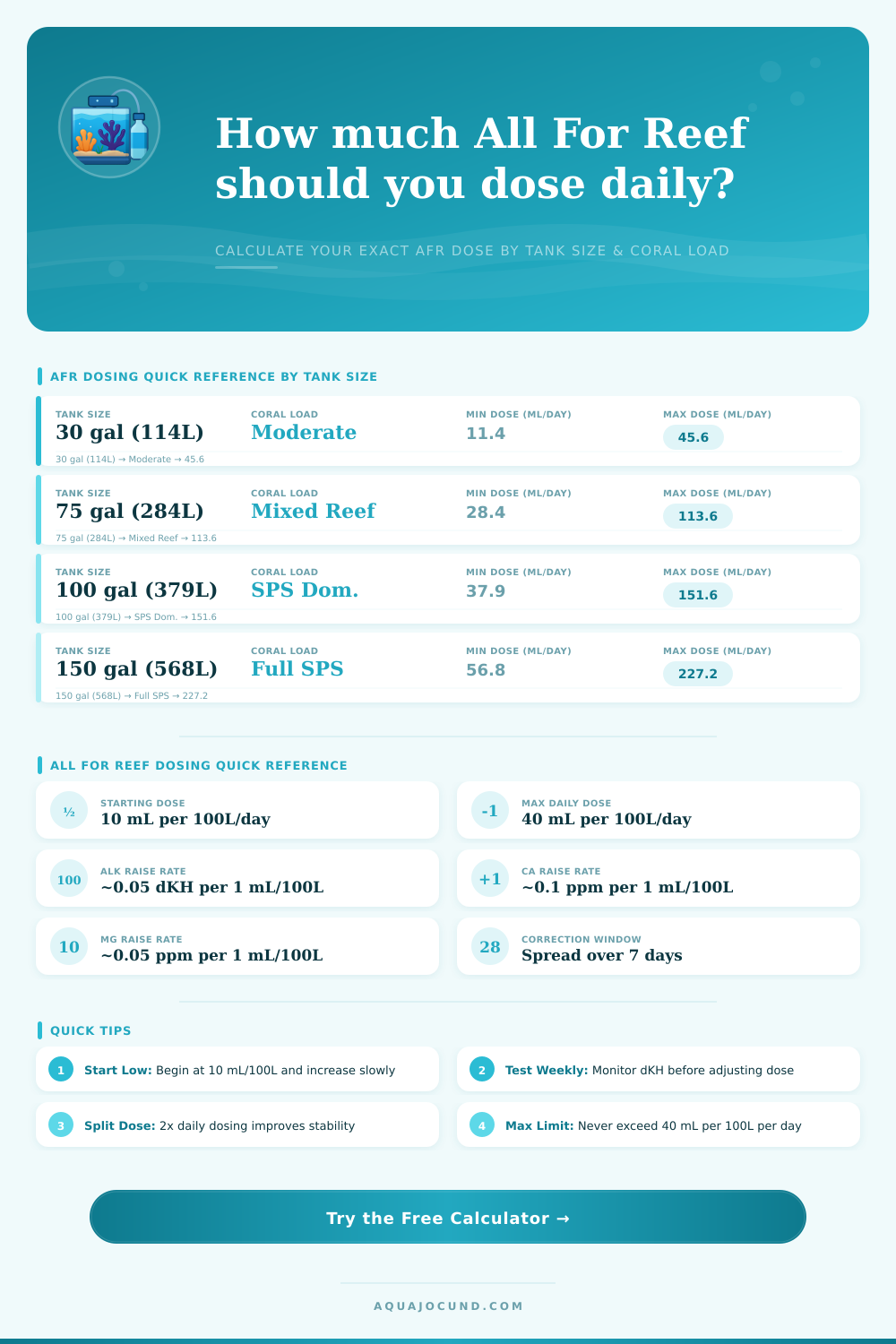
| Tank Size | Volume (L) | Coral Load | Min Daily Dose (mL) | Max Daily Dose (mL) |
|---|---|---|---|---|
| 30 gal | 114 L | Nano / Moderate | 11 | 46 |
| 40 gal | 151 L | Breeder SPS | 15 | 60 |
| 50 gal | 189 L | FOWLR / Low | 4 | 76 |
| 75 gal | 284 L | Mixed Reef | 28 | 114 |
| 100 gal | 379 L | SPS Dominant | 38 | 152 |
| 120 gal | 454 L | Mixed Reef | 45 | 182 |
| 150 gal | 568 L | Display Reef | 57 | 227 |
| 200 gal | 757 L | Full SPS | 76 | 303 |
| 250 gal | 946 L | Show Tank | 95 | 378 |
| Coral Type | Min dKH | Ideal dKH | Max dKH |
|---|---|---|---|
| Fish Only / FOWLR | 7.0 | 8.0 | 10.0 |
| Soft Corals (Softies) | 7.0 | 8.0 | 11.0 |
| LPS Corals | 7.5 | 8.5 | 11.0 |
| Mixed Reef (LPS + SPS) | 8.0 | 8.5 | 10.0 |
| SPS Dominant | 8.0 | 9.0 | 10.0 |
| Full SPS / Competition | 8.0 | 9.5 | 11.0 |
| Method | Parameters Raised | Ease of Use | Best For |
|---|---|---|---|
| All For Reef (AFR) | Alk + Ca + Mg | ★★★★★ Very Easy | Small to medium reefs |
| 2-Part Dosing | Alk + Ca (separate) | ★★★★ Easy | Any size, precise control |
| Kalkwasser | Alk + Ca + pH | ★★★ Moderate | Top-off integration |
| Calcium Reactor | Alk + Ca + Mg + trace | ★★ Complex | Large SPS systems |
Alkalinity is another chemical parameter of reef tanks. Maintaining an alkalinity of reef tanks is necessary for the health of the corals in those tanks. If the alkalinity of reef tanks drop too quick, the corals will experience stress or even recession.
Rapid change in the alkalinity of reef tanks can lead to stress and damage to the corals in those tanks. All For Reef is a product that contain alkalinity, calcium, and magnesium in one bottle. By using All For Reef, individuals can add these three minerals at the same time to they reef tanks.
How to Use All For Reef to Keep Alkalinity Stable
However, individuals has to calculate the correct dose of All For Reef to add to their reef tanks. The amount of All For Reef that an individual need to add to their reef tank depends on the density of the corals in their reef tank. Reef tanks that contains many corals will consume alkalinity at a much fasterer rate than reef tanks that contain few corals.
Therefore, reef tanks that contain many corals will need to add All For Reef more often than reef tanks with less corals. The total water volume in a reef tank also has an impact on how much the alkalinity level of a reef tank change when an individual add All For Reef to that tank. Individuals must also compare the current alkalinity levels of their reef tanks with the target alkalinity levels for those tanks to determine how much correction are needed for those alkalinity levels.
In order to determine the dose of All For Reef that an individual should use in their reef tank, a few mathematical step will need to be completed. These calculations will involve determining how many liter are in the reef tank, how many times the alkalinity of the tank is consume in a given period, and how often the individual want to dose the tank with All For Reef. Individuals should never attempt to correct the alkalinity of their reef tanks all at once.
Instead, individuals should dose their tanks with All For Reef over a period of several day. Once the individual has calculated the dose of All For Reef that should be added to the tank each day, that amount can be divided into two doses if the individual choose to dose the tanks with All For Reef twice per day. By dosing All For Reef twice per day, alkalinity levels in the tanks will be able to remain stability.
An error that many reef tank owner make is adding large dose of All For Reef to their reef tanks based off the information provide on the label of the bottle. When individuals add large doses of All For Reef to reef tanks without first testing the alkalinity of those tanks, the alkalinity of those tanks can spike. Alkalinity spike are dangerous for reef tanks because they can cause stress and for the corals in those tanks to experience recession.
To avoid this problem, individuals should always start with a conservative dose of All For Reef for their reef tanks. As the alkalinity levels in the reef tanks become stable with this initial dose, individuals can then begin to add more All For Reef to their reef tanks. Splitting the doses of All For Reef into morning and evening doses is one method that can be use to dose the tanks.
By splitting these doses, alkalinity levels will be more stable in the reef tanks. The factors that influence alkalinity levels in reef tanks include the evaporation of the water from the tanks and the nutrient levels in those tanks. When water is evaporate from the reef tanks, the individuals must add RO/DI water to those tanks.
RO/DI water, however, can dilute the mineral parameter of those tanks unless individuals dose All For Reef correct into the reef tanks. Additionally, the nutrient levels in the reef tanks can impact the rate at which the corals consume the minerals in the reef tanks. The higher the nutrient levels in the tanks, the more faster the corals will consume the minerals.
Therefore, high nutrient level will change the amount of All For Reef that is needed to be added to the reef tanks. All For Reef also contain a carbonate base. When individuals add carbonate base to the reef tanks, the pH level in those reef tanks will increase.
Maintaining stable alkalinity levels in reef tanks allow the corals to continue building their skeleton and maintaining their color. By correctly calculate the initial dose of All For Reef that should be added to the reef tanks and by regularly testing the alkalinity levels in those tanks, alkalinity levels will remain stable in the reef tanks. Stable alkalinity levels allow the corals to thrive in the reef tanks.