
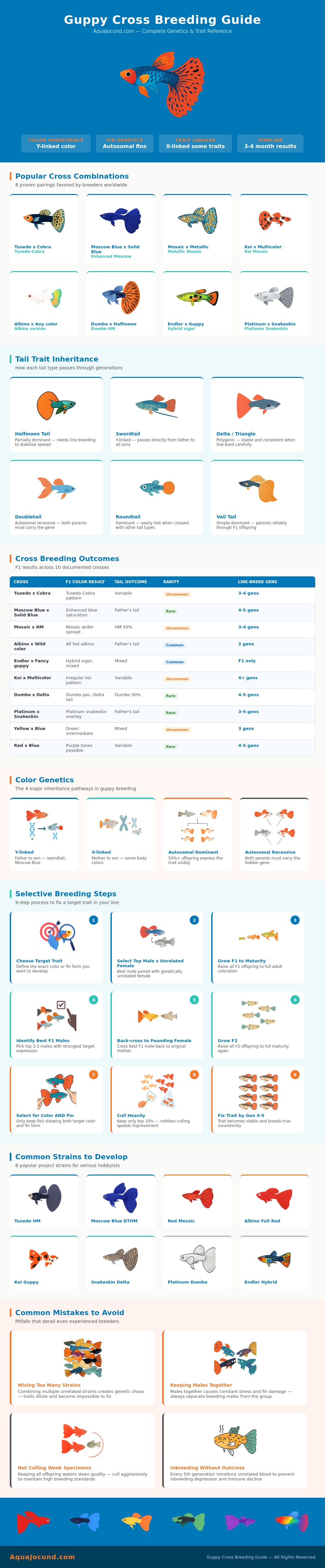
Breeding guppies for specific physical trait require an understanding of the genetic inheritance of guppies. By understanding how the traits of guppies are passed from parent to offspring guppies, breeders can make informed decision about which guppies to crossbreed. If breeder makes the wrong choice of guppy pairs to breed, the offspring guppies will not exhibit the desired trait but will have a mixed population of guppies with inconsistent traits.
However, following the correct breeding patterns will result in the production of strains of guppies with consistent traits. Many of the traits of guppies are linked to the chromosome of the fish. For instance, the Y chromosome links the color of the guppies, meaning the father guppy only passes it to the offspring male guppies.
How to Breed Guppies for Specific Traits
If the father of the guppies is a Moscow Blue guppy, the male offspring guppies will have the same blue color of there parent. The tail shapes of guppies also have specific genetic traits but are more difficult to breed into guppy offspring. The tail traits are partially dominant, meaning many generations of breeding the specific tail shape are required for the desired trait to be expressed in the guppy offspring.
Another method of breeding is line breeding, where breeders breed the best guppies from a batch of guppies together to produce offspring with consistent traits. By breeding different type of guppies together, it is possible to produce new breed patterns. For instance, breeding a tuxedo male guppy with a cobra female guppy will produce tuxedo-cobra hybrid guppies.
Breeding an albino guppy with a brightly colored guppy will produce offspring that carry the albino gene from their parent. The albino gene will manifest itself in one in four offspring guppies as a full white guppy with pink eyes. These outcomes of breeding are not accident but the result of the specific combination of gene of the parents of the guppy pair being crossed.
Many people make mistake when they start breeding guppies. One of the mistakes that many people tend to make is that they dont follow a systematic process to produce the best possible outcome. For example, people should not place a flashy male guppy with any female guppy just because the female guppy is looking healthy.
The male guppies will stress the other male guppies and the stressed male guppies will nip at the fins of other male guppies or lose the intensity of there color. Therefore, people should separate the male guppies from each other to ensure that they are not stressing the other male guppies. Additionally, people should not keep every offspring guppy that is produced from the breeding of the male and female guppies.
People should cull some of the offspring guppy fish, spesifically those with faded tails, to ensure that only the best guppies are kept in the breeding tank. By culling the weaker guppy offspring, the breeder will ultimate maintain the quality of the guppies that are bred. Guppies have genetics that involve several different types of inheritance.
For example, the Y-linked trait will pass from the father to the son, and the X-linked color will pass from the mother to the sons. The autosomal dominant trait will be present in approximately half of the offspring guppies, while the autosomal recessive traits will require both of the parents to contain the recessive gene to be expressed in the guppies’ offspring. Additionally, many genes control polygenic traits, and each trait will require the breeder to continue to select for that specific gene to be expressed.
By understanding each of these genetics, the breeder can accurately predict the outcome of breeding two specific guppy. In order to begin to breed the guppies for a specific gene or trait, there are several steps that must be taken. First, the breeder must determine the specific trait that they wish to breed.
For instance, the breeder may wish to breed for the presence of koi mosaic pattern in there guppy fish. Second, the breeder will pair the prize male guppy with an unrelated female guppy to avoid inbreeding. Third, the F1 generation of guppy offspring must be grown until they reach adulthood, which takes approximately three month.
Fourth, the breeder will select the best quality guppy offspring from this initial breeding and breed them again with the same female guppy. If the weaker offspring have been culled, this selected breeding will result in the desired trait breeding true in the fourth or fifth generation of guppies. In order to breed the guppies for the desired trait, it is necessary to allow three to four months for each cycle of breeding.
To breed a full strain of guppies, it will take the breeder approximately one year of dedication to the breeding process. Additionally, there are some traits that will take five generations to breed true, such as dumbo pectoral fin and delta tails. Furthermore, every pairing of guppies has a specific cost associated with it in terms of the amount of time and tank space that will be required for that breeding effort.
Each pairing will require a different amount of stabilization in order to breed for the specific trait that the breeder desire for their tank. There are several pitfalls that you must avoid during the breeding process. One of the pitfalls to avoid is mixing too many different strains of guppies together as this will muddy the gene pool of the species.
Another of the pitfalls to avoid is continually inbreeding the guppies without introducing fresh blood into the gene pool, as this will also lead to health problems for the guppies and make there offspring prone to developing diseases. Finally, you must be patient and follow the steps of the process in order to successfully multiply your desired strains of guppies.
