🐟 Arowana Tank Size Calculator
Calculate the minimum aquarium size for your arowana based on species, current size, and stocking plan
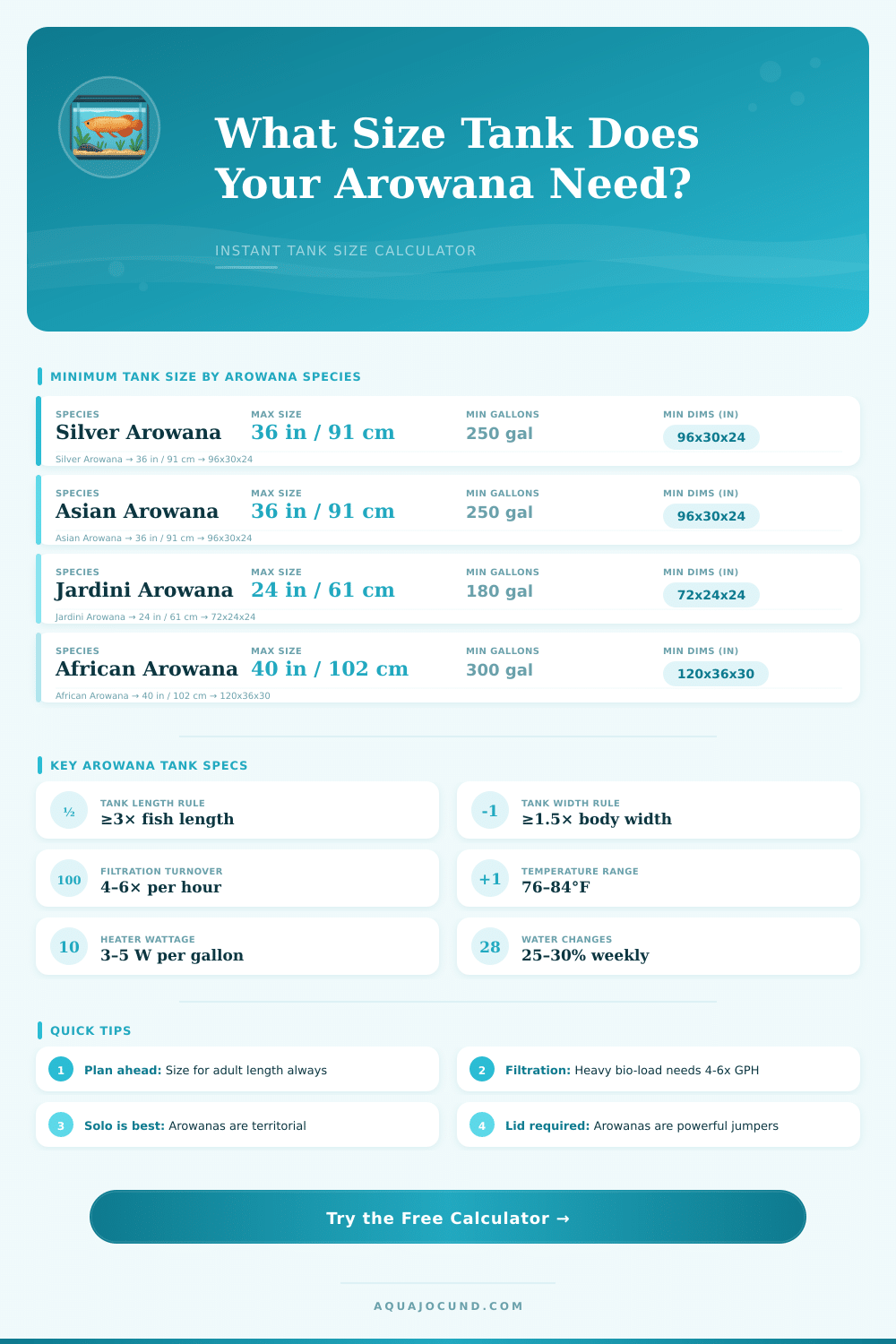
| Species | Max Size (in) | Min Tank (gal) | Temp (°F) | pH Range | Lifespan |
|---|---|---|---|---|---|
| Silver Arowana | 36 | 250 | 76–82 | 6.0–7.0 | 15–20 yrs |
| Asian Arowana | 36 | 250 | 76–84 | 6.0–7.5 | 20–60 yrs |
| Black Arowana | 36 | 250 | 76–82 | 5.5–7.0 | 15–20 yrs |
| Jardini / Australian | 24 | 180 | 76–82 | 6.5–7.5 | 15–20 yrs |
| African Arowana | 40 | 300 | 76–82 | 6.5–7.5 | 15–20 yrs |
| Leichardti | 24 | 180 | 76–82 | 6.5–7.5 | 15–20 yrs |
| Growth Stage | Fish Length | Min Gallons | Min Liters | Recommended Dims (in) |
|---|---|---|---|---|
| Juvenile | Under 8 in | 75 | 284 | 48 × 18 × 18 |
| Sub-Adult | 8–16 in | 125 | 473 | 72 × 24 × 20 |
| Adult | 16–24 in | 180 | 681 | 84 × 24 × 24 |
| Full Grown | 24+ in | 250–300 | 946–1136 | 96 × 30 × 24 |
| Tankmate | Compatibility | Min Tank Addition | Notes |
|---|---|---|---|
| Large Plecos | Good | +20 gal | Bottom dweller, avoids conflict |
| Oscar | Moderate | +50 gal | May spar; needs space |
| Bichir | Good | +30 gal | Bottom dweller, peaceful |
| Large Catfish | Good | +30 gal | Stays low; compatible |
| Stingray | Moderate | +75 gal | Requires very large footprint |
| Clown Knife | Moderate | +50 gal | Similar size; monitor aggression |
| Silver Dollar | Good (group) | +40 gal | Fast schooling fish; dither |
| Small Fish | Poor | N/A | Will be eaten |
| Parameter | Ideal Range | Critical Notes |
|---|---|---|
| Temperature | 76–84 °F (24–29 °C) | Use reliable heater with backup |
| pH | 6.0–7.5 | Stable pH more important than exact number |
| Ammonia | 0 ppm | Any detectable ammonia is dangerous |
| Nitrite | 0 ppm | Must be zero at all times |
| Nitrate | Under 20 ppm | Weekly water changes keep this low |
| Hardness | 1–8 dGH | Soft to moderately hard water preferred |
Arowana rank among the most liked freshwater fishes for aquariums. They became popular because of their shining scales and elegant motion in water. Even so, so that one of them stay healthy and happy, they need quite a lot of Tank Size.
Wrong choose of too little space can create serious troubles.
How Big Should an Arowana Tank Be
Important spot to recall is that Arowana jump from too small tanks. They risk to injure themselves during such action. Young Arowana one can start in a 60-gallon tank, but a full grown one require at least 150 gallons, according to the species.
Some variants far surpass that minimum.
The basic surface of the tank matters more than the whole capacity. Arowana pass the most time swimming near the surface, hence long and broad tanks answer more than high. A tank with 2 feet depth, but 7 feet long and 3 feet wide, form a much more good solution.
Almost all Arowana must have at least 2.5 feet wide for comfort. Lowering the height help to spare costs, if that is the target.
For Asian Arowana, a Tank Size of around 240 until 260 gallons works well. Even a 300-gallon option gives more space. Some keepers succeed with 180 gallons during some years, until the fish grows fully.
Long term housing of Asian or Australian Arowana require minimal tank of 6 feet long and 2.5 feet broad. When the fish surpasses 24 inches, one choose an 8-foot by 3-foot by 2-foot tank for best care.
Silver Arowana become truly huge. A full grown silver requires at least 250 gallons. Some of that type reaches 3 until 3.5 feet, so an 8- or even 10-foot long tank with 3 until 4 feet depth is perfect.
A 125-gallon tank of 6 feet long can suffice for a bit of time, but soon the fish will outgrow it.
Many Arowana reach around 3 feet in captivity. Some species surpass that. Young Arowana of 4 until 6 inches one can keep in a 36-by-18-by-18-inch tank, until it arrives at 12 until 15 inches, what happens about after a year.
Later, far bigger tanks become needed.
Jardini and other Australian Arowana stay slightly more small, commonly around 30 inches or mroe. Tanks of 110 until 170 gallons answer for full grown Australians, if the tank measures 4 feet long and 2 feet broad. The bottom of the tank usually gets covered with small stones or sand.
Floating fake cover always is useful too.